"...the main purpose of criticism...is not to make its readers agree, nice as that is, but to make them, by whatever orthodox or unorthodox method, think." - John Simon

"The great enemy of clear language is insincerity." - George Orwell
Showing posts with label Steve Buscemi. Show all posts

Friday, February 18, 2022

Desperado

In 1992, independent filmmaker Robert Rodriguez made his feature film debut with El Mariachi, a $7,000 action movie that showed a stylistic flare beyond its meager budget. It made the rounds at several film festivals with a lot of media attention on the self-assured young man and the incredible story of how he made a movie for so little money. Naturally, Hollywood came calling and initially Rodriguez resisted, making Roadracers (1994) for the Showtime cable television channel after his deal with Sony Columbia Pictures was put on the back burner due to scandal. He eventually made Desperado (1995), a sequel to Mariachi that not only saw him working with a significantly larger budget of $7 million, but with movie star Antonio Banderas.


The film begins almost as if we are in a Quentin Tarantino film with a grungy gringo (Steve Buscemi) walking into a Mexican bar. He proceeds to tell a story about how he witnessed a massacre in a similar bar by a mysterious man. Rodriguez cuts back and forth between the storyteller and what happened at the bar to the strains of “Jack the Ripper” by Link Wray.
 
What is immediately clear from this opening scene is how far Rodriguez has progressed as a filmmaker. The screenplay is well-written as Steve Buscemi delivers his hilarious monologue with gusto. The director’s technique has also gotten better as the opening gunfight is stylishly choreographed with the El Mariachi (Banderas) dispatching bad guys like something out of a 1980s action movie as a shotgun blast sends a goon hurtling through the air.

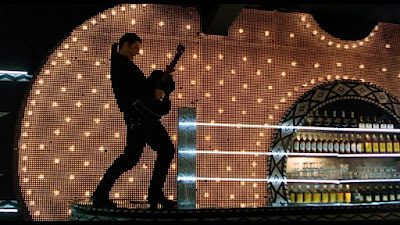
It is interesting to note that Rodriguez not only plays up the mythic quality of El Mariachi, introducing him walking into a bar in slow motion in the shadows so you never get a good look at his face, but also has fun with the character as well, showing him playing with his band in a nightclub over the opening credits. El Mariachi even has time to stop a bar fight by striking a patron with his guitar without missing a beat. Rodriguez reveals that this sequence is a dream as we see the villain from El Mariachi appear in the nightclub and we flashback to the end of that film.
 
Another façade is stripped away when it is revealed that the story Buscemi’s character told was exaggerated for effect – he’s El Mariachi’s hype man. Armed with a guitar case full of weapons, the musician cum killer is working his way through the Mexican criminal underworld to find and kill Bucho (Joaquim de Almeida), the man responsible for his wife’s death. Not surprisingly, the crime lord is surrounded by an army of flunkies, chief among them Navajas (Danny Trejo), a man armed with a seemingly endless supply of throwing knives. El Mariachi is aided in his quest for revenge by Carolina (Salma Hayek), the beautiful local bookstore owner who patches him up whenever he’s wounded (which is often).
 
In the film’s second action sequence, Rodriguez really cuts loose as he transforms Banderas into a two-gun-toting action hero in the tradition of John Woo’s heroic bloodshed films. Apart from doves flying in slow motion, it features many of Woo’s trademark action flourishes but with a cheeky sense of humor as El Mariachi and the last man left search frantically for a weapon that has bullets before he eventually breaks the man’s neck to the strains of “Strange Face of Love” by Tito & Tarantula. It is a beautifully choreographed action sequence that demonstrates his skill as not just a director but as an editor as he times the cuts to the rhythm of the action. When it comes to action editing is everything and Rodriguez understands this intuitively.

Rodriguez cast Antonio Banderas at just the right time in their respective careers. The former needed to cast a movie star and the latter was looking for a change of pace having just come off the big budget adaptation of Interview with the Vampire (1994). Banderas not only has the charisma to carry the film, he also demonstrates an ability to go from dramatic moments to comedic ones with ease. He also showed his ability to handle action, transforming himself into a credible action star. The actor also has wonderful chemistry with Salma Hayek as their characters develop a romantic relationship over the course of the film.
 
Desperado was Hayek’s first mainstream, Hollywood role, cast by Rodriguez against the wishes of the studio. The impossibly beautiful actor holds her own against the likes of Banderas as she demonstrates a light, comic touch and dramatic chops when Carolina explains why she is complicit with Bucho’s dealings with the town, aiding and abetting his drug operation in order to survive. She forces El Mariachi to realize that his desire for revenge is not the only reason to take out Bucho – it would also free the town of his tyrannical hold on it. He is a tragic hero and she gives him a reason to keep on going after he fulfills his goal.
 
Desperado would mark the beginning of a long-running collaboration with several actors, including Banderas, Hayek, Cheech Marin, Danny Trejo, and Quintin Tarantino, who he met on the film festival circuit while promoting El Mariachi. He made Tarantino the lead on his next film, From Dusk Till Dawn and has often featured him in cameos where he delivers a monologue and is then killed off in gruesome fashion. Marin and Trejo make quite an impression with the former playing a grinning bartender that meets his fate at the hands of the El Mariachi and the latter in a silent role as a deadly assassin brought in to take out the film’s hero but in an unexpected twist is taken out prematurely through a comic case of mistaken identity.

 
After the success of El Mariachi, Rodriguez was eager to make a sequel and capitalize on his new deal with Sony Columbia but the studio put on the brakes while they dealt with the Heidi Fleiss scandal that broke in early summer of 1993. She was a high-end madam that facilitated call girls to several of Hollywood’s elite and a list of her clients, which included at least two studio executives, appeared in the press. At the time, producers Carlos Gallardo (who starred in El Mariachi), Elizabeth Avellan, and line producer Bill Borden had already begun pre-production and realized that the film was on hold until the scandal blew over. Never one to be idle, Rodriguez shifted gears and accepted another gig making Roadracers that he shot in less than two weeks in January 1994 for $1 million. It was his first Hollywood production and working with a union crew. He was struck by how wasteful and slow studio productions were as he was used to collaborating with a small, hand-picked crew that worked fast. It would give him a taste of what he would be in store for when working for Sony.
 
By the summer of 1994, Rodriguez finally got the greenlight to make his Mariachi sequel, then known as The Return of El Mariachi but soon changed to Pistolero during production and eventually became Desperado. Ironically, this was due in large part to his future employer – Bob and Harvey Weinstein – who approached Sony executive Stephanie Allain at the Cannes Film Festival telling her what a fan they were of El Mariachi and how they would be more than happy to make the sequel with Rodriguez.
 
The studio wanted a name actor cast in the lead role and Allain suggested Antonio Banderas but Rodriguez was hesitant to cast a non-Mexican in the part. Undeterred, Allain showed Banderas El Mariachi and he loved it. He said, “I thought, ‘This guy has incredible energy.’ It reminds me of the first films I did with (Pedro) Almodovar. Not in his style, of course. But it’s like, you know, the same thing, when you don’t have any money and you’re working outside the studio, with no trailer, no nothing, just waiting on the corner to do your shot. And I thought, ‘Wow! That’s the kind of cinema I would like to do again.’” She told Rodriguez this and he agreed to meet with the actor.

Rodriguez and Avellan saw a rerun of Salma Hayek on comedian Paul Rodriguez’s talk show from 1992 where she talked about changing Hollywood’s refusal to cast Latina actresses. The next day, Avellan called her and asked her to audition for the female lead in Desperado. In addition to competing with many other Latina actresses, auditioning many times and performing several screen tests, she was up against the likes of Cameron Diaz who the studio liked as, according to Hayek, “her last name was Diaz, so they said she can be Mexican.” Originally Raul Julia had been cast as Bucho and Rodriguez had scheduled principal photography around his availability but when he suffered a stroke that preceded his death, he was replaced by Argentine actor Joaquim de Almeida.
 
On Desperado, Rodriguez was working with a significantly larger budget of $7 million and returned to Acuna, Mexico to use the same locations he had on his first film. It was a challenging shoot with cast and crew members staying on both sides of the border and filming equipment shipped in from both Mexico and the United States. During the first week of shooting the studio was not happy and threatened to fire people until Rodriguez showed them dailies and cut together a couple of trailers to give them a taste of what he was doing.
 
In addition, the studio insisted on using department heads and imposed a more traditional studio structure, which Rodriguez balked at having been used to working with a small crew and doing a lot of the different jobs himself. Gary Martin, head of physical production at Sony, was being told exaggerated stories that the filmmaker was “throwing a lot of tantrums and kicking cameras” on location with key crew members, such as director of photography Guillermo Navarro, ready to quit. Avellan claims that Borden was the source for a lot of disinformation and discord, creating problems on the set. Borden even played Gallardo, Avellan and Rodriguez against each other. When Allain called Avellan and asked her about these rumors she responded that everything was fine and defended Rodriguez. Avellan told Rodriguez about Borden and they decided to keep a close eye on him.

Hayek remembers that the film’s steamy sex scene her character has with El Mariachi was not in the screenplay and was added after a screen test. To try and make her as comfortable as possible, Rodriguez filmed it on a closed set with just him, Avellan and Banderas but Hayek found it a difficult experience nonetheless.

Martin met with Avellan and told her that Rodriguez would not be editing the film himself as he had done on El Mariachi and told her, “Honey, just like when you go to a beauty parlor and somebody does your nails because they specialize in that and somebody does your color because they specialize in that, it’s the same in the movie business.” Insulted, Avellan said nothing in order to keep the peace between Rodriguez and the studio but inside she was fuming. Post-production began in November 1994 in Los Angeles with the studio finally allowing Rodriguez to edit his own film but only if he did it there where they could keep an eye on him. Rodriguez said:
 
“They just didn’t want me to have that much control, but they let me do it. That was a big mistake because it sets another precedent. If my next movie hadn’t been Desperado, if I had done one of the really big budget movies they were offering me, I would have lost that control.”
 
His studio experience on Desperado soured the filmmaker on ever working in Hollywood and convinced him to put down permanent roots in Austin. With his deal done with Sony, he made his next film, From Dusk Till Dawn (1996), for indie film darlings Miramax who gave the kind of creative freedom he craved.

Desperado garnered mixed to negative reviews from critics. Roger Ebert gave it two out of four stars and wrote, "Rodriguez has a lively color sense, a good feel for composition and a willingness to put the camera anywhere it can possibly go. What happens looks terrific. Now if he can harness that technical facility to a screenplay that's more story than setup, he might really have something." In her review for The New York Times, Janet Maslin wrote, "Overdependence on violence also marginalizes Desperado as a gun-slinging novelty item, instead of the broader effort toward which this talented young director might have aspired. It's still clear that Mr. Rodriguez has a talent for fancy directorial footwork and that his movie has its fiery moments. But not even a Mariachi in Mr. Banderas's league can get by on looks alone."
 
In his review for the Los Angeles Times, Kenneth Turan wrote, "if you’re not a fan of huge explosions, oversized weapons and people getting sliced and diced in all kinds of ways, Desperado doesn’t have a lot more to offer." The Washington Post's Desson Howe wrote about Rodriguez's jump from indie film to his big budget remake/sequel: "the commercial transition has been remarkably successful. This is primarily thanks to Rodriguez, who not only retains the original movie's kinetic flair, but takes it further. Finally, Entertainment Weekly's Owen Gleiberman gave it a "B" rating and wrote, "The dawdling pace has us lingering a little too much over Desperado‘s primitive human dimensions. Still, when Rodriguez unleashes a scene with Banderas leaping backwards from one building to the next, or with a couple of mariachis launching rockets from their guitar cases, he’s a true corker. The action, in all its demonically outlandish wit, is its own show."
 
At the time, Desperado was a breath of fresh air in the action genre by starring a Latino actor with a predominantly Latino cast that also had universal appeal. In many respects it is a modern western with El Mariachi as a lone gunslinger that walks into town and rids it of the bad guys. Much like one of his cinematic heroes, director George Miller, Rodriguez draws inspiration from Joseph Campbell’s The Hero with a Thousand Faces with El Mariachi as this mythic figure that makes the hero’s journey to redemption. In this respect, Desperado is part Mad Max myth-making and part John Woo action melodrama. Rodriguez gives this template a novel spin by having his film showcase Latino culture and present a hero that can be celebrated, which was largely absent in the mainstream at the time. It can’t be stated enough how significant an achievement that was back then or even now for that matter. Like, Evil Dead 2, Desperado is the rare successful remake/sequel hybrid that manages to not alienate fans of the first film while appealing to people who haven’t seen it. The film demonstrated that Rodriguez could work with bigger budgets and movie stars, paving the way for a fantastic career that he made his way.


SOURCES
 
Frederick, Candice. “’The Studio Wanted Cameron Diaz’: Salma Hayek on the Role that Changed Her Life.” Elle. October 15, 2020.

Leydon, Joe. “Cranking up the Volume.” Los Angeles Times. November 27, 1994.
 
Macor, Allison. Chainsaws, Slackers and Spy Kids: 30 Years of Filmmaking in Austin, Texas. University of Texas Press. 2010.
 
Martinez, Jose and Christian Divine. “Hispanic Blood: An Interview with Robert Rodriguez.” Creative Screenwriting. December 21, 2015

Friday, June 16, 2017

Con Air

By all rights, Con Air (1997) should have been an awful waste of time – just another tired Jerry Bruckheimer testosterone action movie whose final fate should have been wedged between beer and pick-up truck ads on television. Instead, the movie cleverly sends up and celebrates nearly every action cliché in the genre. No expense is spared as Powers Boothe is enlisted to solemnly intone the virtues of the U.S. Rangers at the beginning of the movie and then has Trisha Yearwood sing a sappy love song (“How Do I Live”) over the protagonist reuniting with his wife.

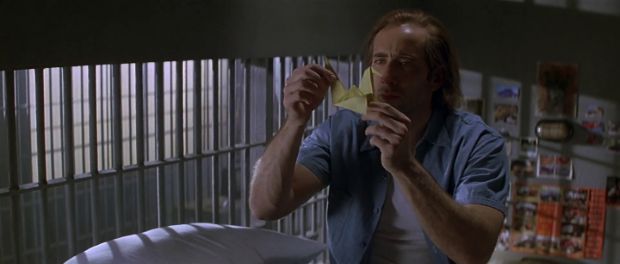
U.S. Ranger Cameron Poe (Nicolas Cage) is due to be paroled after killing a drunk who threatened him and his wife (Julia Roberts wannabe Monica Potter). We are subjected to the typical passage of time montage documenting Poe’s stint in prison as director Simon West and the screenplay by Scott Rosenberg slyly reference a similar sequence with Nicolas Cage in Raising Arizona (1987) and the prison riot scenes in Natural Born Killers (1994). No, really. The prologue clocks in at a speedy five minutes and change, economically setting up the premise. Then, the opening credits play over Poe in prison reading and writing letters to his daughter, employing every cliché in the book all with a thick as molasses Southern drawl.

Of course, Poe’s trip home isn’t going to be that easy as his knack of being in the wrong place at the wrong time continues when the plane he’s on just happens to be transporting the worst criminal scum on the planet. Chief among them, Cyrus “The Virus” Grissom (John Malkovich), a serial rapist (Danny Trejo), a Black Panther-esque militant (Ving Rhames), a Hannibal Lector rip-off (Steve Buscemi), a young Dave Chappelle riffing his way through the movie as a minor criminal that incites the jailbreak, and a whole slew of mass murderers.

Naturally, the convicts get free of their restraints and take control of the plane. To make matters worse, Poe’s buddy (Mykelti Williamson) goes into insulin shock. On the ground, U.S. Marshal Vince Larkin (John Cusack) and DEA Agent Duncan Malloy (Colm Meaney) get into a heated debate about how exactly to deal with the runaway plane – Larkin wants to take it down through peaceful means while Malloy wants to shoot it out of the sky. Naturally, it’s up to Poe to do the right thing and save the day.

Clearly riffing on his psychotic assassin from In the Line of Fire (1993), albeit with a much better sense of humor, John Malkovich gets the lion’s share of the movie’s best dialogue and delivers it with his trademark scathing dry wit. He really seems to be having fun with this role. Along comes Steve Buscemi as a criminal with a revered and feared reputation and yet we never actually see him do anything to support these claims. He and Malkovich get locked into a competition to see who can deliver the best one-liner with the driest of deliveries.

Colm Meaney and John Cusack have a lot of fun bickering back and forth, as the former plays an assholish DEA agent, a typical blowhard authority figure, while the latter plays a cerebral U.S. Marshal – one of his trademark characters dropped into a slam-bang Bruckheimer action movie. Part of the fun of watching Cusack in Con Air is seeing him navigate the kind of movie he doesn’t usually do, butting heads with Bruckheimer stereotypes with often interesting results.

You have to hand it to Nicolas Cage; he certainly knows how to pick action movies that allow him to play ever so slightly left-of-center characters like The Rock (1996), where he played an anti-action hero, and Face/Off (1997), a stylish John Woo movie with an insane role reversal plot twist. In this movie, the actor looks ridiculous with his glorious mullet, taking his cue from Jean-Claude Van Damme’s similar ‘do in Hard Target (1993). With Con Air, Cage wisely plays Poe as if it were a straight-forward action movie, which is in sharp contrast to many of the larger than life characters around him. He’s gracious and smart enough to know that when everyone around him is playing larger than life characters, go the low-key route.

Getting his start in commercials, director Simon West wears his influences on his sleeve, doing his best Michael Bay impersonation as he employs oh-so dramatic slow-mo shots of badass characters walking towards the camera (a ‘90s staple – see Armageddon), our hero outrunning an explosion, and everything is gorgeously shot and edited within an inch of its life.

For a big, loud action movie, the dialogue is quite clever and, more importantly, delivered well by the cast – which, incidentally, is an incredible collection of movie stars and character actors. It is so jam-packed with talented thespians that you wonder how in the hell did the powers that be get them all to be in this movie? Con Air looks and sounds like a Bruckheimer action film but it is Rosenberg’s screenplay that is the wild card. It sets up the standard, implausible action movie premise and introduces the genre archetypes (i.e. the lone wolf protagonist with his pretty, loving wife and the criminal mastermind, etc.) and starts messing around with the formula.

Scott Rosenberg garnered a lot of buzz from his screenplay for Things To Do In Denver When You’re Dead (1995). Disney came calling and hired him to write a script. They gave him a Los Angeles Times article about a Federal Marshal program that transported inmates across the country. To research the operation, he went to Oklahoma City and spent three days on a plane with convicts. He observed, “hardened convicts at their worst. It was very unsettling, and a bit terrifying.” Rosenberg settled down to write the script, listening to a lot of Lynyrd Skynyrd and Allman Brothers albums and came up with an idea about a guy sent to prison when his wife was pregnant and had never met his daughter. This freed up Rosenberg to populate the script with “the craziest motherfuckers; the most absurd dialogue and set-pieces.”

Producer Jerry Bruckheimer read Rosenberg’s script and bought it for his production company but felt that it needed to be more character-driven. He worked closely with Rosenberg to “add more dimension” to the characters and make it a story about redemption. Bruckheimer hired Simon West to direct because he had been impressed by his T.V. commercial work.

Upon completing The Rock with Nicolas Cage, Bruckheimer asked the actor to star in Con Air. With this movie, he wanted to return to a “more old-fashioned style of action movie,” and used Gary Cooper in High Noon (1952) as a point of reference, playing a character with good values. To prepare for the role, he visited Folsom State Prison where he had to sign a “no hostage” clause in order to walk among hardened inmates in the Level Four lock-up. Everything was fine until he, Bruckheimer, Rosenberg and West talked to one group of inmates in the yard and not another. All hell broke loose as one inmate tried to stab another.

Cage observed that many inmates had chiseled physiques and decided to take his cue from boxer Ken Norton and “look like I could survive anything, anywhere.” To this end, he adopted a specific diet, ran five miles a day and lifted weights frequently. At one point, the studio was worried that the actor was getting too ripped, which he found amusing: “I thought, ‘Now that’s a new one – too built-up for an action movie.’” In the script, Poe wasn’t too smart, “just a skeleton of a character,” according to Cage, and made him a Southern man that idolizes his wife. He also decided to make Poe an Army Ranger to explain how he could survive on a plane without a gun. Winning an Academy Award hadn’t mellowed out the actor as West remembered, “If we were doing an intense scene, he’d howl like a banshee and he’d leap around like a banshee, too. I’d give him a minute or two and then I’d say, ‘Let’s move on, Nick.”

Con Air received mixed reviews from critics. Roger Ebert gave the movie three out of four stars and wrote, “The movie is essentially a series of quick setups, brisk dialogue and elaborate action sequences…assembled by first-time director Simon West…it moves smoothly and with visual style and verbal wit.” In her review for The New York Times, Janet Maslin wrote, “Con Air has an important secret weapon: an indie cast. All of the principals normally work in films more interesting and human than this one, which gives Con Air a touch of the subversive and turns it into a big-budget lark.” Entertainment Weekly gave it a “C” rating and Owen Gleiberman wrote, “Con Air may be the closest thing yet to pure action thriller pornography. Ultimately, there’s nothing to it but thrust.” In his review for the Los Angeles Times, Kenneth Turan wrote, “But with a noise level so high the dialogue has to be screamed and more silly moments than sane ones, Con Air is an animated comic book put together to pound an audience into submission, not entertain it.”

Con Air works because the filmmakers take a simple set-up and expertly execute it. The movie still plugs in the usual, over-the-top set pieces. For example, a sports car is towed behind a cargo plane only to crash through a control tower and explode. Our hero’s best buddy even gets to utter a stirring soliloquy as he lies gravely injured. True to form, the ending is highly implausible and excessive even by Bruckheimer standards but you have to admire the filmmakers for going for it. There is a fascinating push and pull going on with this movie as it trots out all the usual action movie clichés while often commenting on them ironically in true ‘90s fashion – so much so that at one point, Steve Buscemi’s spooky killer even acknowledges said irony. Ultimately, what redeems Con Air – well-placed sense of irony – is, sadly, what goes missing when its sappy ending rears its ugly head, even if it tries to evoke the ending of Wild at Heart (1990). No, really.


SOURCES

Con Air Production Notes. 1997.

Longsdorf, Amy. “Traditional Values Drew Iconoclastic Nicolas Cage To Do Con Air.” The Morning Call. June 1, 1997.


“Screenwriter Scott Rosenberg Interview.” Kid in the Front Row. March 13, 2010.

Friday, April 5, 2013

Miller's Crossing


Despite opening the New York Film Festival in 1990, Miller’s Crossing was buried by a tidal wave of other gangster films that year, including GoodFellas, King of New York, Dick Tracy and The Godfather Part III. They all drew some kind of buzz or hype, whether it was through controversy, awards or a massive marketing blitzkrieg. The Coen brothers’ film was a modestly budgeted film that did not contain a recognizable movie star like Robert De Niro or Al Pacino for audiences to latch onto and, coupled with a detached, distanced approach to the characters and a densely textured plot with several implicit and explicit events occurring concurrently, Miller’s Crossing became something of a cinematic oddity, a critical darling that was ignored by mainstream audiences.

Set during the Prohibition era in an unnamed northeastern city, Miller’s Crossing weaves a complex web as two warring gangs face off against each other. Leo O’Bannon (Albert Finney), a headstrong Irishman, is the gangster who controls the town, but his power is in danger of being usurped by a rival gang headed by the ambitiously violent Italian, Johnny Caspar (Jon Polito) and his silent but malevolently evil henchman, Eddie Dane (J.E. Freeman). Caught between the two sides is Tom Reagan (Gabriel Byrne), a brooding thinker and right-hand man to Leo. Tom’s only hope for survival rests in his ability to play off both men until only one side emerges victoriously.

Miller’s Crossing begins with a riff on the opening of The Godfather (1972) except that instead of a man asking for a favor and having it granted from the head of a powerful mob family, as happens in Francis Ford Coppola’s film, the man – Johnny Caspar – is rebuffed and admits that he’s not really asking, “I’m telling you as a courtesy, I need to do this thing so it’s going to get done.” This “thing” is Johnny killing small-time grifter Bernie Bernbaum (John Turturro) for letting word out on a fixed boxing match that the mob boss set up. Besides losing money, Johnny sees this as a betrayal of the highest order as evident from the monologue he delivers about ethics, which is his way of pitching permission to whack Bernie.

All Leo has to do to avoid trouble with Johnny is give up Bernie, but he refuses out of his love for Verna (Marcia Gay Harden), his girlfriend and Bernie’s sister. This decision sets everything in motion. Jon Polito acts the hell out of this scene as Johnny starts off all genial and then he comes on a bit stronger, getting indignant when Leo refuses him and then outraged when Leo tells him, “So take your flunky and dangle.” Johnny is tired of getting the “high hat” from Leo. It’s a fantastic introduction to the three main characters while also setting the story in motion.


The opening credits play over a stately tracking shot looking up through a forest of trees where the film derives its title from while Carter Burwell’s elegant music plays. Finally, a black hat comes to rest in a forest clearing, and then a gust of wind lifts it into the air sending it flying down an avenue of trees. It was the first image the Coen brothers conceived and an image that best describes the evocative, visual style of Miller’s Crossing. Aside from establishing the atmosphere for the film, the opening credits also set up a repeating visual motif of hats.

Tom Reagan is a fixer, someone who can see all the angles and spends the entire film trying to figure out how to play them for his advantage. If he has any weak spot it is an inability to kill someone when he needs to. For someone who, on the surface, shows little emotion, he has strong feelings for those close to him, namely Leo and Verna. Gabriel Byrne plays Tom as an intelligent guy who is always thinking. The actor does a great job of maintaining Tom’s poker-faced façade and uses his eyes to convey the emotions that exist underneath. Over the course of the film, Byrne shows Tom’s internal conflict of logic vs. feeling and how he resolves it to chilling effect.

Miller’s Crossing would introduce two important actors to the Coen brothers’ stable of regulars. Steve Buscemi has a small, but memorable role as Mink, a fast-talking grifter in league with Bernie, but who is also “friendly” with Eddie Dane. He would go on to have memorable cameos in the Coens’ next two films before being given a meaty role in Fargo (1996). John Turturro plays Bernie, Verna’s scheming brother and Tom’s doppelganger. He thinks he has all the angles covered, like Tom does. On the surface, Bernie is all emotion, cracking jokes and, at one point, shamelessly begging for his life, but underneath he is cold and calculated. Tom is generally a good judge of character; able to figure out someone’s strengths and weaknesses. Some people, like Leo and Johnny, are easier to read than others, while some people are more difficult, like Bernie because he’s so similar to Tom, which is why he takes the longest to figure out.

Despite playing an untrustworthy character, Turturro’s charisma gives Bernie a certain charm that is fascinating to watch, especially in the film’s signature scene where Bernie pleads pathetically for his life as Tom has been ordered to kill him out in the forest. Turturro goes to hysterical extremes so that you’re almost hoping Tom will whack Bernie if only to shut him up and silence his incessant pleading. The actor would go on to star in the Coens’ next film Barton Fink (1991) and appear in many more of theirs, always delivering memorable performances.

Marcia Gay Harden is excellent in an early role as a tough-talking dame who loves Tom despite how poorly he treats her at times. As she tells him at one point, “I’ve never met anyone who made being a son of a bitch such a point of pride.” Yet, for all of her bravado, Harden also conveys Verna’s vulnerable side when things go sour and she tries to kill Tom. J.E. Freeman has played his share of tough guys and heavies (most memorably in Wild at Heart) and cuts quite an imposing presence as the much-feared Eddie Dane. He knows that Tom is no good for his boss and can’t wait to kill him. Freeman gets his moment when the Dane takes Tom out to the forest to kill him. It really looks like Tom has finally gotten the angles wrong and Freeman’s Dane really makes you fear for the protagonist’s life.


As with all of the Coen brothers’ films, the attention to dialogue, in this case period gangster-speak, is fantastic as characters greet each other with a, “What’s the rumpus?” and throw around racial epithets like, “schmatte.” There’s the snappy back and forth banter between Tom and Verna, Bernie’s smartass pitches to Tom, and Johnny’s gangster philosophizing about ethics. The plotting is also a marvel to behold. The Coens had such a time trying to put it all together that they developed writer’s block while writing the screenplay and wrote Barton Fink before returning back to Miller’s Crossing. In addition to the escalating war between Johnny and Leo, the Coens also devised three love triangles between various characters. There’s the obvious one between Leo, Tom and Verna, however, two others are hinted at: that between Tom, Verna and Bernie, and the one between Mink, Eddie Dane and Bernie. These last two only become readily apparent upon subsequent viewings. If that weren’t enough, there are all kinds of colorful flourishes that the Coens sprinkle throughout, like the tough guy (Mike Starr) who takes off his coat and rolls up his sleeves before laying a beat down on Tom (whose reaction is priceless), or the polite henchman who roughs up Tom for owing money to his boss, only to leave him battered and bruised with kind rejoinder, “Take care now.”

That being said, the Coens did not forsake the visual pizazz of their first two films as evident in bravura scene where a team of rival gangsters tries to kill Leo in his home at night. It’s a wonderful bit of virtuoso filmmaking as Leo dispatches his killers to the strains of “Danny Boy.” For such an exciting action sequence, the rather somber rendition of “Danny Boy” gives it a decidedly melancholic vibe, perhaps hinting at the gradual crumbling of Leo’s empire. This would be the last film Barry Sonnenfeld would shoot for the Coens. He would go on to his own successful directing career. The Coens never broke stride, hiring Roger Deakins to shoot Barton Fink and he’s been there go-to cinematographer ever since.

Originally called The Bighead (a nickname for Tom), Joel and Ethan soon got lost in the intricate plottings of the story and went to stay with their good friend William Preston Robertson in St. Paul, Minnesota, hoping that a change of scenery might help. One night, they went and saw Baby Boom (1987), returned to New York City and wrote Barton Fink in three weeks before returning to the Miller's Crossing screenplay. The first image they conceived was that of a black hat coming to rest in a forest clearing, then, a gust of wind lifts it into the air. Ethan said, "I mean, the whole hat thing, the fact that it's all hats, is good, because even if it doesn't mean anything, it adds a little thread running through the whole thing that's the same little thread." Furthermore, he has said that "the hat doesn't 'represent' anything, it's just a hat blown by the wind." Joel continued, "It's an image that came to us, that we liked, and it just implanted itself." The Coens were interested in making “a film with people who were dressed in a certain manner, hats, long coats, and put them in an unusual context like a forest.”

Interestingly, the Coen brothers weren’t inspired by classic gangster films, but rather fiction of the period. After the cartoonish slapstick comedy that was Raising Arizona (1987), they shifted gears with Miller’s Crossing, a love letter to the works of Dashiell Hammett, a famous pulp writer of the 1930s. The film mixed aspects of crime and corrupt politics involved in running a city from the author’s novel, Red Harvest, with several triangular relationships and sadistic, often homoerotic undertones found in another of his books, The Glass Key. In regards to Red Harvest, Joel said, “It gave us the idea of making a movie where everybody is a gangster … Also typical of Hammett is the enigmatic central character.” The Coens first thought of gangsters in a small town and not a big city. They were also interested in putting an emphasis on ethnicity: “The more established Irish, the recently arrived Italians and the sort of outsider Jews all struggling for a piece of the pie.”


In addition to the literary influences on Miller’s Crossing, the Coens referenced several films. For example, the opening sequence with Johnny Caspar and Leo evokes the beginning of The Godfather. The climactic forest scene references Bernardo Bertolucci's The Conformist (1970). The film's final scene partially quotes the ending of The Third Man (1949) and The Long Goodbye (1973).

After the success of Raising Arizona, the Coens stayed with the same production company, which gave them between a $10-14 million budget. They decided to make Miller’s Crossing in New Orleans because they were attracted to the look of the city, as Ethan commented in an interview: “There are whole neighborhoods here of nothing but 1929 architecture. New Orleans is sort of a depressed city; it hasn’t been gentrified. There’s a lot of architecture that hasn’t been touched, store-front windows that haven’t been replaced in the last sixty years.”

Gabriel Byrne was a fan of Raising Arizona and eager to work with the Coen brothers. A casting director recommended him to the filmmakers and he was one of many actors that read for the role of Tom Reagan. The Coens originally envisioned the character to be an American, but Byrne decided to use his natural Irish accent and they liked it. The actor found Tom to be a rather enigmatic character and to keep the audience interested in him he sought to convey a vulnerable side. This was achieved in the scenes spent in his bedroom. “That’s when Tom did his thinking; that’s when Tom did his worrying; that’s when he did his plotting and his strategy.”

The Coen brothers knew John Turturro through Frances McDormand (who was married to Joel) and they had seen him in several plays. As a result, they wrote the part of Bernie specifically for him. The role of Johnny Caspar was originally written for a 55-year-old man and the Coens felt that Jon Polito was too young. They wanted him in to play the character of Eddie Dane, but he would only come in and read for Johnny. Trey Wilson, who played Nathan Arizona in Raising Arizona, was supposed to play Leo, but two days before the first day of principal photography he tragically died from a brain hemorrhage. The Coen brothers called Albert Finney in London and asked him to take on the role of Leo on two days notice. Much to their surprise, he accepted.

Miller’s Crossing received mostly positive reviews from critics. Roger Ebert gave it three out of four stars and wrote, “The pleasures of the film are largely technical. It is likely to be most appreciated by movie lovers who will enjoy its resonance with films of the past.” USA Today gave it four out of four stars and Mike Clark wrote, “Often accused of employing jazzy film school ‘tricks,’ the Coens have now gone the other way – all the way. Cold and cut to the bone, the film is a primer in screen virtuosity.” Entertainment Weekly gave the film a “B+” rating and Owen Gleiberman wrote, “Miller’s Crossing is most fun when the actors bite into their roles. Polito is superb as the gravel-voiced vulgarian Johnny. John Turturro plays Bernie with a giggly hysteria that recalls some of Richard Widmark’s desperate weasels.” The Globe and Mail’s Jay Scott hailed it as “a masterpiece, but of a unique kind. It’s a gangster movie so morally and ethically bleak, it evokes the dead-end world of the ultimate twentieth-century playwright, Samuel Beckett: lower or higher than this, you cannot go.”


In her review for the Washington Post, Rita Kempley wrote, “And Miller’s Crossing is very much a story of honor among thieves. In its hard heart of hearts, it is a masterfully written and visually unsettling study in manly love.” However, The New York Times’ Vincent Canby called it, “a movie of random effects and little accumulative impact.” Finally, the Chicago Reader’s Jonathan Rosenbaum wrote, “the double crosses are so intricate and the cynicism so enveloping that it becomes increasingly difficult to care about the characters.”

A brilliant gangster melodrama, Miller’s Crossing is arguably one of their best efforts, if not the best, with complex characters and an attention to detail that makes it one of the most atmospheric films to come along in some time. As Richard T. Jameson said in an issue of Film Comment, “It has always been one of the special pleasures of movies that they dream worlds and map them at the same time.” This is exactly what the Coen brothers do with their film by creating a living, breathing world with authentic period costumes and gangster language of the time. But like their other films, they are clearly aware of the conventions of the genre that Miller’s Crossing is set in and pay to homage to it and parody its elements simultaneously.


SOURCES

Bergan, Ronald, The Coen Brothers, Thunder’s Mouth Press: New York, 2000

Coursodon, Jean-Pierre, "A Hat Blown By The Wind," Joel and Ethan Coen: Blood Siblings, edited by Paul A. Woods, Plexus: London, 2000, pp. 91

Dudar, Helen. “Gabriel Byrne, Bound for Miller’s Crossing.” The New York Times. September 16, 1990. Pg. 19.

Goodman, Joan. “The Coen Brothers Return to the Screen with Miller’s Crossing.” The Globe and Mail. October 5, 1990.

Jameson, Richard T., “Chasing the Hat.” Film Comment. October 1990.

Levine, Josh, The Coen Brothers: The Story of Two American Filmmakers, ECW Press: Toronto, 2000.

Levy, Steven, "Shot By Shot," Joel and Ethan Coen: Blood Siblings, edited by Paul A. Woods, Plexus: London, 2000.

Friday, January 13, 2012

The Big Lebowski

I’ve always wondered if The Big Lebowski (1998) was an attempt by the Coen brothers to address their critics, chief among them J. Hoberman and Jonathan Rosenbaum, who accuse the filmmaking duo of anti-semiticism in films like Miller’s Crossing (1990) and Barton Fink (1991). This is a rather odd charge considering that Joel and Ethan Coen are in fact Jewish. Keeping this in mind, one has to wonder what to make of Walter Sobchak (John Goodman), a character in The Big Lebowski who is proudly Jewish and even married and converted to Judaism for his wife. Then, when they were divorced, remained Jewish, defiantly so.


Clearly, the Coens were playfully thumbing their noses at Hoberman and Rosenbaum and this is further reinforced in the faux scholarly introduction to the film’s screenplay, which claims that it won the 1998 Kochba Award, “honouring achievement in the arts that defy racial and religious stereotyping and promote appreciation for the multiplicity of man.” Yeah … right. Furthermore, the unidentified writer (probably the Coens) goes on to explain the nature of humor with a hilariously in-depth analysis of what makes The Three Stooges funny and thereby making the point that if you have to explain why something is funny to someone else then they’ll never get it. So, are the Coens saying that critics like Hoberman and Rosenbaum don’t “get” their films?

Set in Los Angeles during the first Persian Gulf War, the Coens weave a decidedly unconventional tale about a man known as The Dude. Jeff "The Dude" Lebowski (Jeff Bridges) is a laid-back kinda guy, an aging Hippie who spends his days drinking White Russians, smoking pot, and bowling with his buddies — Walter, a bitter Viet Nam veteran, and Donny (Steve Buscemi), a not too-bright surfer. One night, two thugs invade the Dude’s home, rough him up, and urinate on his rug. It seems that they have him confused with another Lebowski, a rich millionaire (David Huddleston) whose young trophy wife Bunny (Tara Reid) owes money all over town. Bummed at having his prized rug ruined, The Dude decides to contact the other Lebowski and in doing so becomes immersed in a very strange, convoluted plot that involves nihilists, a kidnapping, Busby Berkeley dream sequences, British performance artists, and, of course, bowling.

I’m not going to write my usual in-depth article with production information, as that has already been done and better than I ever could. Rather, here are 24 of my favorite moments:

1. The Two Dumbest Flunkies. You’ve got one who pees on The Dude’s rug and the other who’s apparently never seen a bowling ball before. I love the one’s reaction when he realizes that The Dude’s humble abode does not resemble that of the wealthy millionaire they’re looking for.


2. The introduction of Donny, Walter and The Dude is awesome in how it shows the dynamic between these friends, like how The Dude and Walter bicker like an old married couple while Donny is the conversation cheerleader, occasionally commenting on what’s being said, like “a child who wanders in the middle of a movie,” as Walter puts it.

“Forget it, Donny. You’re out of your element.”
 3. I love the scene where The Dude first confronts the other Lebowski and after schooling him on how he prefers to be addressed is then chastised by the blustery rich man – “The bum’s lost!” This sets up a class struggle between haves like Lebowski and the have-nots as represented by The Dude.

“…or El Duderino if you’re not into the whole brevity thing.”
 4. “I’m just gonna find a cash machine.” Bunny Lebowski’s offer of oral sex comes at a high cost and Brandt’s (Philip Seymour Hoffman) reaction is hilarious (“That’s marvelous.”). Hoffman is so funny as the terminally uptight toady Brandt.

"That's marvellous."
 5. “If you will it, it is no dream.” This is the first declaration of Walter’s Jewish pride as he quotes Theodore Herzel but this is unfortunately quickly forgotten when he freaks out all over Smokey’s (Jimmie Dale Gilmore) breaking of the rules of bowling. After all, this isn’t ‘Nam. This is bowling. There are rules. Fortunately, Smokey narrowly avoids entering a world of pain.


6. The Dude’s easygoing nature deflates the other Lebowski’s theatrics as he tells of Bunny being kidnapped by the nihilists. Jeff Bridges’ reaction shot at one point as he takes a drag off a joint and says, “Fuckin’ A,” is hilarious. Hoffman is also excellent in this scene as Brandt acts all upset over the news but as soon as he’s required to spring into action drops the act.

“This is a bummer, man.”

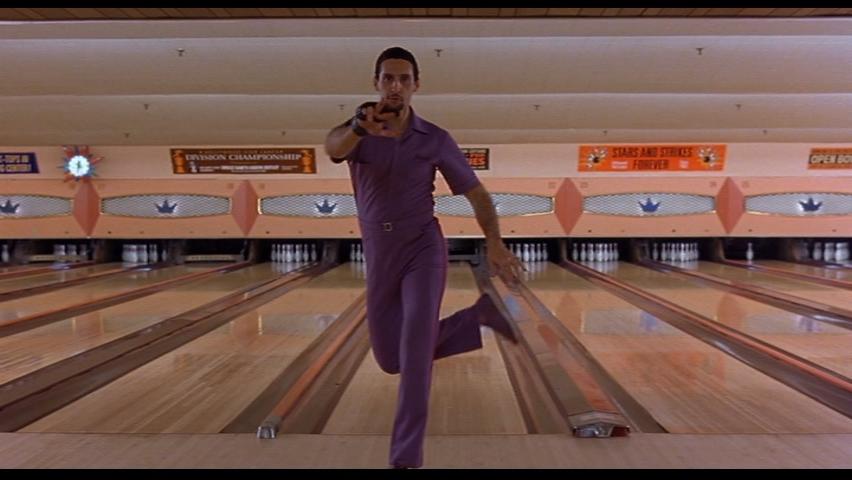
7. One of the greatest introductions of a character that has absolutely nothing to do with the plot ever. John Turturro makes the most of this scene as one of The Dude’s bowling opponents, from the licking of his ball to the little dance moves he pulls off after bowling a strike. The long pinky nail (for cocaine) and hairnet are nice touches as is the music that accompanies his intro – a cover of “Hotel California” by the Gipsy Kings. I also love The Dude’s laidback retort to Jesus’ bowling taunt: “Yeah well, that’s just, ya know, like, your opinion, man.” We even get a brief insight into Jesus’ life as a convicted pederast. Eight year-olds, dude. It is these little details that make this film so enjoyable to watch as even minor supporting characters are given a rich backstory.

“Nobody fucks with the Jesus!”
 8. After The Dude’s team advances to the next round in the bowling tournament (amazing considering that Walter pulled a gun on a fellow bowler), Walter loses his shit when Donny tells him that their next game is scheduled for Saturday, the Jewish day of rest thereby forbidding him from bowling on that day.

“Shomer shabbas”
 9. Logjammin’. Maude Lebowski (Julianne Moore), a feminist performance artist/painter, shows The Dude a cheapo porno film that Bunny starred in with her nihilist boyfriend Karl Hungus (Peter Stormare) in which he plays a cable T.V. technician who arrives to “fix” her cable. When she scoffs at its predictable plot and how it will end, The Dude deadpans, “He fixes the cable?”


10. The Dude is suddenly manhandled by the other Lebowski’s burly limousine driver causing him to spill a glass of one of his beloved White Russians.

“Hey, careful, man. There’s a beverage here!”
 11. The nihilists bust into The Dude’s place (“Hey, this is a private residence, man.”) and interrupt his relaxing bath by throwing a ferret into his bath water, thereby blowing his high and then threatening castration. Peter Stormare and Flea’s Eurotrash German accents sound like they came straight from the Saturday Night Live skit Sprockets!

“We believe in nothing!”
 12. Ah, Sam Elliott as the film’s narrator known as the Stranger and who makes an appearance in full western garb to give The Dude some sage advice and comment on his usage of cuss words. With his awesome mustache and deep voice, Elliott is ideally cast as a mysterious cowboy cum Greek chorus.

“I like your style, Dude.”
 13. And just what the hell is David Thewlis doing in this film as video artist Knox Harrington, armed with an annoying high pitched laugh and shaved head? Nothing really except yet another oddball that The Dude meets along the way. Knox and Maude seem to be sharing a private joke in their scene together, much to The Dude’s chagrin.

“Who the fuck are you, man?”
 14. “Lookin’ Out My Back Door” I love the use of this fantastic Creedance Clearwater Revival song in the scene where The Dude tries to evade a mysterious car that is following him. The little yelp that Bridges lets out when his character drops a lit joint in his lap while driving is priceless.

15. Goodman’s best scene in the film is when Walter and The Dude visit an insolent high school kid they believe stole his car and a million dollar ransom that was intended to free the kidnapped Bunny. The scene becomes funnier the more frustrated Walter and The Dude get as the kid refuses to buckle under their “intense” questioning culminating in Walter’s memorable insult, “This is what happens when you fuck a stranger in the ass!” over and over while trashing a sports car he thinks the kid bought with the ransom money.

“This is what happens…”
 16. Ben Gazzara as Hugh Hefner. The John Cassavetes film veteran turns up late in the game as a classy smut peddler Jackie Treehorn who drugs The Dude. I love the way Gazzara says, “feelings,” when he tells Bridges how the porn biz has changed over the years. This scene is also notable for showing The Dude doing some actual detective work. Too bad it amounts to nothing.


17. Gutterballs. While there are two dream sequences in the film, this is by far the best as a drugged Dude dreams of teaching Maude how to bowl while a chorus line of beautiful women engage in a Busby Berkeley style dance sequence all scored to “Just Dropped In (To See What Condition My Condition Was In)” by Kenny Rogers during his psychedelic period. Oh yeah, and Saddam Hussein gives The Dude bowling shoes and the dream ends with him being chased by the nihilists wielding huge scissors in a sequence that Freud would have a field day with.


18. The Dude hates the Eagles. Man, I’m so with him on this one.

19. I love the moment between Jeffrey and Maude where they bond after having sex. It’s a nice, quiet and amusing scene as we take a break from all the crazy people The Dude encounters and learn that he was briefly a roadie for Metallica (“Bunch of assholes.”). He was also a member of the anti-war group the Seattle Seven and helped write the original Port Huron Statement – not the compromised second draft. The chemistry between Bridges and Julianne Moore is excellent and The Dude’s reaction to Maude’s true intentions for their sexual rendezvous is funny. Plus, she helps him free up his uptight thinking about the mystery he’s embroiled in.


“Jeffrey, love me.”


20. Long-time Coen brothers collaborator Jon Polito pops up as a “brother shamus,” a private snoop trailing The Dude in order to find Bunny who has run away from home in Minnesota. The Dude tells him to back off from his “lady friend” (a.k.a. Maude) and alas that’s the last we see of Polito for the rest of the film.

“Like an Irish monk?”
 21. “3,000 years of beautiful tradition, from Moses to Sandy Koufax…” We get Walter’s full-on justification for why he still practices Judaism despite being divorced. There’s something admirable about his devotion to this religion.

22. Why’d they have to kill Donny? Poor Donny didn’t hurt anybody and is taken out when he suffers a heart attack as the nihilists confront him, The Dude and Walter outside of their beloved bowling alley, which leads us to…


23. Donny’s Eulogy. Walter delivers a heartfelt if not misguided eulogy to Donny. Due to their modest means, Walter and The Dude transport their friend’s ashes in a Folgers coffee tin to a cliff where they plan to scatter his remains. However, the wind blows some of them back into The Dude’s goatee. Fortunately, not even Walter’s ineptitude ruins this poignant moment.


24. Despite Donny’s death, The Dude and Walter advance to the next round in the bowling tournament and our hero is visited by the Stranger once again. As The Dude departs to bowl another round, he offers the parting words of wisdom, “The Dude abides,” and the Stranger wraps things up and brings the film full circle to the soulful strains of “Dead Flowers” by Townes Van Zandt.

“The Dude abides.”
 The Big Lebowski is my favorite Coen brothers film. For me, it is the perfect mix of their flashy style, eccentric characters, and distinctive dialogue. It is a rare comedy that can be watched over and over and never gets old. They have created a richly detailed world that is so inviting and entertaining that you want to revisit it again and again.

So, what are some of your favorite moments/scenes/lines of dialogue from this film?


NOTE: Screencaps from this film came from THE best Coen bros. site - You Know, For Kids!