"...the main purpose of criticism...is not to make its readers agree, nice as that is, but to make them, by whatever orthodox or unorthodox method, think." - John Simon

"The great enemy of clear language is insincerity." - George Orwell
Showing posts with label documentary. Show all posts

Friday, August 5, 2016

Being Evel

For many kids growing up in the 1970s, Evel Knievel was a real-life superhero. He became famous for performing death-defying stunts that usually involved him jumping over something (or many things) with a motorcycle. He was the pioneer of what would later be known as extreme sports, inspiring a generation of kids to push the envelope with what was possible on skateboards, bicycles and so on. Johnny Knoxville and Jeff Tremaine helped create a very popular reality television show called Jackass, which was, in part, their tribute to Knievel. Years later, they helped produce a documentary on the man entitled, Being Evel (2015), directed by Daniel Junge. It chronicles Knievel’s rise from very humble beginnings to being rich and famous until fame consumed him – with help from a sizable ego, precipitating an alarming descent that left him financially destitute.

Right from the get-go, one gets the feeling that this was a passion project for Knoxville who is the first talking head on-screen as he lays out the film’s thesis: “I didn’t know the story of the man and it was pretty complex. I’m a grown-ass man and some of the stuff is hard to reconcile. It’s a crazy story.” The documentary proceeds to examine Knievel’s colorful life as told through vintage footage of his most memorable stunts both on and off the motorcycle and interviews with his family, friends, contemporaries, and admirers.

Knievel grew up in the rough and tough mining town of Butte, Montana without parents, raised by his grandmother. He learned early on how to fight and never backed down from a challenge. As a teen, he discovered motorcycles, raising hell with them at every opportunity. He committed all sorts of petty crimes over the years before eventually settling down and getting a job selling insurance, but when he realized that there was no room for advancement he quit and moved away with his wife Linda and their kids.

He sold motorcycles and then got the idea to start jumping things with them. He and his family settled in California and started a stunt riding show. It was at this time that he started developing showmanship techniques that would serve him well in the future.

Being Evel takes us back to the heady days of ABC’s Wide World of Sports with its iconic introduction that everyone who saw it back in the day could recite by heart: “The thrill of victory and the agony of defeat,” with the shot of the ski jumper wiping out that everyone remembers, memorably illustrating “the agony of defeat.” As ABC Sports producer Doug Wilson says, “We were in the business of sports theater. Sports was drama. Sports was a story.” It was one of the biggest shows on T.V. at that time and was a program that Knievel was perfect for. He was able to get on it by jumping over 15 cars.

The documentary takes us through some of Knievel’s greatest hits, like jumping the fountains at Caesar’s Palace in Las Vegas (scamming the casino’s owner in order to get permission to do it) and the infamous Snake River Canyon jump, which was a high-profile debacle, often with mixed results as the footage of the former shows him crashing and breaking several bones. Not only did he not make the latter jump (in a rocket-powered vehicle no less), but things got ugly among the tens of thousands of people that showed up to witness the event, some of whom belonged to various motorcycle gangs. It was “the evil twin of Woodstock,” as someone puts it. A high school band tried to play and were accosted, outhouses were knocked over and set on fire, women were raped, and fights broke out. Amazingly, no one was killed.

Knievel was breaking new ground and, as a result, was making it up as he went along or, as Knoxville points out, in regards to the stunts: “He dreamed up and sold before he even knew was possible and then on the day, he’s got the crowds there and he doesn’t know if he can make it. He’s just got to go for it.” The film explores how Knievel became an overnight popular culture sensation by putting it in a historical context. The United States was just coming out of the Vietnam War, which was a very dark period of American history. The American public had become very cynical and needed a hero. Knievel, with his white, star-spangled jumpsuit, stepped up and gave people someone to look up to. He was so popular that his stunts were among seven of the top ten rated shows in Wide World of Sports’ 37-year history.

Knievel quickly realized that he drew more crowds when he crashed then when he successfully landed a jump, telling a friend, “Nobody wants to see me die but they don’t want to miss it if I do.” His stunts literally embodied Wide World of Sports' credo of “The thrill of victory,” when he made it, and “the agony of defeat,” when he didn’t. This understandably not only put a great amount of stress on him but also his two sons and first wife Linda who recalls how nerve-wracking life was back then, not knowing if her husband would survive a given jump or not.

Junge deftly juxtaposes archival footage of Knievel talking himself up and espousing his worldview to anybody who’d listen, with his family and friends reflecting on what he was like in private and it wasn’t pretty. He cheated on his wife constantly and the painkillers he took to keep his numerous injuries in check affected his behavior, causing him to act irrationally and paranoid at times. Over time, Knievel crafted a persona and began to believe it, especially once he became rich and famous, adored by millions. As his daughter says at one point, “He forgot how to be Bob and when he became Evel it’s like the world took him away from us.”

The doc is chock-a-block with memorable anecdotes, like actor George Hamilton recounting a time when he was forced to read a screenplay for a movie version of Knievel’s life (written by John Milius no less!) with a gun pointed at his head by the man himself! For all of its hero worship, Being Evel tempers it by showing how the man’s monster ego and hubris proved to be his downfall, culminating in an incident where he attacked Sheldon Saltman, the promoter of the Snake River Canyon jump, with an aluminum baseball bat for writing a relatively tame tell-all book about the tour leading up to the event. Apparently, it was a little too truthful for Knievel.


The doc ends by touching upon Knievel’s legacy and how he lives on with guys like Tony Hawk, Travis Pastrana, Robbie Maddison, and Mat Hoffman who embody his daredevil spirit and theatricality, while the Jackass crew represent the flipside – his numerous crashes and wipeouts. Evel Knievel – daredevil superhero or charismatic con man? This is the dichotomy that Being Evel wrestles with and ultimately embraces in its fascinating portrait of one of the cultural icons of the ‘70s. Towards the end, one gets the feeling that this film has been something a cathartic experience for Knoxville as he forced himself to take a good long look at his hero and concludes, “I still think he’s a superhero. I know a more complete story, now. And some of the stuff is really heartbreaking, you know? But to me, what he did transcends that.”

Friday, January 31, 2014

Intergalactic Robinson Crusoe: An Interview with Mark Askwith

For those that remember it, Prisoners of Gravity was a television show clearly ahead of its time. It devoted a half-hour every week to the serious (and sometimes not so serious) discussion of science fiction, fantasy and comic books. Every episode was devoted to a particular theme (censorship, time travel, ecology) or to specific topics (Cyberpunk literature, the Watchmen graphic novel, writer Neil Gaiman). It was a show that tackled thought-provoking subjects in an entertaining and informative matter. There had been nothing like it before and nothing like it since.

The primary creative force behind the show was Mark Askwith. He had started off as the manager of The Silver Snail, one of the premiere comic book stores in North America, in 1982. Located in Toronto it was right across the street from Bakka bookstore, a shop dedicated exclusively to fantasy and science fiction books and magazines. This was the perfect area to cultivate a serious love of science fiction and comic books. More importantly, it also gave Askwith an opportunity to meet legendary comic book creators, like Frank Miller, and local science fiction authors.

He left the Snail in 1987 and worked on Ron Mann's excellent documentary, Comic Book Confidential (1988). Its success led to the creation of Prisoners of Gravity, a television program that took the ideas presented in Mann's movie and expanded on them in detail and scope. It was the brainchild of Mark Askwith, Daniel Richler and Rick Green. Askwith conducted the bulk of the interviews done for the show (over 400 guests by the end of its run), Green was the host (and provided the humorous asides and personality) and Gregg Thurlbeck directed each episode. All three worked closely together writing the show and assembling it so in actuality their tasks often overlapped. PoG's budget was very modest, only $23,000 an episode and over the course of its run received numerous awards and accolades.


Prisoners of Gravity first aired on TVOntario, a Canadian public television station, in 1989 where it ran for five seasons and 137 episodes before being canceled in 1994. It was shown numerous times in syndication, briefly on PBS, the Discovery Channel and Space: The Imagination Station (the Canadian equivalent to the Sci-Fi Channel). Over this time PoG developed a small but loyal following.

I had the chance to conduct an interview with Askwith via email. He is currently one of the founding producers of the Space channel and graciously took time out of his busy schedule to reminisce about Prisoners of Gravity.

How did you get into comic books and science fiction? Were you always into them as a young age or did you get into them later on?

I read the Narnia books, Andre Norton, the Robert Heinlein juveniles, and anything I could get my hands on. My mother ran a children's bookstore in Ottawa called the Bookery, so I had exposure to "the good stuff."

I was given a Tintin album Explorers on the Moon when I was 4. I think it was really what got me hooked on comics. I also ran across a stash of superhero comics when I was 7 - that also was a pivotal event for me... the seeds were sown.

I didn't take comics seriously until a friend with "The Tiny Perfect Collection" turned me on to great comics. This would have been first year university. I've always read every genre, and it wasn't until Prisoners of Gravity that I focused exclusively on genre.


How did you get involved in Ron Mann's documentary, Comic Book Confidential? Was it the blueprint or did it give you the idea for Prisoners of Gravity?

I pitched a documentary to Ron, because his previous documentary was on where I used to work - Coach House Press. He was open to the idea, but then started to mutate it into a valentine to Marvel Comics. Now, there's nothing wrong with that, but I thought that Ron would be more attracted to the work of the underground artists, and I thought we had an opportunity to do something unique and timely - get these major creators before they left us. I gave him some direction, and with BP Nichol, the film happened.

Did Comic Book Confidential attract Daniel Richler's attention and result in the creation of Prisoners of Gravity?

Yes. Much as I loved working on a documentary film, I hated the fact that it took three years to produce. I realized that comics and pop culture really need a faster delivery system - television. When Comic Book Confidential won a Genie [note: this is the Canadian equivalent of the Academy Awards], that caught several people's attention. I initially saw PoG as "The New Music for SF/comics," [note: The New Music is an excellent T.V. magazine show dedicated to musicians and new trends in music] and as a person who was instrumental in shaping New Music, Daniel was the perfect person to pitch.

I really like that analogy of PoG being The New Music for SF/comics. I remember that program well! What really stood out was the quality of the questions asked of the artists. PoG certainly had the same level of quality and intelligent interviews. PoG didn't ask superficial questions or go for the fanboy response but really put some thought behind what was asked of the interviewee. I also think that what makes PoG stand out, is that it treated the comic book/SF/fantasy genre with respect and legitimacy. Was that an important thing for you to convey in the show?

I think it is important to remember that I am a writer, and was the manager of one of the best comic book stores in the world. By the time I worked on Comic Book Confidential, I had already met/interviewed hundreds of creators, and by the time I created PoG I had published The Prisoner Graphic Novel. Many of the Canadian SF writers knew me, as I hung out at Bakka, so I was "one of them." I had "street cred," or "genre cred" (!?). What I wanted to do was showcase what I saw as a hotbed of creativity, and not some guy in pointy ears at a convention. Interestingly, one of the few complaints I got from fans was that the show wasn't more about them, that we were elitist because we dared to focus on the authors (and didn't I know that fans went to cons to meet other fans, not see the guests). I really felt that if we got to the rich center of genre-ideas - then ANYBODY could watch (I always aimed the show at my mother and father), so I assumed no knowledge of the material. We built the shows so the material added up, and hopefully made sense.

Also, on all the shows I've worked on - whether it was an interview with Margaret Atwood, or John Updike, or William Shatner, my approach has always been to respect the material.


What was your original brainchild/plan for Prisoners of Gravity?

Originally the show was pitched as a 7 minute segment to fit between episodes of Dr. Who. I'd host it, and do the interviews, and use the platform to talk about the latest in genre. TVO lost the rights to Dr. Who, and I talked Daniel into a half hour, theme based show. I think he thought I'd host it (horrors), but blessed as I am with a face for radio, he let Rick Green audition.

How did Rick Green's name come up as a possible host? Was he much of a fan of comics/SF before he did PoG?

Rick was in seeing Daniel about other ideas, but Rick knew about my show because we played ball hockey together every Sunday. That may give Americans the idea that all Canadians know each other, and play hockey, but hey, that's my story...Rick was/is an old school SF fan, into Bova, Asimov, Bradbury...

Did TVOntario give you guys a lot of freedom on the show or did they try to impose any kind of restrictions?

They were great. We didn't cost a lot. We were not on their radar, and because of Daniel's clout, they gave us total free rein. Luckily, I knew what a blessing that was! They were very supportive, not only of the show, but of the producers and Rick.

Was it tough, at first, to get interviews with authors/filmmakers/artists or did you already have connections that opened doors for you?

One of the great things about being first, and getting it right, is that support just grew in the community. Everybody we put on air seemed to like it, so one interview led to another. It does seem crazy that we'd get so many wonderful, famous people (Anne Rice, Ray Bradbury, Jack Kirby), but in a way we were the only game in town. My work in publishing and managing the Silver Snail, and writing for DC Comics meant that I had some credentials... but mostly I think it was the show that opened the doors. It's also hard to remember, but when we interviewed first Neil Gaiman, or Terry Pratchett, or Jaime Hernandez, most people didn't know who they were.


I remember that the first season had a more Cyberpunk flair to it (Commander Rick even had his hair spiky and dyed!) that seemed to be toned down in subsequent seasons. Was that a conscious decision? Did you feel that his look and some of the visual tricks distracted from the content?

Yes, although there were other factors. One, a new director, Gregg Thurlbeck, who went back to my original idea, and the collective realization that film clips and certain visual tricks would date the show, and perhaps mean we couldn't repeat the shows.

You've talked about some of your favorite interview subjects over the run of Prisoners of Gravity in other interviews. I remember that you guys interviewed Harlan Ellison at one point. I've heard that he's an incredible storyteller and he certainly made some memorable contributions to certain episodes. What was he like to talk to?

I love his writing, but Harlan and I never seemed to connect. Gregg did the last three interviews, including the incredible one about censorship, and those two guys REALLY connected! I have no ego about my work, so if I feel another producer should do an interview, I'm the first to suggest it.

I find it incredible that Prisoners of Gravity was canceled even though it was inexpensive to produce and it was getting decent ratings? Did you ever find out why it was canceled at the height of its popularity?

The best explanation came from the Head of English Language Production (way up on the T.V. food chain), and he felt that other communities needed to be served. He felt that much of the PoG material could be wrapped into Imprint, and a short time later, I became the producer of Imprint. I think I was the least affected by the cancellation, I was the least upset. I didn't take it personally, because I was humbled that we got 5 years and 137 shows out before anybody shut us down. We won some awards, and turned some people onto good reading, so I was happy. Frankly, it never occurred to me we'd last more than a year or two.

In many respects, Prisoners of Gravity was ahead of its time.

Thank you. It does seem to have aged well.

To this day, I'm hard-pressed to think of anything else like it on television. Do you think a show like it would still work today or did it belong to a certain time and place?

Great question. I think it was the product of its time, and the show was a labour of love for the very few people who produced it, and the hundreds of people we interviewed, and the tens of thousands who watched it. Others don't agree, and they think the show could work now. I'm a skeptic, you'd have to convince me.

I would like to think PoG would work now. With the success of Space: The Imagination Station in Canada and the Sci-Fi Channel here in the United States, there is certainly a market for a program focusing on SF/fantasy. Also, I think that with the recent resurgence in hugely successful cinematic adaptations of comic books (Spider-Man, X-Men, Ghost World, Hellboy, et al) there would be a definite market for that kind of show. Especially, if one were to establish it with a strong web-presence as well. That would be the key, because so many fans of comic books and SF have a strong, dominant presence on the Internet.

I'm glad you feel so strongly. I only see two possible markets - SPACE and Sci-Fi... so it isn't as financially viable as I'd like. I have long advocated a web tie-in, so I agree there. Frankly, I wouldn't do another PoG unless it was available beyond Canada.


Do you still get emails/letters requesting Prisoners of Gravity to be re-broadcast or put onto DVD?

We ran the show on SPACE in 1997/98, to great ratings and feedback. That prompted people to ask about further airings (it's airing now on BookTV), and possible DVD's. Oddly, in 1996 there was talk of doing a web-based PoG... with Microsoft (!), but plans fizzled out.

To that end, is there any interest in this area?

Some, but not enough.

The episodes are all available at The Merril Collection of Science Fiction, in Toronto. The raw interviews are not available.

Do you own the rights to Prisoners of Gravity? Is there any chance of this happening or perhaps it being re-broadcast in some format?

It's a murky area that would need lawyers... but I think that the agreements that the authors originally signed would mean "no."

On a side note, seeing as how you are so heavily involved in comic books, I was wondering what you thought about recent comic book adaptations into movies? What are some of your favorite and least favorite in the past few years and why?


I'm not very involved in comics now, although many of my friends make them. I did an eight page story with R. G. Taylor for a benefit book called Drawing the Line (plug, plug), and an eight page story drawn by M.W. Kaluta. I liked Spidey 1 and 2, X-Men 2, Crumb and Ghost World.


If you want to watch episodes of this show, check out this channel on YouTube.

Friday, February 10, 2012

Manufacturing Consent: Noam Chomsky and the Media

"It's true that the emperor doesn't have any clothes, but the emperor doesn't like to be told it, and the emperor's lapdogs like The New York Times are not going to enjoy the experience if you do." – Noam Chomsky

With the media frenzy that surrounded Michael Moore’s documentary, Fahrenheit 911 (2004), it is interesting to observe how the controversy that swirled around it (Disney backed it financially but wouldn’t distribute it) had been documented in the press. It made a film like Manufacturing Consent: Noam Chomsky and the Media (1992) all the more relevant more than ten years after its release. Noam Chomsky is a soft-spoken professor at MIT who has become quite a vocal political activist and critic of the American media. He believes that ordinary people can comprehend and act on the issues he raises, but this is not always an easy task because of the thick web of deceit and doublespeak that the government creates to blind us from "elementary truths" that are right in front of us.

However, he believes people are indoctrinated to be apathetic so that they don't want to make the effort that is needed to see what is really going on. And the media doesn't help either. In fact, one might say that they promote this sense of apathy by showing redundant, repetitive sitcoms and reality shows that turn us into mindless couch potatoes. Now, you might be thinking, this sounds like a lot of conspiracy theory garbage, but Chomsky does not look, act or speak like some crazed conspiracy nut. He is an intelligent man who talks to a BBC reporter the same way he would talk to an ordinary person. Chomsky is a clear and concise speaker who backs up everything he says with an ample supply of facts and unfaltering logic. He is a man dedicated to uncovering the deception and atrocities that are committed by governments all over the world and teaching others how to become aware of and act on these acts.

With funding from the National Film Board of Canada, filmmakers Peter Wintonick and Mark Achbar followed Chomsky around the globe for five years. The result was a two hour and forty-five minute documentary that explored Chomsky's view of the media and his relationship with it. The film acts as a sort of "stepping stone" to Chomsky's books, which are filled with pretty heavy concepts and a lot of information to absorb. The film doesn't water down his ideas, but rather represents them on a visual level so that they are a bit easier to grasp.

The film wisely begins with Chomsky’s origins so that we can get a handle on who he is and where he came from. Born in Philadelphia, Pennsylvania in 1928, his parents taught Hebrew and as a result Chomsky became fascinated with literature, reading voraciously at an early age (often borrowing 12 books out of the library at once). He grew up during the Depression and was surrounded by a frightening amount of anti-Semitism, which were probably the roots to him championing the cause of the underdog. Growing up, Chomsky would take the train to New York City and hang out at anarchist bookstores on Fourth Avenue, which exposed him to working class ideals and culture. He learned all about politics and how to organize and fight back against oppressive institutions, which he would employ later in life.

Chomsky started as a linguist with the publishing of Syntactic Structures in 1957, which offered a radical new way of looking at grammar. He began to look at language and behaviorism. The established belief at the time was based on the writings of B.F. Skinner who stated in his book Beyond Freedom and Dignity, that "the control of population as a whole must be delegated to specialists—to police, priests, owners, teachers, therapists, and so on, with their specialized reinforcers and their codified contingencies." Skinner suggested a control of speech, creating strict rules for us to follow to make the world a safer place. These rules are really restrictions to ensure that people say what is politically correct so as to ensure advancement. Anyone who deviates or questions the party line is punished.

Chomsky disagreed with Skinner's theory, effectively saying that we are not living in a democracy where the power is exercised by a population free of hierarchy or ordered classes, but actually living in a "regime of dictatorship," as Michel Foucault says. The most powerful class uses violence and coercion to control the masses. Chomsky criticizes these powerful institutions for the abuses they perpetrate on weaker nations and exposes the subtle and not so subtle ways that they go about performing these actions. It is important that we understand, as he puts it, the "nature of power and oppression and terror and destruction in our society," and combat it. The United States in particular, is guilty of all of these abuses, and we are guilty for sitting by and letting it happen.

Once Chomsky realized that the government and media were working hand in hand to support this system of behaviorism, he decided to take an active role. His first major action as a dissident was participating in a weekend anti-war demonstration at the Pentagon on October 19-21, 1967. He was arrested and ended up sharing a cell with Norman Mailer. From that point on Chomsky has never looked back, releasing countless books criticizing the U.S. government, its foreign policy, and how periodicals like The New York Times push these covert actions under the carpet and out of sight from the public.

Chomsky has always remained a sort of character on the fringes, never getting any real media exposure. He has never enjoyed the limelight, emphasizing his ideas more than himself. To this end, he avoids becoming a role-model for other people, instead stressing that you can change your own life. Chomsky rarely does T.V. because it is a medium that does not conform with his way of speaking. He will make a radical statement and then have less than two minutes to support it. Chomsky just does not fit into the two commercial time slot of Nightline. However, on those rare occasions where he does get his time to speak, like on Bill Moyer's show, A World of Ideas, he garners a huge response. Chomsky's appearance generated over 1,000 letters and more requests for transcripts than any other show in the series.

In Manufacturing Consent, Chomsky reveals that all major decisions over what happens in our society are controlled by a heavily concentrated network of corporations, conglomerates and investment firms. This network also has considerable influence over positions in the government. Just looking at the big Savings and Loans scandals that plagued the U.S. years ago reveals this link. Corporations also own the media and therefore decide what we watch and hear for the most part. They control the resources and as a result show only what is in their best interests. This is achieved by propaganda or the "manufacturing of consent," a term borrowed from political philosopher and journalist, Walter Lippmann. Manufacturing consent is a technique of control over the masses — in other words, propaganda or the creation of necessary illusions to marginalize the general public or reduce them to apathy in some form. The news media participates in this manufacture of consent by simplifying, selecting, and dramatizing events. Propaganda affects not only the masses, but is targeted at what Chomsky calls the "political class," approximately 20% of the population who are educated and articulated decision makers. These are teachers, managers and so forth — people who vote and whose consent is crucial. The rest of the population follow orders, are apathetic, and rarely vote, therefore paying for their inactions by living in impoverished conditions.

The national media for example, The New York Times, the Washington Post, NBC, or CBS set the general framework for local media to adapt to. The national media ignore and place emphasis on certain issues, in effect shaping history. Another great trick of the trade is rhetoric. Everyone knows about the military doublespeak used in the Persian Gulf War, but the government used it long before then. During the 1980 and 1984 elections, the Reagan administration blasted the Democrats as the "party of special interests," which was negative because special interests were considered a bad quality. However, upon closer scrutiny, they listed special interests as: women, poor people, workers, young people, old people, and ethnic minorities — everybody, but corporations because they belonged to the national interest, and everyone is in favor of that. So, people voted for a person who was against the population and who supported corporations.

Perhaps the most effective part of Manufacturing Consent is a case study of how selective the U.S. media is of what they report. They usually support the party line, rarely criticizing their actions. There are always exceptions to the rule, but the most startling case of selective reporting by the U.S. media is the simultaneous genocides in Cambodia and East Timor between 1975 and 1978. In Cambodia during these years, the Communist backed Khmer Rouge wiped out thousands upon thousands of people, which received tons of press coverage because it was backed by our official enemy. What the press barely covered was the period before that (1973-1975) when U.S. backed forces were wiping out the people of Cambodia. That period was described by the U.S. press as a tranquil, peaceful time. While the Communist backed genocide was occurring in Cambodia, a genocide on a comparable level was taking place in East Timor, a little country north of Australia between the Indian and Pacific Oceans. It was hardly covered at all in the U.S. press because it was backed by the U.S. government. They provided 90% of the arms to the Indonesian forces and Ford and Kissinger were even near the area prior to the invasion, but conveniently delayed the attack so that their hasty departure would not look suspicious. By February of 1976, approximately 60,000 people were killed in East Timor. When 1978 rolled around, the killings were approaching real genocidal levels with around 200,000 people dead.

Coverage in The New York Times had a definite bias. Between 1975-79 the Times spent only 70 column inches on East Timor, while 1,175 column inches was dedicated to Cambodia. These stats are just of index listings and don't even cover the length of the actual stories which would probably show an even more dramatic gap. The Times made the excuse that they couldn't possibly cover every story with the same detail and depth, but this act was on such a devastating level that it should not have been ignored. And it wasn't ignored in the international press. Australian media in particular, deserves a large part of the credit for keeping the story alive. At least six Australian journalists lost their lives covering the story that the U.S. media tried to bury.

Manufacturing Consent goes on to not only identify this problem of manufacturing of consent, but how to fight back. Wintonick and Achbar take a look at various forms of alternative media, from the successful independent publishers, South End Press to Alternative Radio that is dedicated to reporting events that the U.S. media conveniently ignores and giving people like Noam Chomsky more exposure. The film has certainly exposed Chomsky's ideas to a wider audience creating a sort of cult following in Canada and in Europe where he is more popular than in his native United States.

The film doesn't talk down to the viewer and brilliantly conveys Chomsky's ideas on a visual level utilizing all forms of media. The directors also dedicate time to show some of Chomsky's detractors like William F. Buckley, Jr. and Tom Wolfe who come across like pretentious bullies while Chomsky appears calm and rational in response to their vicious, snide attacks. They are ironic scenes that add more credibility to Chomsky's views.

Manufacturing Consent received positive reviews from critics at the time. In his review for The New York Times, Vincent Canby wrote, “Whether or not you agree with Mr. Chomsky's conclusions, his reading of the American scene is persuasive: that the government is most responsive to the wishes expressed by the minority of citizens who vote, which is also one of the principal points made by John Kenneth Galbraith in his recent book The Culture of Contentment.” The Washington Post’s Hal Hinson wrote, “With regard to this journey, Manufacturing Consent makes an excellent starting point. With it, Achbar and Wintonick have made a significant and timely contribution to the debate. Even if their arguments are not wholly persuasive, their movie is well-supported, confidently reasoned, imaginatively presented and, without a doubt, seductive." The Chicago Sun-Times gave the documentary three-and-a-half stars out of four and wrote, "Ultimately, we shouldn't judge a film like this on whether we agree with its positions, but on how well it presents them. On those terms, Manufacturing Consent is a brilliant success. It casts a haunting, post-1984 glow with its use of video imagery – Chomsky's talking head is seen, among other places, atop Times Square and on a giant amalgamation of screens. At the same time, it plugs into a deep, humanist belief in the people's ability to change things.” The San Francisco Chronicle’s Mick LaSalle wrote, “The documentary is a good movie in different ways. For one thing, it's an admirable piece of film making that provides satisfying visual contexts for what is essentially three hours worth of ideas. Though the film begins to strain in the last 20 to 30 minutes, Manufacturing Consent is often fascinating and never boring.”

When asked about the documentary, Chomsky’s biggest gripe about it was that he felt it portrayed him as a leader of a movement for people to join: “I don't think the medium can make people understand that if they film me giving a talk somewhere, that's because somebody else organized the talk, and the real work is being done by the people who organized the talk, and then followed it up and are out there working in their communities. If they can bring in some speaker to help get people together, terrific, but that person is in no sense ‘the leader.’ That somehow doesn't get across in a movie – what gets across is, ‘How can I join your movement?’ And then I've got to write a letter which is a big speech about this. So I am ambivalent about it.”

Manufacturing Consent is a fascinating look Chomsky and his ideas that are guaranteed to provoke discussion. It also makes one want to check out some of his work and sparks a desire to wake up and realize what is going on in our society. The film is a real eye-opener to the behind the scenes mechanics of our government and the media and how little we realize what they are really up to. The film does not dip into tabloid or conspiracy depths, but presents a logical and intelligent analysis with a good sense of humor that is often missing from such material. Chomsky is a man who sincerely believes that we can identify and react to the problems in our government and media, but realizes that it cannot be done by just one man, it will take a massive grass-roots organization. First, people must be educated and this is hard because it is so easy to do nothing. Realizing that there is a problem is the first step, correcting it is the next.

 
This documentary is available to download at the Internet Archives.

Saturday, November 26, 2011

Dogtown and Z-Boys / Lords of Dogtown

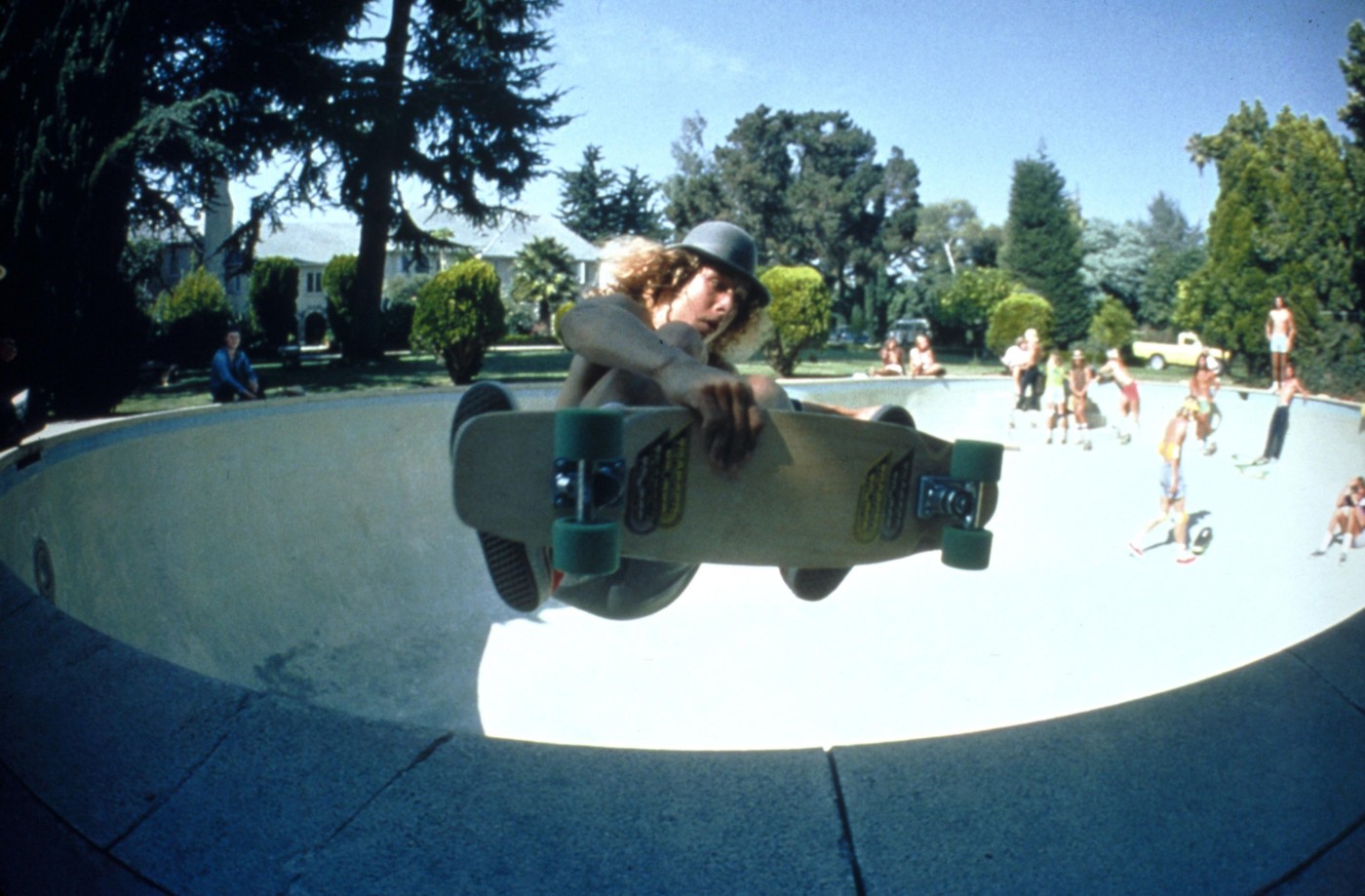
In the mid-1970’s, California was hit by a crippling drought that made it impossible to surf any kind of decent waves. The locals that lived in an area of West Los Angeles known as Dogtown always had skateboarding to fall back on when the surfing wasn’t any good. They all hung out at a local surf shop that reflected their surroundings: a rough seaside slum that fostered a proudly anti-establishment image because they all felt like outcasts. The surf shop was a place where these kids felt like they belonged.

The core group consisted of 12 kids who rejected the tried and true skating techniques of the 1960’s for a more aggressive, stylish approach inspired by the way they surfed. Amazingly, no one had thought of doing this before and it blew the world of skateboarding wide open. Dogtown and Z-Boys (2001) is a documentary that traces their origins and the rise and fall of this group, known as the Zephyr team (or Z-Boys for short), from the perspective of its members.

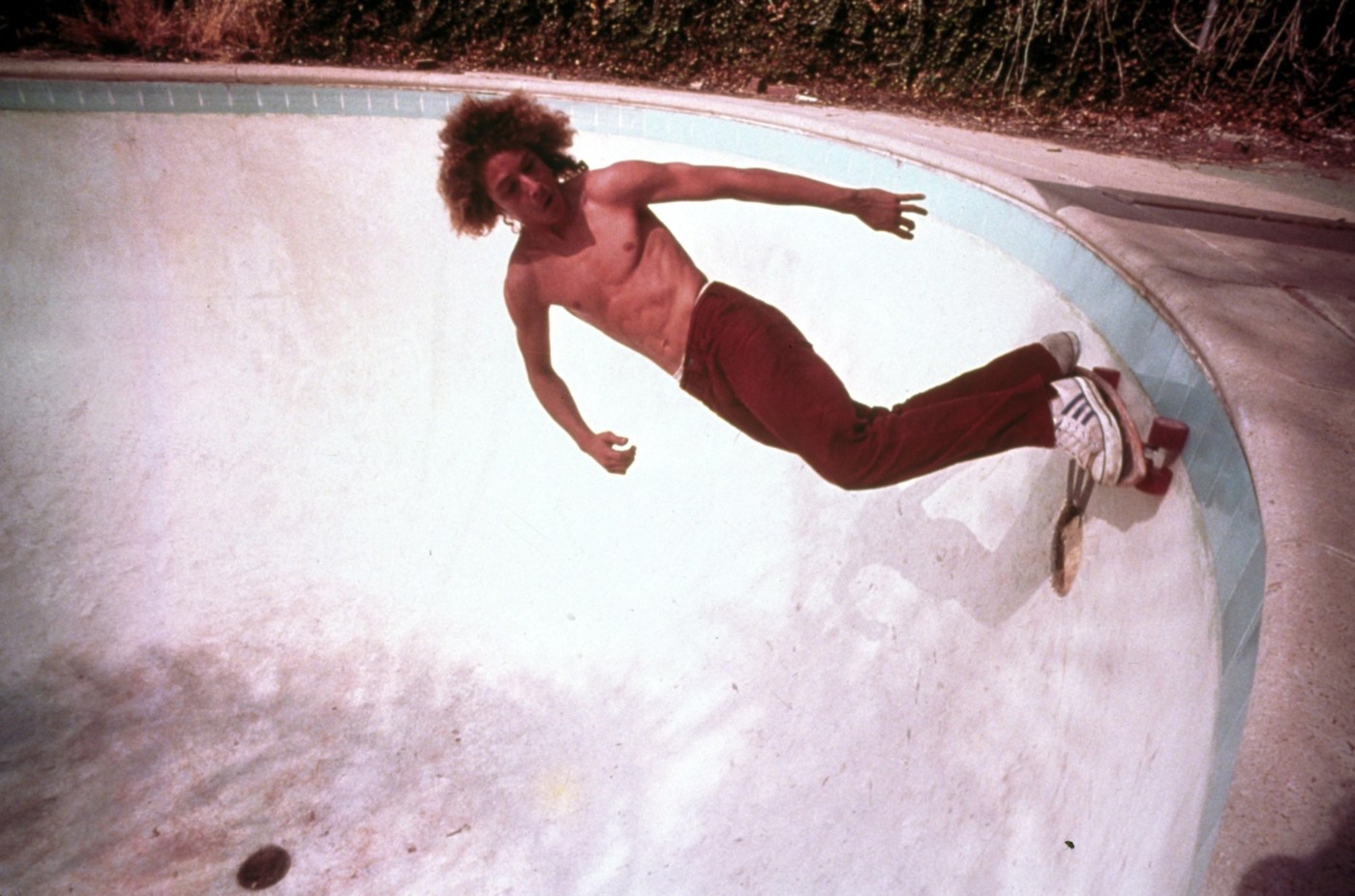
At the time, there were no skate parks so the Zephyr team had to skate in deserted schoolyards and then, once they discovered them, empty swimming pools drained by the drought. They ended up being the perfect spots for skating and ushered in the era of vertical skating thanks to the influence of surfing and the vision of one of their own, Tony Alva. The only problem with skating in background pools is that the Z-Boys weren’t supposed to be there and a session would end suddenly when the owners or the cops showed up.

Finally, skateboarding enjoyed enough of a resurgence that a national competition surfaced in Del Mar in 1975. The Z-Boys got a team together and came in with their punk rock aesthetic and blew the minds of people used to the hopelessly outdated ‘60s style. However, the downside came in the form of rich skateboard companies that broke up the Z-Boys with the lure of money and fame. Within a year, their beloved surf shop was out of business.

The documentary goes on to trace the rise of several of the Z-Boys, like Alva, Stacy Peralta and Jay Adams, into superstars. They were treated like gods in the skateboarding world and went from living on the streets to having all kinds of money, fame and women thrown at them. Some of them, such as Adams, couldn’t handle the sudden fame and fortune. It’s a shame because he was the most natural and spontaneous of the team, a brilliant “athletic stream-of-consciousness,” as one person puts it. However, Alva and Peralta were able to diversify and take control of their careers and still skate today, capitalizing on their early success.

The impetus for this documentary came from an article that appeared in Spin magazine about the Z-Boys. Within a week of it hitting newsstands, six major Hollywood studios contacted Stacy Peralta wanting to buy the life rights to their story and make it into a fictional film. Executives were able to get Tony Alva and Jay Adams on board but Peralta agreed only on the condition that he would have some input. The studio refused and he decided to do a documentary on the Z-Boys himself. Peralta was able to get Vans, a skateboarding gear manufacturer, to finance the film for $400,000 and give him complete creative control. With his connections to the scene, he was able to get access to all the key people who were around back in the day.

There is an infectious energy to this documentary that mirrors its subject. Gone are boring talking heads mixed with standard stock footage. Instead, we are presented with stills and vintage footage taken back in the day and that comes to life thanks to kinetic editing and period rock ‘n’ roll music setting just the right tone.

Like its subjects, the doc’s style lets it all hang out. For example, at one point, the film’s narrator, none other than Jeff Spicoli himself, Sean Penn, clears his throat in mid-narration. Most slick docs would have edited this out but director Stacy Peralta keeps it in. It is these little touches that make Dogtown and Z-Boys distinctive.

What also gives Dogtown and Z-Boys such authenticity is that it was made by one of their own, Peralta, and this gives the documentary unprecedented inside access that an outsider would never have. This is a fascinating look at these maverick skaters and how they influenced contemporary skateboarding that we now take for granted.

Dogtown and Z-Boys was a hugely successful documentary chronicling a group of wild skateboarders in Venice Beach, California in the ‘70s. Why dramatize an already great documentary that pretty much says it all? Naturally, Hollywood got interested and wanted to make a fictional version (because hey, no one watches docs, right?) with Fred Dirst (of Limp Bizkit fame) directing and David Fincher producing.

Fortunately, someone came to his or her senses and Dirst was out with Fincher taking over but the budget for his vision was too large. So, the studio opted for a low budget take with independent film darling Catherine Hardwicke, fresh from the success of thirteen (2003), taking over as director. In an effort to keep it real, Stacy Peralta, who made the Z-Boys doc, wrote the screenplay for Lords of Dogtown (2005) and worked closely with Hardwicke in order to remain true to what he and his friends went through all those years ago.

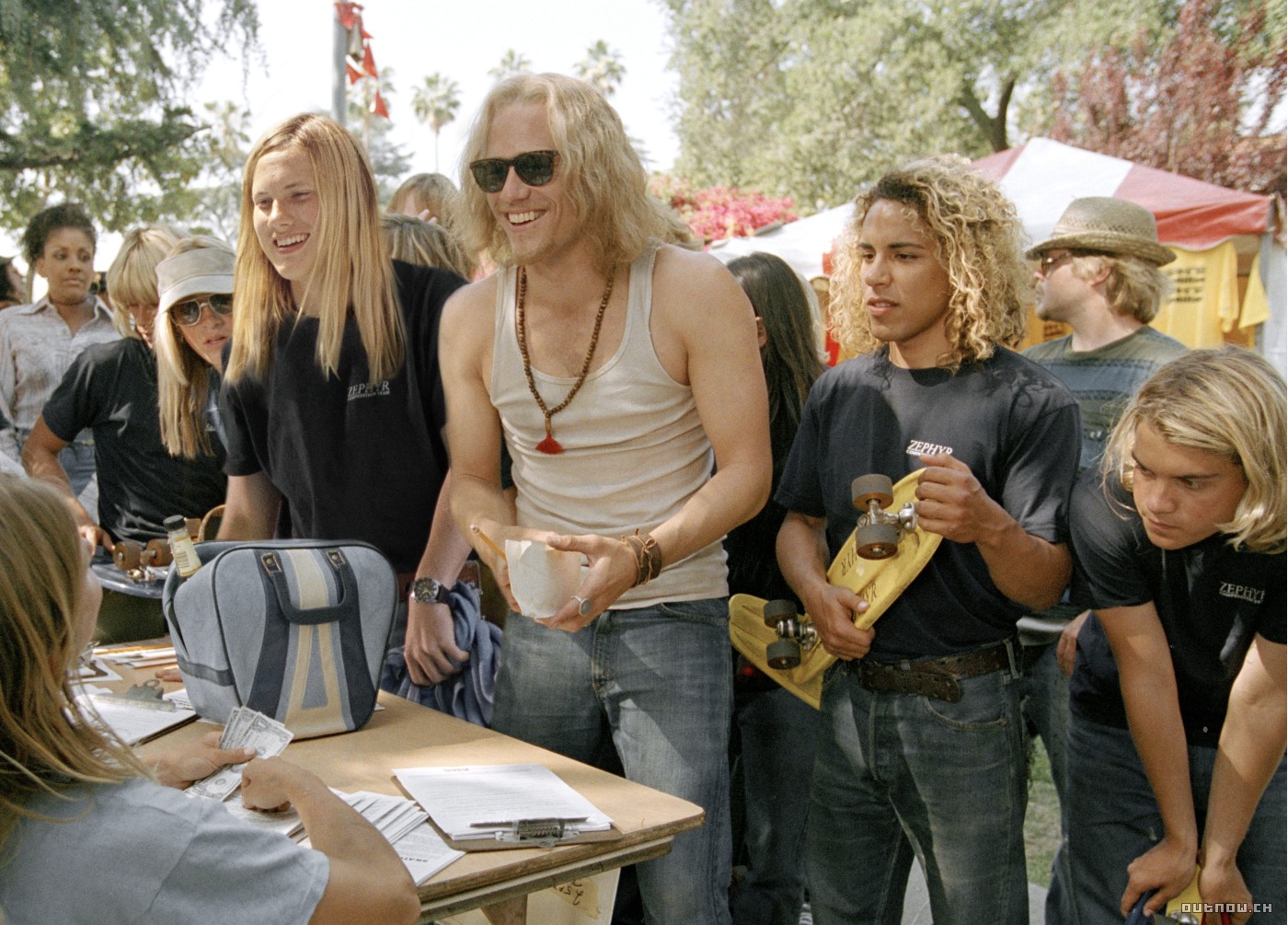
The film takes us back to the heady days of 1975 when the Venice Beach locals would surf the dangerous waters where you could easily get brained by a piece of the nearby pier. These were tough kids growing up in a tough neighborhood and out of it came a group of young surfers who adopted the same style they used to attack the waves to skate asphalt and concrete: Jay Adams (Emile Hirsch), Tony Alva (Victor Rasuk) and Stacy Peralta (John Robinson).

One of the reasons why Lords of Dogtown works so well is because of the superb casting. The actors who play the three lead Z-Boys are dead ringers for their real-life counterparts. In fact, the entire cast looks and sounds like the real people. In particular, Emile Hirsch is excellent as Jay Adams, a naturally gifted skater who comes from a troubled home. Hirsch is wonderfully cast against type as an edgy, brooding teen — it’s a world away from his naïve dreamer that he played in The Girl Next Door (2004).

Thankfully, the film’s producers didn’t raid the WB cabinet for the young cast. Instead, they got Hirsch, Rasuk (from indie fave Raising Victor Vargas) and Robinson (from Gus Van Sant’s Elephant) who have some actual acting chops but not a high enough profile so as to distract. They disappear into their roles as does, surprisingly, high profile actor Heath Ledger. He does an excellent job of becoming his character, one of the Zephyr skate shop owners who is a burnt out drunk but has vision and tries to protect his team of young skaters.

According to Peralta, he made sure to teach the actors how to “look comfortable on a board.” To this length, the actors portraying skaters underwent a three-month training course led by none other than Alva with surfing in the morning and skating in the afternoon. Of the three lead actors, only Rasuk had no board sport experience before the film. The actors not only had to learn the distinctive skating style of the ‘70s but also had to do it on vintage equipment from that era. Not surprisingly, the actors suffered all kinds of skating-related injuries during the course of training and filming but there hard work paid off as is evident from the final result.

Hardwicke adopts a down ‘n’ dirty approach to the look of her film. She uses a lot of hand-held camerawork and grainy film stock that makes you feel like someone who was there shot it. The film’s warm color scheme is filled with yellows, browns and reds for an almost sunburnt look with grey-blues for the ocean/surfing scenes. The style of the film is never gimmicky; the story dictates the style. The attention to period detail is flawless: the pool surfing, the convenience store cuisine and the music.

These kids aren’t driving around in brand new Mustangs or Woodies but beaten-up junkers as befitting their social status. The film uses period music that is typical of the era but doesn’t rely on the really popular, obvious tunes except during appropriate times like at a party where you would listen to crowd-pleasers like that and so it is justified.

The trailers for this film totally misrepresented it as an over-processed, heavily edited piece of lunchmeat. Instead, Lords of Dogtown perfectly evokes the times it depicts with unerring authenticity. It portrays skaters as they were back then — stylish and below the radar, just before the sport took off to the wildly popular institution that it is now.

Lords of Dogtown shows how fame eventually broke up the Z-Boys. It was inevitable. These kids came from nothing and were suddenly thrust into the spotlight and all kinds of money was thrown at them. Alva and Peralta became hugely popular and went corporate, constantly competing with each other while Adams stayed true to his roots and walked away from it all because he was in it for the love of skating and the thrill of the ride. This film will bring back a lot of memories for people who grew up and skated during these years, making this film more than just a simple retread of the Z-Boys documentary.

Thursday, November 4, 2010

Comic Book Confidential


Often regarded as just for kids, comic books finally gained a modicum of respectability in the mid to late 1980s with the rise in popularity of titles like Watchmen, Batman: The Dark Knight Returns and Maus to name but only a few. Harlan Ellison’s seminal essay, entitled “Did Your Mother Throw Yours Out?”, in the pages of Playboy magazine also helped wake up the mainstream to what comic book fans had known for years – that they were not strictly for juveniles and that they dared to explore complex issues, like the depiction of violence, what it means to be a hero and even using the medium to tell personal, meaningful stories. Around this time, Canadian filmmaker Ron Mann made Comic Book Confidential (1988), a primer, of sorts, for comic books, tracing their origins, documenting their near-extinction and their maturation into a viable art form.

In a nice touch that establishes the playful mood of the documentary, an illustrator does the opening credits as we watch him assemble what was the film’s poster. What better way to list all of the interview subjects than in the medium they work in? Right from the get-go, Mann establishes his unique approach. Not only does he have his subjects talk about their work but he also has them read a sampling as well. As they are doing this, he crudely animates the artwork from which they’re reading and includes sound effects and music in an attempt to free the images from the static confines of the page. It’s a ballsy technique that divided people within the comic book industry (see The Comics Journal coverage).

Mann takes us back to 1933 and the birthplace of comic books with William M. Gaines recalling his memories of the medium’s first baby steps. We meet groundbreaking pioneers like Jack Kirby and Will Eisner who helped create the grammar of comic books and gave birth to iconic characters like Captain America and The Spirit. Ever the eloquent elder statesman, Eisner talks about what the medium did for him: “I was a frustrated writer, frustrated painter. Here, for the first time was this marvelous opportunity that happens to any creative man once in a lifetime. Suddenly there appears a medium, a receptacle, that can take your ineptitudes in both fields, put them together and come out with an eptitude.” It says something when Eisner, reading over moving panels of The Spirit, complete with sound effects, is more effective in conveying the comic book than the entirety of the recent, big-budget live-action film by Frank Miller.

The 1950s saw the rise in horror comics like Tales from the Crypt, The Haunt of Fear, The Vault of Horror and so on. Gaines talks about his run-ins with censorship thanks to conservative watchdogs like Dr. Fredric Wertham who led the charge to have them cleaned up. Mann includes hilarious vintage footage warning people of the dangerous effects of comic books. Publishers decided to self-censor and created the Comics Code, which drove the horror comic books underground. This led to a return of superhero comic books in the 1960s with the rise of Marvel Comics and Stan Lee’s incredible stable of titles: The Fantastic Four, The Incredible Hulk, The Amazing Spider-Man, and many others.

On the flipside, underground comic books that reflected the thriving counterculture at the time began to emerge with Robert Crumb’s Fritz the Cat, Spain Rodriguez’s Trashman and Gilbert Shelton’s The Fabulous Furry Freak Brothers. This portion of the documentary is fascinating as this period of comics isn’t talked about much anymore but these titles really reflected their times and paved the way for the rise of the independents in the ’80s. The cautionary tale that comes out of this time is when Dan O’Neill took on Disney with The Air Pirates, which dared to satire Mickey Mouse. He was sued for his troubles and taken to the cleaners.

Mann also takes a look at an often overlooked aspect: female comic book creators and interviews Shary Flenniken, Lynda Barry and Sue Coe who weren’t afraid to address controversial subject matter in the 1970s, like capital punishment or honest examinations of relationships between men and women or addressing girls coming of age. Women seem to still get short-changed in this medium and it would be great to see a documentary dedicated exclusive to their work, expanding on what was started in Comic Book Confidential.

Mann takes a look at the rise of indie comic book companies and artists that were interested in documenting their own lives, like Harvey Pekar with American Splendor or that of marginalized cultures like Jaime Hernandez with Love and Rockets. These titles are more authentic, slice-of-life stories with rich characters that eschew the endlessly formulaic costumed superhero genre. In the ‘80s, Art Spiegelman strove to have comics regarded as legit art with a European or even avant-garde sensibility. His magazine Raw really pushed the envelope and wasn’t afraid to experiment with how it was presented, not just visually, but in terms of texture (type of paper used, etc.) as well.

One of my favorite subjects comes from this period – Charles Burns who does the kind of stories and art that evokes David Lynch if he decided to work in comic books instead of film. Burns reads from one of his stories where a kid confronts horror under the façade of suburbia. Frank Miller comes in near the end and talks about how he made superheroes relevant again by radically reinventing Batman by returning the character to his darker, more ruthless roots but with a contemporary spin that reflected ‘80s America.

The idea for Comic Book Confidential came in 1985 when Ron Mann’s friend b.p. nichol got him into comic books and he subsequently attended a major comic book convention in San Diego. Mark Askwith, who had worked at Coach House Press, a previous subject of a Mann documentary, pitched the idea of a documentary to Mann who was interested. Originally, it was a love letter of sorts to Marvel Comics but Askwith felt that Mann would be drawn to underground comic book artists as well and with nichols help, the documentary began to take shape. Mann actually started work on it while making an electronic press kit for the Ivan Reitman comedy Legal Eagles (1986). He secretly used the studio’s resources, including their crew, money and film stock to interview the likes of Will Eisner and Jack Kirby during his off hours.

Mann also interviewed a wide range of subjects that never made the final cut, including musician Frank Zappa and important figures in comic books like Carl Banks, Julie Schwartz, and Trina Robbins. Mann was very protective of his subjects and recalled the difficulty he had interviewing legendary comic book artist Jack Kirby in his twilight years and whose memory was very slow: “As I was leaving Jack Kirby’s house, I rolled down the window of my car and unspooled and exposed the film and threw it out on the highway because I didn’t want anybody to see it – because I didn’t want anyone to see Jack Kirby that way … I went back three or four times, just to get a section of Jack Kirby where it was coherent.”

Comic Book Confidential received mostly positive notices from mainstream critics. In his review for the Globe and Mail, Jay Scott found the film, “culturally energizing, the cinematic equivalent of listening to one of the ‘bad girl’ groups of the early sixties – when you realize that so much irreverent satire, straightforward iconoclasm and downright subversion is being absorbed by impressionable minds, it gives you hope for the future.” The Washington Post’s Desson Howe wrote, “there’s a whole world out there Mann has identified well. He’s also done what the good comic strip aims to – keep you absorbed from first frame to last.” However, comic book writer Neil Gaiman felt that “as an attempt to explain why comics are maturing, or even as a snappy overview of the current state of the medium, the film is trivial, weak and misguided.”

Not content with showing a series of talking heads, Mann pushed the envelope with Comic Book Confidential by presenting his subject matter in a dynamic way that no one had thought to do before – or often, since – but perfectly suited the material. The documentary features a healthy cross-section of people in the medium, from pioneers like Will Eisner and William M. Gaines, to underground provocateurs like Robert Crumb and the new wave (at the time) of independents like Charles Burns. The problem with a documentary like this is that you can criticize it for all the subjects it doesn’t interview, important figures like Alan Moore and Neal Adams, but you can only squeeze so many into one film and I think that Mann does an admirable job with the people he does include. Let’s not forget, Comic Book Confidential is not meant to be the definitive word on the medium but merely a primer, a jumping off point for one to become familiar with the major figures and the important movements.

Thanks to the success of Mann’s film, Mark Askwith went on to create Prisoners of Gravity, a half-hour weekly television program dedicated to science fiction, fantasy and comic books with every episode devoted to a particular theme. It first aired in 1989 on TVOntario, a Canadian public television station, where it ran for five seasons and 137 episodes before being canceled in 1994. Mann has gone on to create a series of idiosyncratic documentaries about a wide range of subjects (the Twist dance craze, marijuana, and custom car artist Ed “Big Daddy” Roth) and continuing to push the envelope in terms of style and presentation.


SOURCES

Johnson, Paddy. "Art Fag City: The Return of Comic Book Confidential." The Reeler. October 25, 2006.

Mietkewicz, Henry. "High-Spirited Documentary Celebrates Comic Book Culture." Toronto Star. September 9, 1988.

Monday, February 1, 2010

The Endless Summer

The Endless Summer (1966) is considered by many surfers and surfing aficionados to be the Citizen Kane (1941) of surfing films. While it certainly wasn’t the first, for its time Bruce Brown’s film was the most ambitious, well-made and popular one of its kind. The Endless Summer not only changed the general public’s view of surfing but it also paved the way for countless films about the sport. However, none of them have quite been able to convey the carefree attitude and sheer joy of surfing like Brown’s film – not even his own sequel, The Endless Summer II (1994) or the film by his son Dana entitled, Step Into Liquid (2003).

The first shot of The Endless Summer says it all: the silhouette of two surfers with their boards against a setting sun. Brown follows this up with a shot of the surfers sitting on their boards in the ocean drenched in the orangish gold of the setting sun. Right from the get-go, with these shots and a montage of the ocean and the surf all bathed in this incredible sun, Brown establishes that this film will be an unabashed romantic take on surfing. Even the laid-back surf music by The Sandals conveys a hazy, lazy summer vibe drenched in romanticism. The film’s authenticity is quickly established with a title card that reads, “Filmed in the actual locations around the world.” In other words, there will be no use of cheesy looking rear projection a la Gidget (1959) or the Frankie and Annette beach movies. The Endless Summer is a film made by and for surfers.

Brown’s voiceover narration starts off perfectly as he says, “Summer means many different things to different people...” and rattles off a few hobbies that people like to do before yelping out the word, “surfing” excitedly and the film cuts to a shot of a guy wiping out on a wave. Brown quickly establishes a playful tone that never mocks its subject but instead conveys a genuine affection for the sport. In a few minutes, he covers a few styles of surfing while also conveying some of the basic lingo while identifying a few of its superstars. Brown does this all so effortlessly that you aren’t even aware of it because you’re too busy being entertained.

The Endless Summer takes us through some choice surfing spots in Hawaii and California and pretty soon Brown lays out his film’s premise: “Many surfers ride summer and winter but the ultimate thing for most of us would be to have an endless summer. The warm water and waves without the summer crowds of California. The only way to do this is by traveling around the world following the summer season as it moves around the world.” And so, the film documents two surfers from California – Robert August and Mike Hynson – who do just that. Brown introduces them in rather cheeky fashion as they read up for their first destination, Africa. August is shown reading a book entitled, Shark Attack: Field Dressings Illustrated, while Hynson is reading a Malaria manual. These books are obviously mock-ups done for comic effect.

August and Hynson arrive in Dakar, Senegal where Brown gripes about the $30/day each room rate (?!) at the government-sanctioned hotel that they’re forced to stay at. Fortunately, they find some tasty waves and there is a funny bit as August and Hynson try to explain to a taxi cab driver how to store their surfboards in his car. Many of the natives had never seen surfing before and the two young surfers were breaking new ground. Brown’s narration manages to be simultaneously informative and entertaining. For example, he points out how you could die in 15 minutes after stepping on a Stone Fish. He tempers this with shots of beautiful scenery, like a spectacular view of Cape Town from atop Cable Mountain. August and Hynson meet up with local surfers in Cape Town and travel along the Cape Peninsula.

One of things that strikes you about Brown’s voiceover narration is his way with words, like when he talks about a California surfing spot known as the Wedge: “Few people ride belly boards at the Wedge. Body surfing is bad enough because when you get wiped out it feels like your arms, legs and head are all going different directions. Add a belly board to that mess and it’s like an extra piece of shrapnel in a hand grenade.” As you would expect, there are lots of great slow motion shots of surfers catching fantastic rides on some really beautiful waves. Back in Africa, the guys meet some colorful characters, like a man named Terrence who catches animals for zoos and milks snakes for their venom. He is willing to drive hundreds of miles out of his way to take the two surfers to a sweet location for surfing.

Next, August and Hynson go to Australia where we see the locals riding catamarans and Brown gets some breathtaking point-of-view shots of what it’s like to sail one. They pet kangaroos in Perth and search for waves all over Western Australia but to no avail so they go to Bells Beach near Melbourne and find out that the surfing is better during the winter season. The guys go fishing in New Zealand and surfing in Ragland on the west coast, enjoying extremely long rides.

Bruce Brown started surfing in the 1950s. He took still photographs to show his mother what the draw of the sport was. While serving in the United States Navy on Oahu years later, he used an 8 mm movie camera to photograph surfers from California. Once Brown got back there, he edited his footage into an hour-long film. Surfer Dale Velzy showed it at his San Clemente shop, charging 25 cents for admission. He bought Brown a 16 mm camera and together they raised $5,000 to make Slippery When Wet (1958), Brown’s first “real” surf film.
In the winter of 1958, Brown went back to Hawaii to film the North Shore’s big surf. On the plane ride over, the novice filmmaker read a book about how to make movies. Brown said, “I never had formal training in filmmaking and that probably worked to my advantage.” By 1962, he had spent five years making one surf film per year. He would shoot during the fall and winter, edit during the spring and show the finished product during the summer. Brown remembered, “I felt if I could take two years to make a film, maybe I could make something special.” To do this, he would need a bigger budget then he had on his previous films. To raise the $50,000 budget he needed, Brown took the best footage from his four previous films and made Water-Logged (1962).

While editing The Endless Summer, Brown was contacted by the band The Sandals who were hoping to sell one of their songs to him for use in the film. He was so impressed by their music that he wanted to use several of their songs. The group even toured with Brown and his film, providing live backing for his live narration. Not surprisingly, The Endless Summer was a big hit on the local west coast surfing circuit where it debuted at the Santa Monica Civic Auditorium during the summer of 1964 and played to sold-out crowds for a week. Paul Allen, the man responsible for arranging shows and coordinating publicity, thought that they could attract a national distributor. Brown took The Endless Summer to several Hollywood studio distributors but was rejected because they didn’t think it would have mainstream appeal. So, he took the film to where he felt would be the toughest proving ground: Wichita, Kansas in January. Moviegoers lined up in snowy weather in the middle of winter where the film went on to sell out its entire two-week run. Distributors still weren’t convinced and so Brown rented out the Kuyps Bay Theatre in New York City where his film ran successfully for a year. The Endless Summer was finally released nationally in 1966 where it proved to be a big hit both commercially and critically.

The Endless Summer faced with an uphill battle in the theater of public opinion. At the time, the national media regarded surfers as “beach bums” that were “anti-social” and “drug-induced.” Even one of the most influential magazines in helping shape public opinion in the 1960s, Time, jumped on the bandwagon with a January 1964 feature article entitled, “Shooting the Tube,” that linked surfing with drugs. To whit, “riding a board through the surf is a little like going on hashish.” Once middle America read these words, their mind was made up about surfing culture. However, Brown’s film changed all of this with its fun, positive image of surfing and surfers. August and Hynson weren’t hurting anyone or anything. They were just looking for the perfect wave.

The Endless Summer was well-received by critics of the day. Time magazine wrote, “Brown leaves analysis of the surf-cult mystique to seagoing sociologists, but demonstrates quite spiritedly that some of the brave souls mistaken for beachniks are, in fact, converts to a difficult, dangerous and dazzling sport.” Roger Ebert praised the film’s “beautiful photography” and compared it to Hollywood’s attempts at depict surfing culture when he wrote, “[it] almost makes you wonder if Hollywood hasn’t been trying too hard.” In his review for The New York Times, Robert Alden wrote, “the subject matter itself – the challenge and the joy of a sport that is part swimming, part skiing, part sky-diving and part Russian roulette – is buoyant fun.” Brown was pleasantly surprised by the critical reaction to his film: “For some reason the real entrenched film critics seemed to like it, maybe because it was different from what they were used to seeing.” The Endless Summer went on to gross more than $30 million. Not bad for a film that cost only $50,000 to make.

There is a wandering spirit, a searching for the perfect wave all over the world that makes The Endless Summer so enjoyable to watch. This isn’t just a series of montages of people surfing wave after wave. Brown has actually crafted a narrative that is part travelogue as he gives us a taste of exotic cultures all over the world. He also managed to craft a surfing film that is easily understood and can be enjoyed by the uninitiated while still having plenty of stuff for the seasoned surfer to enjoy which probably explains part of the film’s enduring appeal. The Endless Summer went on to launch and influence a whole cottage industry of surfing films, many of which did not impress Brown all that much who felt that they were “all bang-bang-bang, it’s all industrial. It’s all quick cuts and loud music.”