"...the main purpose of criticism...is not to make its readers agree, nice as that is, but to make them, by whatever orthodox or unorthodox method, think." - John Simon

"The great enemy of clear language is insincerity." - George Orwell

Thursday, November 4, 2010

Comic Book Confidential


Often regarded as just for kids, comic books finally gained a modicum of respectability in the mid to late 1980s with the rise in popularity of titles like Watchmen, Batman: The Dark Knight Returns and Maus to name but only a few. Harlan Ellison’s seminal essay, entitled “Did Your Mother Throw Yours Out?”, in the pages of Playboy magazine also helped wake up the mainstream to what comic book fans had known for years – that they were not strictly for juveniles and that they dared to explore complex issues, like the depiction of violence, what it means to be a hero and even using the medium to tell personal, meaningful stories. Around this time, Canadian filmmaker Ron Mann made Comic Book Confidential (1988), a primer, of sorts, for comic books, tracing their origins, documenting their near-extinction and their maturation into a viable art form.

In a nice touch that establishes the playful mood of the documentary, an illustrator does the opening credits as we watch him assemble what was the film’s poster. What better way to list all of the interview subjects than in the medium they work in? Right from the get-go, Mann establishes his unique approach. Not only does he have his subjects talk about their work but he also has them read a sampling as well. As they are doing this, he crudely animates the artwork from which they’re reading and includes sound effects and music in an attempt to free the images from the static confines of the page. It’s a ballsy technique that divided people within the comic book industry (see The Comics Journal coverage).

Mann takes us back to 1933 and the birthplace of comic books with William M. Gaines recalling his memories of the medium’s first baby steps. We meet groundbreaking pioneers like Jack Kirby and Will Eisner who helped create the grammar of comic books and gave birth to iconic characters like Captain America and The Spirit. Ever the eloquent elder statesman, Eisner talks about what the medium did for him: “I was a frustrated writer, frustrated painter. Here, for the first time was this marvelous opportunity that happens to any creative man once in a lifetime. Suddenly there appears a medium, a receptacle, that can take your ineptitudes in both fields, put them together and come out with an eptitude.” It says something when Eisner, reading over moving panels of The Spirit, complete with sound effects, is more effective in conveying the comic book than the entirety of the recent, big-budget live-action film by Frank Miller.

The 1950s saw the rise in horror comics like Tales from the Crypt, The Haunt of Fear, The Vault of Horror and so on. Gaines talks about his run-ins with censorship thanks to conservative watchdogs like Dr. Fredric Wertham who led the charge to have them cleaned up. Mann includes hilarious vintage footage warning people of the dangerous effects of comic books. Publishers decided to self-censor and created the Comics Code, which drove the horror comic books underground. This led to a return of superhero comic books in the 1960s with the rise of Marvel Comics and Stan Lee’s incredible stable of titles: The Fantastic Four, The Incredible Hulk, The Amazing Spider-Man, and many others.

On the flipside, underground comic books that reflected the thriving counterculture at the time began to emerge with Robert Crumb’s Fritz the Cat, Spain Rodriguez’s Trashman and Gilbert Shelton’s The Fabulous Furry Freak Brothers. This portion of the documentary is fascinating as this period of comics isn’t talked about much anymore but these titles really reflected their times and paved the way for the rise of the independents in the ’80s. The cautionary tale that comes out of this time is when Dan O’Neill took on Disney with The Air Pirates, which dared to satire Mickey Mouse. He was sued for his troubles and taken to the cleaners.

Mann also takes a look at an often overlooked aspect: female comic book creators and interviews Shary Flenniken, Lynda Barry and Sue Coe who weren’t afraid to address controversial subject matter in the 1970s, like capital punishment or honest examinations of relationships between men and women or addressing girls coming of age. Women seem to still get short-changed in this medium and it would be great to see a documentary dedicated exclusive to their work, expanding on what was started in Comic Book Confidential.

Mann takes a look at the rise of indie comic book companies and artists that were interested in documenting their own lives, like Harvey Pekar with American Splendor or that of marginalized cultures like Jaime Hernandez with Love and Rockets. These titles are more authentic, slice-of-life stories with rich characters that eschew the endlessly formulaic costumed superhero genre. In the ‘80s, Art Spiegelman strove to have comics regarded as legit art with a European or even avant-garde sensibility. His magazine Raw really pushed the envelope and wasn’t afraid to experiment with how it was presented, not just visually, but in terms of texture (type of paper used, etc.) as well.

One of my favorite subjects comes from this period – Charles Burns who does the kind of stories and art that evokes David Lynch if he decided to work in comic books instead of film. Burns reads from one of his stories where a kid confronts horror under the façade of suburbia. Frank Miller comes in near the end and talks about how he made superheroes relevant again by radically reinventing Batman by returning the character to his darker, more ruthless roots but with a contemporary spin that reflected ‘80s America.

The idea for Comic Book Confidential came in 1985 when Ron Mann’s friend b.p. nichol got him into comic books and he subsequently attended a major comic book convention in San Diego. Mark Askwith, who had worked at Coach House Press, a previous subject of a Mann documentary, pitched the idea of a documentary to Mann who was interested. Originally, it was a love letter of sorts to Marvel Comics but Askwith felt that Mann would be drawn to underground comic book artists as well and with nichols help, the documentary began to take shape. Mann actually started work on it while making an electronic press kit for the Ivan Reitman comedy Legal Eagles (1986). He secretly used the studio’s resources, including their crew, money and film stock to interview the likes of Will Eisner and Jack Kirby during his off hours.

Mann also interviewed a wide range of subjects that never made the final cut, including musician Frank Zappa and important figures in comic books like Carl Banks, Julie Schwartz, and Trina Robbins. Mann was very protective of his subjects and recalled the difficulty he had interviewing legendary comic book artist Jack Kirby in his twilight years and whose memory was very slow: “As I was leaving Jack Kirby’s house, I rolled down the window of my car and unspooled and exposed the film and threw it out on the highway because I didn’t want anybody to see it – because I didn’t want anyone to see Jack Kirby that way … I went back three or four times, just to get a section of Jack Kirby where it was coherent.”

Comic Book Confidential received mostly positive notices from mainstream critics. In his review for the Globe and Mail, Jay Scott found the film, “culturally energizing, the cinematic equivalent of listening to one of the ‘bad girl’ groups of the early sixties – when you realize that so much irreverent satire, straightforward iconoclasm and downright subversion is being absorbed by impressionable minds, it gives you hope for the future.” The Washington Post’s Desson Howe wrote, “there’s a whole world out there Mann has identified well. He’s also done what the good comic strip aims to – keep you absorbed from first frame to last.” However, comic book writer Neil Gaiman felt that “as an attempt to explain why comics are maturing, or even as a snappy overview of the current state of the medium, the film is trivial, weak and misguided.”

Not content with showing a series of talking heads, Mann pushed the envelope with Comic Book Confidential by presenting his subject matter in a dynamic way that no one had thought to do before – or often, since – but perfectly suited the material. The documentary features a healthy cross-section of people in the medium, from pioneers like Will Eisner and William M. Gaines, to underground provocateurs like Robert Crumb and the new wave (at the time) of independents like Charles Burns. The problem with a documentary like this is that you can criticize it for all the subjects it doesn’t interview, important figures like Alan Moore and Neal Adams, but you can only squeeze so many into one film and I think that Mann does an admirable job with the people he does include. Let’s not forget, Comic Book Confidential is not meant to be the definitive word on the medium but merely a primer, a jumping off point for one to become familiar with the major figures and the important movements.

Thanks to the success of Mann’s film, Mark Askwith went on to create Prisoners of Gravity, a half-hour weekly television program dedicated to science fiction, fantasy and comic books with every episode devoted to a particular theme. It first aired in 1989 on TVOntario, a Canadian public television station, where it ran for five seasons and 137 episodes before being canceled in 1994. Mann has gone on to create a series of idiosyncratic documentaries about a wide range of subjects (the Twist dance craze, marijuana, and custom car artist Ed “Big Daddy” Roth) and continuing to push the envelope in terms of style and presentation.


SOURCES

Johnson, Paddy. "Art Fag City: The Return of Comic Book Confidential." The Reeler. October 25, 2006.

Mietkewicz, Henry. "High-Spirited Documentary Celebrates Comic Book Culture." Toronto Star. September 9, 1988.

Tuesday, November 2, 2010

DVD of the Week: Paths of Glory: Criterion Collection

The subject of war was one that fascinated Stanley Kubrick for much of his career. His first film, Fear and Desire (1953), was an allegorical war picture and with Dr. Strangelove (1964), he made a scathingly satirical anti-war film. Full Metal Jacket (1987) depicted war as a waking nightmare bordering on madness. It could be argued that Paths of Glory (1957) is his most straightforward take on warfare but this doesn’t make it lesser than any of Kubrick’s other war films. Much like Full Metal Jacket, Paths of Glory presents combat in the battlefield as dirty, noisy and chaotic – in other words, dehumanizing. Whereas Full Metal Jacket depicted the prelude to war and then actual warfare, Paths of Glory’s focus is primarily on warfare and then its aftermath, shown with unflinching honesty. Made early in his career, this film established Kubrick as a cinematic force to be reckoned with – a self-taught filmmaker who would go on to re-define every genre he tried his hand at.


It is France, 1916 and the country is mired in World War I against Germany. It is literally a series of battles for inches with each side trying to get every bit of real estate that it can. Two French generals (Adolphe Menjou and George Macready) debate about taking a piece of land known as the Anthill. The one wants the other’s soldiers to take it in an unrealistic amount of time but is convinced to do so anyway. Kubrick soon immerses us in the trenches and we see the appalling living conditions – mud, cramped quarters and the sounds of gunfire and bombs all around. We see the wounded and even one soldier suffering from shellshock.

The soldiers, led by Colonel Dax (Kirk Douglas), are given a suicide mission: take the Anthill with no support and with severely depleted numbers with conservative losses estimated at half their forces in the ensuing battle. Kubrick’s depiction of the battleground itself is that of a desolate area of dirt decorated with large craters created by bombing. Wreckage and dead bodies litter the landscape. The battle sequence where Dax and his men attempt to take the Anthill is as harrowing and realistic as the D-Day sequence in Saving Private Ryan (1998) only with less money and many years before. Three soldiers (Ralph Meeker, Timothy Carey and Joseph Turkel) are selected from the battalion that failed to take the hill, put on trial for cowardice and sentenced to be executed by a firing squad. In the hearing, Dax defends the men against the pompous General Mireau (Macready).

Kubrick does a fantastic job showing the vast disconnect between the generals and the soldiers in the trenches. It becomes readily apparent that the military leaders have no idea what is going on in the battlefield and expect the impossible from their soldiers. The director has crafted a fascinating anti-war film with a trademark intense performance from Kirk Douglas. This is an angry film that rails against the hubris and arrogance of military leadership and how disposable the average foot soldier is in their eyes. It is a theme that is sadly relevant today. Paths of Glory juxtaposes the brutality of war with the farce that is the subsequent court case with Dax as the lone voice of reason in an unfair world. Kubrick is often described as a cold and calculating filmmaker but what stands out in this film is the humanity of the three soldiers doomed to be executed for completely arbitrary reasons. Kubrick ends the film on an emotional and poignant moment that is incredibly moving and lingers long after the end credits.

Special Features:

There is an audio commentary by film critic Gary Giddins, author of Warning Shadows: Home Alone with Classic Cinema. He points out that Kirk Douglas was at the peak of his popularity and he was responsible for getting Paths of Glory made. Giddins balances analysis with production information while also pointing out brief biographical details on key cast and crew members. He touches upon the differences between the source novel and the film. Giddins delivers an eloquent and informative track.

There is a brief audio interview conducted with Stanley Kubrick from 1966 about the origins of the film.

Also included is a television interview with Kirk Douglas on the popular British talk show Parkinson in February 1979. The actor speaks with his usual candor and enthusiasm, proving to be quite a lively subject. He talks about his career and, of course, Paths of Glory.

There is an interview with producer James B. Harris and he talks about the film and working with Kubrick. He also speaks about how the film came together, done independently and then presented to a studio to back financially. Harris provides fascinating detail on the genesis of the film as well as various other aspects of production.

Also included is an interview with Kubrick’s wife, Christiane. She talks about how meeting Kubrick for the first time and being cast in the film. She actually picked the song she sung in the film. Christiane offers her impressions on her husband’s directing style.

There is an interview with Kubrick’s long-time executive producer Jan Harlan. He talks about the themes in Paths of Glory and in Kubrick’s films in general.

Also included is an excerpt from a French news program about World War I French soldier Theophile Maupas whose tragic story partly inspired Kubrick’s film.

Finally, there is a theatrical trailer.


Friday, October 29, 2010

Twin Peaks: Fire Walk With Me

BLOGGER'S NOTE: I actually wrote two different versions of this article but wasn't happy with either one and decided to merge the two to something approximating what I wanted to convey.


The year is 1992 and David Lynch has just come off of, arguably, two of the most successful years in his career. Twin Peaks was a critics darling, revered as one of the most groundbreaking television shows in recent memory. Concurrently, Wild at Heart (1990) received the coveted Palme D'Or at the Cannes Film Festival. Then, things started to go wrong. ABC canceled the show after the ratings sharply declined in the second season after the murder of Laura Palmer was solved. Two other shows that Lynch worked on, American Chronicles and On the Air did not even last a full season. The proverbial icing on this rancid cake was the film, Twin Peaks: Fire Walk With Me (1992), which debuted at Cannes Film Festival in 1992 to a hostile reaction from the audience and received an unholy critical ass-kicking. It went on to commercial and critical failure in the United States. How did Lynch go from media darling to media pariah with overwhelming negative reaction towards Fire Walk With Me from even fans of the show?


Lynch ended the T.V. show with multiple cliff hangers – most significantly, Agent Dale Cooper (Kyle MacLachlan) was possessed by the evil spirit, BOB (Frank Silva), while his good self was trapped in a supernatural realm known as the Black Lodge. Instead of resolving this storyline (and many others), Lynch decided to make a prequel to the series. The filmmaker remembers, "At the end of the series, I felt sad. I couldn't get myself to leave the world of Twin Peaks. I was in love with the character of Laura Palmer and her contradictions: radiant on the surface but dying inside. I wanted to see her live, move and talk." Fire Walk With Me focuses on the murder investigation of Teresa Banks (Pamela Gidley), who was killer BOB's first victim, and with the emphasis on the last seven days of Laura's life.


The 1990s have become known as the age of irony for the horror genre. Self-reflexive humor, as epitomized by the Scream trilogy, replaced formulaic slasher franchises like Friday the 13th and A Nightmare on Elm Street during the 1980s. One of the few films that went against this trend was Fire Walk With Me. Lynch’s film is not usually regarded as a horror film per se, but if looked at closely, does contain many conventions of the genre (i.e. the final girl against the malevolent monster). However, the veteran filmmaker pushes these rules as far as they can possibly be stretched. Film critic Kim Newman observed in his review for Sight and Sound magazine that Lynch’s movie “demonstrates just how tidy, conventional and domesticated the generic horror movie of the 1980s and 1990s has become.”


Right from the opening credits, Lynch establishes that this film will not be like the T.V. series and also it’s horror genre credentials. A television is set to an abstract, white noise image with ominous sounding music provided by Angelo Badalamenti playing over the soundtrack. An axe comes crashing through the T.V. followed immediately by a woman’s piercing scream. This opening sequence establishes the dark, foreboding mood that will permeate the entire film. This also feels like Lynch's statement on the unfair cancellation of his show. It is easy to see why Fire Walk With Me was a shock to some fans of the show. The first third of the film sets up a sharp contrast to the series.


Like the beginning of Mario Bava’s Bay of Blood (1971), the events of Fire Walk With Me are set in motion by the murder of a woman. Lynch also presents an inhospitable world: FBI agents Chet Desmond (Chris Isaak) and Sam Stanley (Kiefer Sutherland) encounter resistance at every step of their investigation. They are given a cryptic briefing by their superior Gordon Cole (David Lynch); they are forced to deal with a belligerent local sheriff and his deputy (when they ask for the dead girl’s ring, the sheriff replies, “We’ve got a phone. It has a little ring.”); and the locals offer little help (“I don’t know shit from shinola!” says a man at the local diner). By and large, the detectives are unable to figure out the identity of the killer. This is certainly a far cry from the upstanding Sheriff Truman (Michael Ontkean) and the friendly townsfolk of Twin Peaks.


One of the criticisms leveled at Fire Walk With Me was the lack of humor. However, the first third of the film is one of the best examples of Lynch's wry, absurdist comedic sensibilities. The first appearance of Agent Desmond has him and several other agents busting a school bus full of crying kids. It is a classic, surreal Lynchian image. Other examples of his dry sense of humor are Sam's estimation of how much the sheriff's office furniture is worth and how Desmond deals with the belligerent deputy. It is not what they say rather how they say it that makes these moments funny.


Donna: Do you think if you were falling in space that you'd slow down after a while, or go faster and faster?


Laura: Faster and faster, and for a long time you wouldn't feel anything, then you'd burst into fire, forever. And the angels wouldn't help you because they've all gone away.


Once the film goes back to Twin Peaks, the mood becomes noticeably darker and foreboding as the last week of Laura's life plays out. Lynch shows an unflinching depiction of a young woman consumed by drugs, sex and, most harrowingly and disturbing of all, a victim of incest by her father, Leland (Ray Wise) under the guise of being possessed by a malevolent supernatural force known only as BOB.


Twin Peaks is a particularly atmospheric setting with indications that something ominous lurks out in the woods. Laura not only meets her demise among the trees but a grove of trees also serves as an entry point into an otherworldly dimension where the killer resides. The film's most impressive, show-stopping sequence is Laura and Donna's (Moira Kelly) trip to a Canadian roadhouse with two men. This sequence is an intense audio-visual assault on the senses. The entire frame is saturated by a hellish red color scheme, punctuated by a pulsating white strobe light. Over the soundtrack is a deafening bass-heavy song with a rockabilly guitar twang cranked up so loud that the characters have to yell over top of it. This powerful audio-visual combination fully immerses the viewer in an unpredictable setting that echoes the scene at Ben's in Blue Velvet (1986) and the introduction of Bobby Peru in Wild at Heart.


Laura Palmer is the final girl archetype but deeply flawed. She is arguably one of Lynch’s most complex and fully realized characterizations. She immerses herself in all of these vices, which distracts from the painful incestuous relationship with her father and BOB’s desire to possess her. The push and pull of these opposing forces are too much for her and this only increases her self-destructive impulses. Sheryl Lee does an incredible job conveying Laura’s overwhelming sadness at the realization that the sweet girl she once was is rapidly disappearing and try as she might there is nothing she can do to stop it. Lee is able to show the different sides of her character. There is the confident, aggressive side that picks up strangers and has sex with them. There is the scared little girl that is dominated by her father. And there is the sweet high school girl whose reserves of inner strength — that she uses to fight off BOB — are gradually being depleted. It is an intricate portrayal that requires Lee to display a staggering range of emotion.


BOB is ostensibly the monster of the film. With his disheveled, unshaven look of a dirty drifter, he is the evil side of Leland and a frightening metaphor for the incestuous relationship between father and daughter. BOB is a demon of some sort, a serial killer who delights in taking on hosts, such as Leland, and using them as instruments of evil and to indulge in his depraved appetites. Kim Newman observed that, “In the monster father figure of Leland/BOB, Lynch has a bogeyman who puts Craven’s Freddy Krueger to shame by bringing into the open incest, abuse and brutality which the Elm Street movies conceal behind MTV surrealism and flip wisecracks.”


There are some truly frightening and unsettling set pieces in Fire Walk With Me. Laura comes home for dinner and her father scolds her for not washing her hands. The scene goes from being one of typical domestic strife to one of unsettling horror when he starts questioning her about a necklace with an intensity that is not the sweet Leland Palmer we know and love from the T.V. series. It is an uncomfortable scene that is beautifully played by Ray Wise who never goes over the top with his performance. The next scene shows Leland getting ready for bed with a menacing look on his face — he is clearly under the thrall of BOB. Then, something happens. It is like something washes over him as his expression shifts to one of sadness and he starts to cry. BOB has left him temporarily and Leland is back in control again but with the knowledge of how badly he treated Laura at dinner. He goes into her room and tells her how much he loves her. It is a touching moment, one of love and compassion, in an otherwise bleak and cruel film. Wise does an incredible job at conveying the subtle shifts of personalities, from the menacing BOB to the sweet Leland and the inner turmoil that exists in his character.


There are little touches, such as the twisted wife (Grace Zabriskie) who is driven crazy by her evil husband a la Cry of the Banshee (1970) where an equally evil husband (played by Vincent Price) also drove his wife insane. There is the truly frightening moment where Laura goes to visit Harold Smith (Lenny Von Dohlen), a kindly shut-in to whom Laura delivers Meals on Wheels. She also confides in him and tries to convey the divided nature of herself and for a brief, startling moment, her evil nature makes itself visible to Harold, shocking both of them.


Even the birth of the film was beset by problems. The T.V. show had only been canceled for a month when it was announced that Lynch would be making a Twin Peaks movie. On July 11, 1991, Ken Scherer, CEO of Lynch/Frost Productions, said that the film was off because Kyle MacLachlan did not want to reprise his role as Agent Cooper. A month later, the actor changed his mind and the film was back on – albeit without cast members Lara Flynn Boyle and Sherilyn Fenn due to scheduling conflicts.


In a 1995 interview, Fenn revealed why she really opted out of the film. "I was extremely disappointed in the way the second season got off track. As far as Fire Walk With Me, it was something that I chose not be part of." As a result, her character was cut from the script and Boyle was recast with Moira Kelly (With Honors). MacLachlan also resented what had happened during the second season. "David and Mark were only around for the first series...I think we all felt a little abandoned. So I was fairly resentful when the film, Fire Walk With Me came round." Even though MacLachlan agreed to be in the film, he wanted a smaller role (he only worked for five days on the film), forcing Lynch and co-writer Robert Engels to re-write the screenplay so that Agent Desmond investigated the murder of Teresa Banks instead of Agent Cooper.


To make matters worse, Lynch's creative partner in the series, Mark Frost opted out of the film as well. The relationship between the two men had become strained during the second season when Lynch went off to make Wild at Heart; leaving Frost with what he felt was most of the work on the show. Frost was busy with his directorial debut, Storyville (1992), but one can read between the lines. His absence on Fire Walk With Me was his way of voicing his displeasure with Lynch.


Fire Walk With Me debuted at the Cannes Film Festival in 1992 to a hostile reaction from both audiences and critics. Janet Maslin wrote in The New York Times, "Mr. Lynch's taste for brain-dead grotesque has lost its novelty." Her fellow Times reviewer, Vincent Canby agreed: “It's not the worst movie ever made; it just seems to be.” USA Today gave the film one-and-a-half stars out of four, calling it, "a morbidly joyless affair.” Entertainment Weekly gave the film a “C” rating and Owen Gleiberman wrote, “In a strange way, Fire Walk With Me is tipped too far toward the dark side. What's missing is an organic vision of goodness. The movie is a true folly-almost nothing in it adds up-yet it isn't jokey and smug like Lynch's last film, Wild at Heart.” Rolling Stone magazine’s Peter Travers wrote, "And though the movie ups the TV ante on nudity, language and violence, Lynch's control falters. But if inspiration is lacking, talent is not. Count Lynch down but never out.” The film's editor, Mary Sweeney, commented on why it was on the receiving end of such hostility: "They so badly wanted it to be like the TV show, and it wasn't. It was a David Lynch feature. And people were very angry about it. They felt betrayed."


To this day, Fire Walk With Me remains Lynch’s most maligned and underappreciated film. Fans of the show missed the folksy humor but that is not what the film is about — it is Laura’s last dark days. By paring down many of these elements that made the show endearing to its fanbase, it ended up alienating many of them. The film has aged well and is starting to enjoy a reappraisal of its merits. Sheryl Lee is very proud of it: "I have had so many people, victims of incest, approach me since the film was released, so glad that it had been made because it helped them to release a lot." To his credit, Lynch looks back on his film with no regrets. "I feel bad that Fire Walk With Me did no business and that a lot of people hate the film. I really like the film. But it had a lot of baggage with it.” The director may have upset fans of the show but for fans of his feature film work, Fire Walk With Me is more consistent with their much darker tone. Once the film shifts focus to Laura’s descent into darkness, Lynch is relentless in his depiction of her downward spiral — one of the most harrowing depictions of a person coming apart at the seams. As a result, Fire Walk With Me is one of the best and truly terrifying horror films ever to come out of the 1990s.


SOURCES

Persons, Dan. “Son of Twin Peaks.” Cinefantastique. October 1992.

Friday, October 22, 2010

Candyman

Based on Clive Barker’s short story, “The Forbidden,” Candyman (1992) is one of the more well-known mainstream horror films to openly acknowledge and use urban legends as the basis for its story. When most people think of such things the first ones that come to mind are alligators in the sewer or razor blades hidden in Halloween candy. The one Candyman uses is much more sinister. A young couple are about to have sex. The girl looks into a mirror and says the word, “Candyman” five times. A tall man with a hook instead of his right hand appears and brutally murders her. Urban legends are, as one character puts it, “modern oral folklore. They are the unselfconscious reflection of the fears of urban society.”

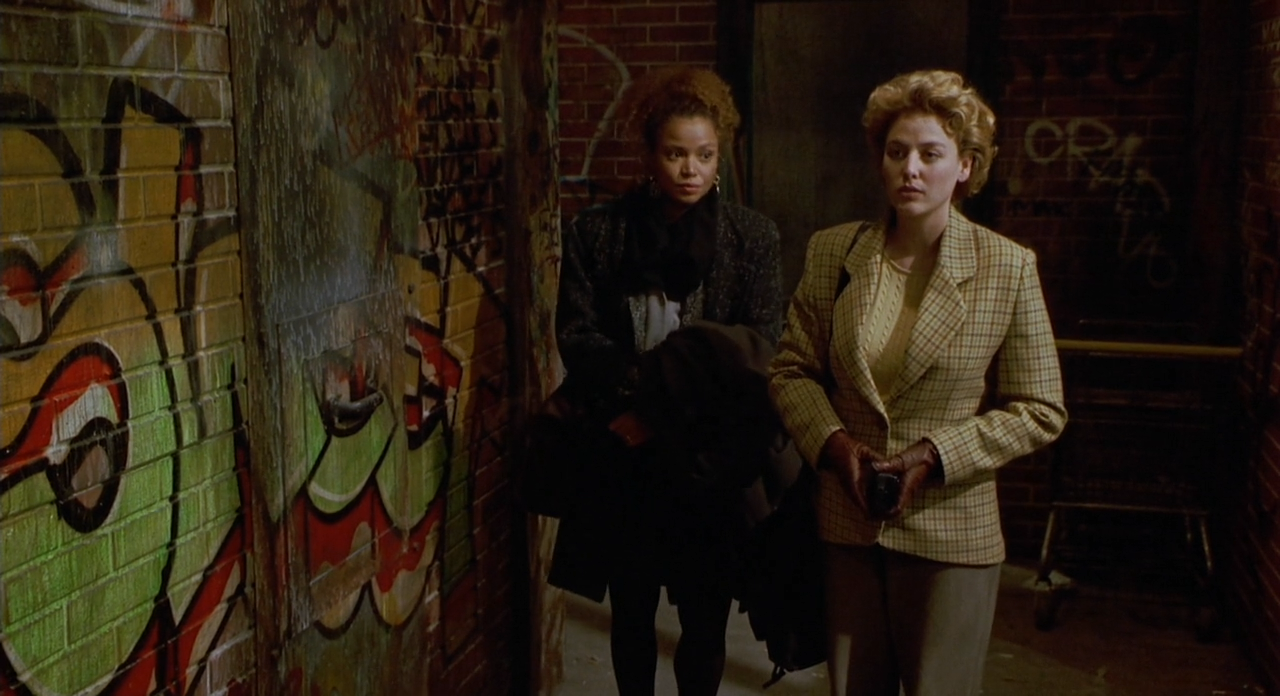
Two graduate students — Helen Lyle (Virginia Madsen) and Bernadette Walsh (Kasi Lemmons) — are doing research on the Candyman urban legend for a thesis paper at the University of Illinois in Chicago. Helen’s husband Trevor (Xander Berkeley) is a professor at the school and teaches a course in urban mythology. Through the course of their research, the two women learn that the residents of a dangerous area in the city known as the Cabrini-Green projects believe that Candyman (Tony Todd) haunts their building. I like that the film shows Helen’s methodical approach to her subject. She interviews several people who have heard of the supposed incidents involving Candyman and she also scans newspaper archives. This all establishes Helen as an intelligent protagonist steeped in the rational. She believes that the Candyman myth is just that.

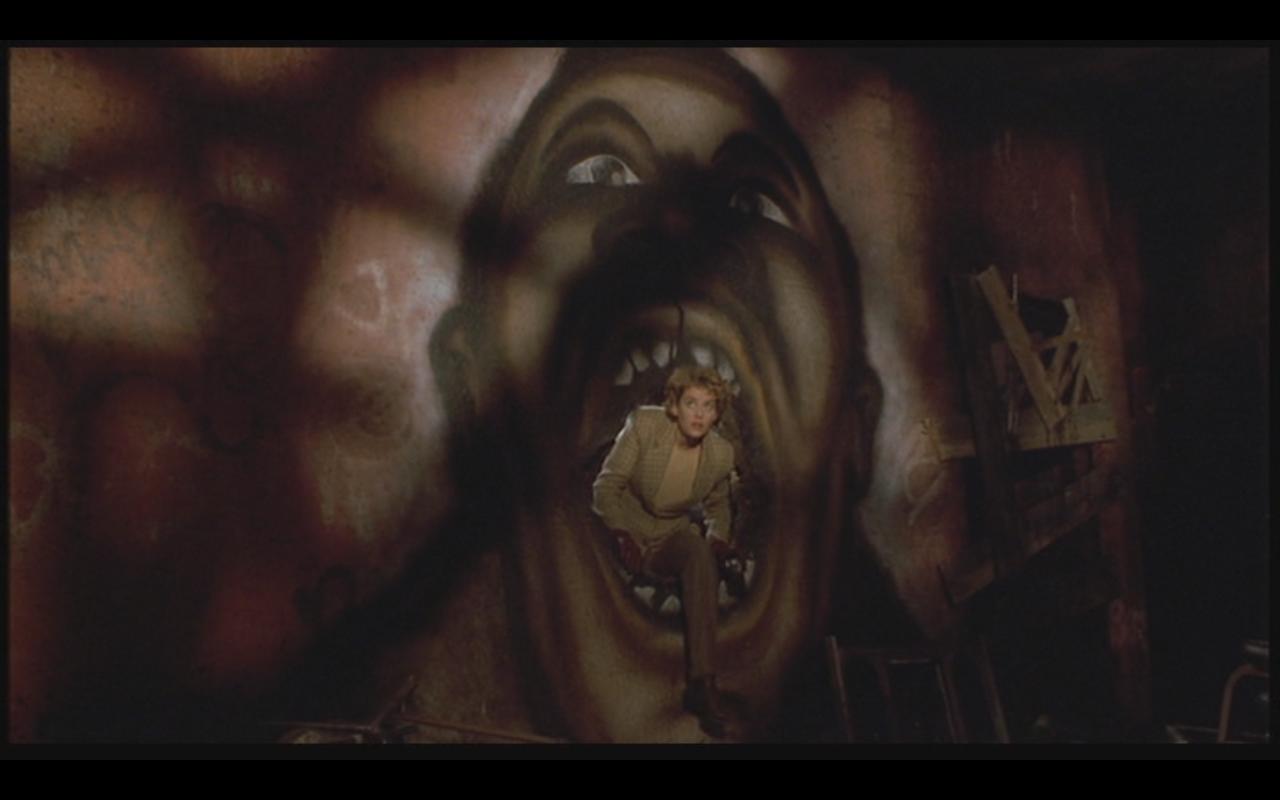
Helen soon uncovers a news clipping of the mysterious death of one the building’s residents — Ruthie Jean — that may have links to Candyman. She and Bernadette decide to go to Cabrini-Green and check things out for themselves. Helen is driven and has the conviction to brave the dangers of the place to further her research paper so it will have something more than just the same old stories recounted endlessly before. She’s willing to risk potential life and limb to get what she wants. But she’s smart about it. She and Bernadette dress conservatively (they’re even mistaken for plain clothes cops) and are careful not to provoke the gang members that greet them at the building’s entrance. As the film progresses, she becomes obsessed with her work, going back to Cabrini-Green by herself. The deeper Helen investigates the Candyman legend, the more her perception of reality becomes skewed. She starts seeing him in broad daylight. Her life gets more complicated when he frames her for several horrific murders. Helen begins to question her own sanity as her world rapidly unravels before her very eyes.

Candyman opens with a rather apocalyptic image of the Chicago skyline being engulfed by thousands upon thousands of bees and then we hear the ominous deep voice of Candyman saying, “I came for you.” Director Bernard Rose fades to the image of Helen’s face which foreshadows that this horror film is also an interracial love story between her and Candyman, a pretty daring concept back in 1992 which met with some resistance from the studio, according to Rose. The film also touches upon the sexism inherent in the world of academia as one of Trevor’s fellow professors acts condescendingly towards Helen and Bernadette but Helen is defiant and yet also captivated when the professor recounts Candyman’s backstory.

Candyman takes a mainstay of the horror genre — the haunted house — and effectively updates it for a contemporary audience. The Cabrini-Green projects are an imposing structure: an immense concrete monolith covered in graffiti, dirt and trash and crawling with dangerous gangs. This is not a place for a white, upper class academic type to be spending her time and yet Helen makes the perilous journey because she is obsessed by the Candyman legend.

Rose has a strong visual sense. He does not shoot Candyman like a traditional horror film. For example, he uses overhead shots of the city to establish several scenes — it’s a powerful, God’s eye view of the streets and buildings that creates an unsettling mood. Rose presents truly disturbing imagery, from the swarm of bees that engulfs the city in Helen’s dream, to a toilet bowl filled with swarming bees that she finds at Cabrini-Green. This imagery is complemented by Philip Glass’ experimental, elegiac score. It is never overused but instead insinuates itself into the film, lurking in the background.

Candyman stands apart from most other horror films in that Rose spends a lot of time establishing Helen’s character, letting the audience get to know her and thereby empathizing with her when things go horribly wrong. Virginia Madsen is well cast as the smart, strong-willed Helen. She conveys a vulnerability that makes her a sympathetic character and this helps us identify with her. For the film to work, we must be emotionally invested in what happens to her and empathize with her plight. It’s a strong, layered performance that requires her to show a wide range of emotions: the confident grad student to the fearful murder suspect who questions her own sanity. Helen is no damsel in distress but rather a thoughtful, inquisitive person who may be losing touch with reality. Madsen plays a very atypical horror film protagonist and the actress conveys an intelligence and confidence that is refreshing.

The Candyman legend itself is an intriguing one and we are soon as fascinated by it as much as Helen. Its backstory is steeped in cruelty and prejudice, making Candyman a tragic figure and somewhat sympathetic in his own right. He is more than just an anonymous scary monster that must be destroyed. The casting of Tony Todd also helps transform Candyman into a fully realized character. He has the fearsome physical presence with his deep, booming voice and towering figure. Todd manages to convey the tragic nature of his character and this makes Candyman not a conventional monster that must be dispatched outright. He has a clear, understandable motive for why he’s doing what he does in the film.

Xander Berkeley plays another irredeemable jerk. There are early warning signs that Trevor is no good. He flirts with a young female student in his class right in front of Helen and also messes up her research by teaching his urban legends class while she’s gathering data from his students for her thesis. I’m sorry but there is no way a guy like that would cheat on a woman as smart and beautiful as Virginia Madsen. Kasi Lemmons complements Madsen well. They both play smart characters and Bernadette provides a welcome injection of common sense to counterbalance Helen’s obsessive drive.

Bernard Rose got his start directing music videos for Propaganda Films and short films for the Playboy Channel. He shared an agent with author Clive Barker and through him Barker found out that Rose liked several of his short stories, in particular, “The Forbidden.” Barker saw Rose’s film, Paperhouse (1988), enjoyed it and felt that the director could translate his story into a film with “style and believability.” After making Chicago Joe and the Showgirl (1990), Rose met Barker in London, England to talk about adapting the story into a film. They agreed that it should be relocated from Liverpool to the United States because an American studio was planning to back it financially and it would make the film more commercially viable. According to Barker, Rose “took the thematic material in the story and expanded it and turned it into something that was very much his own.”

Rose took the project to Steve Golin, the head of Propaganda Films. Unaware that Rose had not written any screenplays, Golin hired him to write and direct Candyman. The filmmaker wrote the script and only then did Golin find out that he had never written one before. He was angry at Rose and was going to replace him as writer. However, Golin read Rose’s script, liked it and agreed to produce the film. Rose worked on the script for years with Barker supervising the various drafts. Rose actually wrote the part of Helen for his wife Alexandra Pigg to play and Virginia Madsen was going to play Bernadette. However, Pigg got pregnant and was unable to do the film and so Rose asked Madsen to play Helen instead. Casting Candyman was a challenge for the filmmaker who met with resistance from the studio when he wanted to Tony Todd to play the titular character. The actor recalled in an interview:

“I had to do what they call a ‘Personality Test,’ where I had to go to the studio at literally 8 in the morning, in front of a bunch of suits, and display whether I had a personality. So I did my best not to spill the coffee or insult them, and at the end of it, I heard they didn’t think I had a personality. They said, ‘Well, we don’t know if he has personality, but if you believe that he can do the film… Okay… Are you sure?’ He said, ‘Yeah. That’s the guy.’ And then the last hurdle was meeting Virginia Madsen, who’s from the Chicago area, and she just had it in her contract that she had to sign off on me. Then we met, went to lunch, and she said ‘Yes,’ and that was it.”
While working on the script, Rose combined Barker’s short story with two urban legends – the Hook, about a serial killer who murdered people with a hook and Bloody Mary, whose name is to be said in the mirror. Rose decided to set Candyman in Chicago because he had been there once for a film festival and became fascinated with its architecture. Before filming started, he went to the city and did a significant amount of research, talking to people there and learning how they spoke. He felt that it was important not to write “generic-sounding dialogue.” Much of the film was shot in and around the notorious Cabrini-Green, a gang-infested housing project. Rose navigated the gang problem there by hiring many members to play themselves in the film. Madsen had grown up in Chicago but did not want to drive past Cabrini-Green because of its scary reputation. Once she began filming on location there, she found out that most of its inhabitants lived in good homes. However, the place was not without its dangerous moments. Tony Todd recalled, “I tried to come there with no expectations, but I still felt fear. Anybody who didn’t belong there was subject to danger.” At one point, the police told him to watch the rooftops for snipers! For Rose, it was important that they shot on location and included it in the film as an element of social criticism. He said, “how people can be expected to live in squalor, because the housing authority has allowed Cabrini Green to rot instead of trying to maintain it.”

The filmmakers were faced with a dilemma when it came to shoot the scene where Helen is covered with bees. Madsen was extremely allergic to bee venom and the filmmakers had to lie to their insurance company by telling them that the bees being used were so young that they were incapable of stinging her. To avoid being stung, Tony Todd and Madsen were covered with queen bee pheromones so that the insects would be infatuated with them rather than angry. In addition, Rose cleared the set and spent ten minutes putting the actress in a trance! She did the sequence without incident.

Rose consciously wanted to slow the pace of the film down because the “slower and quieter the film became, the more intense it would become.” He also did not want music that would telegraph what would happen next but instead, “just strip the track down to very simple sounds.” He also wanted to “get away from the rape fantasies that one associates with slasher movies. Helen deals with her desires when she summons the Candyman. She’s like a priest who’s always asking for God. But what would happen if God appeared and said, ‘Here I am’? That might be what the priest wants, but it would also drive him mad.”

Candyman had its world premiere at the 1992 Toronto Film Festival, playing on its Midnight Madness line-up. The film went on to enjoy generally positive reviews from film critics. Roger Ebert gave the film three out of four stars and wrote, “Rose has been clever in his use of locations. Just as urban legends are based on the real fears of those who believe in them, so are certain urban locations able to embody fear. Empty apartments in the upper floors of public housing projects are, it is widely believed, occupied by gangs. We perceive a real threat to the women, at the same time they're searching for what they think is an imaginary one.” In his review for the Washington Post, Richard Harrington wrote, “Rose invests the film with plenty of frightful atmosphere (aided by a Philip Glass score), allowing Madsen to descend into madness at a pace that drags the viewer along, somewhat unwillingly … Madsen is a much better actress than is usually found in such a role.” The New York Times’ Janet Maslin wrote, “Ms. Madsen's performance is a lot more enterprising than what the material requires; the same can be said for Mr. Rose's direction.” Empire magazine gave the film its top rating and wrote, “Rose's movie is a triumph on many levels. Not only does it deliver a plethora of visually imaginative, shocking scenes … there's the score by American minimalist composer Philip Glass, which moves from a nursery rhyme tinkle to melancholic, melodic choral histrionics as the true grand guignol erupts.”

However, in his review for the Chicago Reader, Jonathan Rosenbaum felt that the film, “starts out promisingly while the plot is mainly a matter of suggestion, but gradually turns gross and obvious as the meanings become literal and unambiguous.” In her review for USA Today, Susan Wloszczyna wrote, “Too bad the premise is spoiled by some racially condescending overtones – Madsen comes off as the tenement's great white hope. And once she is drawn into Candyman's world, the story loses some of its edge. But Rose wisely concentrates on scares, not sociology.”

Candyman is a horror film that plays it straight. It refuses to resort to irony and self-reflexivity which would dominate the rest of the 1990s with the rise in popularity of the Scream trilogy and its offspring, like I Know What You Did Last Summer (1997) and Urban Legends (1998), which knowingly wink at its audience and lets them in on the joke. Candyman is grounded in realism and this makes the more fantastical elements so unsettling. It is also a rare horror film that wrestles with weighty themes such as academic sexism, urban decay, racial tensions and even interracial romance.


SOURCES

Pearlman, Cindy. “Going Behind the Screams with the Candyman Clan.” Chicago Sun-Times. October 20, 1992.

Ryan, James. “Virginia Madsen Graduates from Sultry Vixen to Brainy Blonde.” BPI Entertainment News Wire. October 15, 1992.

Strickler, Jeff. “Candyman Star Found Movie’s Site Haunted by Real Terror of Gangs.” Star Tribune. October 18, 1992.

Wilner, Norman. “A Candy-Coated Urban Legend for the 1990s.” Toronto Star. October 16, 1992.