"...the main purpose of criticism...is not to make its readers agree, nice as that is, but to make them, by whatever orthodox or unorthodox method, think." - John Simon

"The great enemy of clear language is insincerity." - George Orwell
Showing posts with label Fred Ward. Show all posts

Friday, May 12, 2023

Miami Blues

 
"The Sunshine State is a paradise of scandals teeming with drifters, deadbeats, and misfits drawn here by some dark primordial calling like demented trout.” – Carl Hiaasen

 
Author Charles Willeford has been called “the progenitor of modern South Florida crime novel” with his last four novels chronicling Miami’s shift from vacation paradise destination for retirees to “the nation’s capital of glamor, drugs, and weird crime,” inspiring writers such as Carl Hiaasen and James W. Hall, and filmmakers like Quentin Tarantino. It was his 1984 novel Miami Blues that started it all, featuring the first appearance of grizzled police detective Hoke Moseley who would go on to appear in three subsequent novels. Their commercial success eventually roused interest in Hollywood and Miami Blues was adapted in 1990, part of a fantastic crop of neo-noirs that also included The Grifters, The Hot Spot, and After Dark, My Sweet. A passion project for both its writer/director George Armitage and producer/star Fred Ward, it sadly did not do well at the box office, was coolly received by critics, and has become largely forgotten, despite its profane dialogue and sudden, often violence that anticipated the films of Tarantino two years later.
 
Frederick J. Frenger Jr. a.k.a. Junior (Baldwin) is an ex-convict flying into Miami from California, armed with someone else’s driver’s license, and ready to wage a one-man crime spree on the city. He gets off to a roaring start right out of the gate – literally, when he tries to steal another passenger’s luggage but misses the opportunity. Undaunted, seconds later, he bribes a small child and makes off with another piece of unattended luggage and for an encore, breaks the finger of a Hari-Krishna follower who subsequently dies from shock.

We meet homicide detective Hoke Moseley (Ward) negotiating money with a blind informant, which is the kind of colorful introduction that tells us a lot about his character. He and his partner (Charles Napier) investigate the Krishna murder and the scene illustrates the short-hand between these two men who have obviously been partners for a long time, while showcasing the film’s black humor: “Your turn to notify next of kin,” Hoke says to his partner who replies, “No way! I did the fat lady that sat on a kid. That’s good for two.” It’s great fun to see these two veteran actors share a scene together, lobbing dialogue back and forth. One almost wishes a prequel had been done about these two characters.
 
Junior checks into a hotel and quickly arranges for a hooker and meets Susie (Jennifer Jason Leigh). He doesn’t want to have sex, but instead sells her clothes out of his stolen luggage. He takes an immediate shine to her. He hasn’t been with a woman in a long time – and initially it looks like he’s going to be rough with her – but instead is very tender.
 
Miami Blues is a battle of wills, fused with a cat-and-mouse game, as Hoke pursues Junior. He questions him early on at Susie’s over a dinner in a fantastic scene that’s crackling with subtle tension simmering under the surface, as the cop knows the crook is lying about the dead Hari Krishna, but puts on airs for Susie’s benefit. It is a wonderfully acted and staged scene as she is oblivious to what is going on while Hoke and Junior sniff each other out.

Junior is a career criminal who sees the world as a playground. If he wants something he takes it. Someone gets in his way he removes them. He is all about taking short cuts. The first third of the film mostly focuses on Junior’s exploits as we see him spotting a two-man pickpocket team and follows the guy with the loot into a public bathroom, beats him up, and takes the money. He’s a ballsy crook, buying a realistic looking water gun and then robbing a bunch of guys on the street. Baldwin looks like he’s having a blast playing Junior as a legend in his own mind as he sits in his hotel room at one point with a bunch of money, pretending he’s Al Pacino in Scarface (1983). He is excellent as a clever crook whose fault is that he never plans his crimes ahead of time. He’s spontaneous and this works for awhile but eventually catches up to him.
 
Jennifer Jason Leigh plays Susie as a naïve innocent who falls in love with Junior but is blind to his true nature. The actor conveys an earnest vulnerability. Susie sees Junior as a way to a better life – the house, the white picket fence, kids, and so on. Juniors taps into this when he tells her, “Let’s go straight to the ‘happily ever after’ part, okay?” She is the one ray of hope and optimism in his otherwise cynical world.
 
Ward’s Hoke is a broken-down detective on the outskirts of retirement but he’s smart and a student of human behavior, sussing Junior right away, correctly figuring out he’s an ex-con by the way he protects his food while eating dinner. He’s also pissed that Junior is running around with his badge impersonating him and makes it his mission to take the guy down. It’s a fantastic role that showcases Ward’s considerable talents and rare opportunity to headline a film. It’s a shame that Miami Blues wasn’t a bigger hit as it would’ve been great to see him reprise the role again in another adaptation.

Associate producer William Horberg gave Miami Blues to Fred Ward soon after it was published. After reading it, he thought it would make for a great film. “It has a certain irony about it, a certain dark comedy that I like. It’s a little absurd. There’s a random violence in it that I thought was very real,” Ward said in an interview. He optioned the book rights for a two-year deal with $4,000 that the actor paid out of his own picket. He brought it to friend and filmmaker Jonathan Demme, with whom he had worked with on Swing Shift (1984), in the hopes that he’d direct. Demme, just having shot Married to the Mob in Miami (1988), demurred but suggest another friend of Ward’s – George Armitage – to direct instead. Demme knew Armitage from when they were starting out, making films for Roger Corman. He read the book and loved it, going on to write a spec screenplay and agreed to helm it with Demme producing along with Gary Goetzman. Ward had pitched the project to Orion Pictures on two occasions and was turned down both times until he showed them Armitage’s script. They agreed but only if a young actor was cast in one of the lead roles.
 
Originally, Ward wanted to play Junior with Gene Hackman playing Hoke. The two men met and Hackman was interested but when Alec Baldwin came in to read for the part of Junior, he was so good they cast him in the role, and Ward decided to play Hoke. Early on, Leigh Taylor-Young (Jagged Edge) was originally cast as Susie but dropped out for unknown reasons. Jennifer Jason Leigh was later cast in the role and to prepare, she cut her hair short and isolated herself from the rest of the crew to replicate the loneliness of her character. She also went to Okeechobee, Florida, attended her first football game, and hung out with local high school girls to learn the dialect, their attitudes and aspirations.
 
Miami Blues received mixed reviews from critics. Roger Ebert gave it two out of four stars and wrote, “The movie wants to be an off-center comedy, a lopsided cops-and-robbers movie where everybody has a few screws loose. But so much love is devoted to creating the wacko loonies in the cast that we're left with a set of personality profiles, not characters.” In her review for The New York Times, Janet Maslin wrote, “Miami Blues is best appreciated for the performances of its stars and for the kinds of funny, scene-stealing peripheral touches that keep it lively even when it's less than fully convincing.” The Washington Post’s Rita Kempley wrote, “Armitage, a Demme pal, has been struggling to escape B-moviedom for the past decade. But Miami Blues, panicky and sleek as a fire engine, is more than a snappy comeback. It's a centered lament, a screwball thriller about making ends meet, about how even an armed robber can't afford the American Dream.”

In his review for Entertainment Weekly, Owen Gleiberman wrote, “By the time Miami Blues winds into its crushingly bloody, absurdist finale, the only question of any urgency is, Which actor has become harder to watch: Baldwin with his histrionics or Fred Ward flashing those naked gums?” The Los Angeles Times’ Peter Rainer wrote, “This is the problem with the action-filmmaker’s anything-for-a-jolt ethos: Whatever doesn’t jump-start the story is skimped. In fact, in Miami Blues, the story is all jump-starts. I realize that this may be all that most people require from a glorified programmer like Miami Blues, but the film has so much finesse, and its best moments are so freakishly dippy, that you regret the devaluation.”
 
Miami Blues presents a heightened reality of a city where danger lurks behind every corner, where a veteran police detective is assaulted in his own home, and where an opportunistic crook can wage a one-man crime wave posing as a cop. As Hiassen has said, the film presents “a paradise of scandals teeming with drifters, deadbeats, and misfits drawn here by some dark primordial calling like demented trout.”
 
 
SOURCES
 
Fisher, Marshal Jon. “The Unlikely Father of Miami Crime Fiction.” The Atlantic. May 2000.
 
Leung, Rebecca. “Florida: ‘A Paradise of Scandals’.” 60 Minutes. April 17, 2005.
 
Mitchell, Sean. “Exploring the Dark Side.” Los Angeles Times. April 15, 1990.

Pinkerton, Nick. “Interview: George Armitage.” Film Comment. April 28, 2015.

Van Gelder, Lawrence. “Miami Splice.” The New York Times. September 30, 1988.

Van Gelder, Lawrence. “Fred Ward’s Blues.” The New York Times. April 20, 1990.
 
Weinstein. Steve. “The Transformation of Jennifer Jason Leigh.” Los Angeles Times. April 29, 1990.

Friday, August 7, 2015

Southern Comfort

Walter Hill’s best films are gritty, no frills explorations of the violent conflict between men, be it the lone gang that has to run a dangerous gauntlet through New York City in The Warriors (1979) or a veteran cop’s relentless pursuit of a ruthless escaped convict in 48 Hrs. (1982). He is also interested in how people forge close bonds under extreme circumstances and this is certainly true of Southern Comfort (1981), a little-seen action film about a squad of National Guardsmen that become lost in the rural bayou country of Louisiana and run afoul of the local Cajun people.

It’s 1973 and the National Guard are out on maneuvers. In his typical economic fashion, Hill introduces a squad of nine men and immediately establishes conflict between some of them, like Staff Sergeant Poole (Peter Coyote) warning recent transfer Corporal Hardin (Powers Boothe) that he won’t tolerate any kind of insubordination. PFC Spencer (Keith Carradine) is a racist and PFC Stuckey (Lewis Smith) is an arrogant prick that gleefully fires his weapon at one of his fellow soldiers (the gun has blanks). They talk tough but as Spencer confides to Hardin, they’re basically a good group of guys.

The squad’s arrogance proves to be their undoing. First, they take three boats that don’t belong to them. Then, when they spot a few Cajun men on the shore, they show nothing but contempt with Stuckey opening fire with his gun full of blanks as a joke. The Cajuns respond by killing their squad leader and all hell breaks loose. This squad of National Guardsmen now have to navigate treacherous terrain against well-armed locals that know it way better than they do. The rest of Southern Comfort plays out as a battle for survival in classic Hill fashion.


Hill establishes the squad a dysfunctional group from the get-go and it only gets worse once they are stuck in the bayou as the men bicker amongst each other. There is even genuine distrust, like when Reece (Fred Ward) refuses to share the box of live ammunition he squirreled away before they set out on their mission. Southern Comfort takes a fascinating look at a group dynamic and how it breaks down under extreme circumstances as one-by-one the Guardsmen are picked off by frighteningly enigmatic antagonists. As the film progresses, they become tired, scared and frustrated by their predicament while some of them crack under the pressure.

Powers Boothe plays one of Hill’s trademark protagonists – a man of few words and who prefers to let his actions speak for themselves. Hardin is an anti-authoritarian type, preferring to go his own way but when it comes down to it his instinct is to survive and help those around him. He’s smart and wisely respects his opponents.

Keith Carradine’s Spencer starts off as something of a crass opportunist but as their situation gets more serious he steps up and becomes one of the few rational voices along with Hardin. He and Boothe make a great team with the former being the chattier of the two and so they play well off each other in their initially contentious relationship that evolves into grudging mutual respect – a common trait among many of Hill’s films.


In a film like this, where the characters are at the mercy of an inhospitable environment, the setting becomes another character – one that we become immersed in as Hill sets a wonderfully atmospheric mood with the opening credits playing over beautiful yet foreboding footage of the bayou while Ry Cooder’s evocative score plays on the soundtrack. The squad constantly slogs through swampy water and danger lurks behind every tree. What makes this environment even more daunting is that it is seemingly never-ending as these men become increasingly lost and disoriented.

Walter Hill made Hard Times (1975) and it had a Cajun sequence in it. Writer David Giler said to the director, “You know, those Cajuns strike me as interesting, tough guys.” The director agreed and Giler suggested that they make an adventure story incorporating them. Hill wanted to do a survival story and had already made Hard Times in Louisiana. Michael Kane was hired to write a draft, but the studio didn’t like it. The project was put into turnaround. Giler and Hill did some more rewriting of their own and found independent financing. The two men had a deal with 20th Century Fox to acquire and develop “interesting, commercial scripts that could be produced cheaply,” as Hill said in an interview. The studio ended up distributing the film.

During the two-day cast rehearsal prior to principal photography, Hill told his actors, “A lot of people will perceive this to be a metaphor for Vietnam. I don’t like to make movies about metaphors … Let’s just go make a movie about guys caught in a situation.” Hill shot Southern Comfort in the swamps in the Castle Lake area outside of Shreveport six days a week for nine grueling weeks. He said, “And just to get out there took this enormous drive, we had to get up four in the morning to be ready to shoot at the crack of dawn.” He remembered that the cast didn’t complain much during filming because they knew what they were all getting into and were in good physical shape. Hill recalled that it was “as tough a movie as I’ve ever done … So often you would get a camera position, you had to get a shot in a couple of minutes before the soft bottom sunk.”


Southern Comfort didn’t cost much but the studio also didn’t spend much promoting it because the subject matter wasn’t deemed all-that commercial. Roger Ebert gave the film three out of four stars and wrote, “The strength of the movie is in its look, in its superb use of its locations, and in Hill’s mastery of action sequences that could have been repetitive.” However, in his review for The New York Times, Vincent Canby wrote, “Mr. Hill chooses to photograph his material so self-consciously and so prettily, with lots of slow-motion stuff and superimpositions, that you automatically reach for a bottle of aspirin.”

Unlike many other backwoods movies where the locals are portrayed as dumb hillbillies, Southern Comfort presents the Cajuns as proud people with their own vibrant culture and thriving life nestled away from modern society. Hill doesn’t judge them and does a nice job of immersing us in their culture towards the end of the film so that they are no longer some faceless enemy in the bayou. If anything, it is the arrogant, aggressive Guardsmen that are at fault here and responsible for their own fate. After all, they took what wasn’t theirs and provoked the locals on their own turf.

The cruel irony of Southern Comfort is that infighting and the unforgiving terrain does more to decimate the squad than the local Cajun hunters. At the time, the film was seen as a commentary on the United States’ involvement in the Vietnam War – something that Hill has not denied but downplayed. Like the U.S. Army, this squad of National Guardsmen are completely out of their depth and at the mercy of an environment they aren’t equipped to deal with and facing an opponent they don’t understand. Today, we are still mired in war with our troops at the mercy of an equally imposing environment, making Southern Comfort as timely today as it was back in 1981.


SOURCES

Markowitz, Robert. “Visual History with Walter Hill.” DGA.

Rizov, Vadim. “Tough Little Stories: Director Walter Hill at 92Y Tribeca.” Filmmaker. January 29, 2013.


Zelazny, Jon. “Kicking Ass with Walter Hill.” Hollywood Interview. December 8, 2012.

Friday, December 20, 2013

The Right Stuff

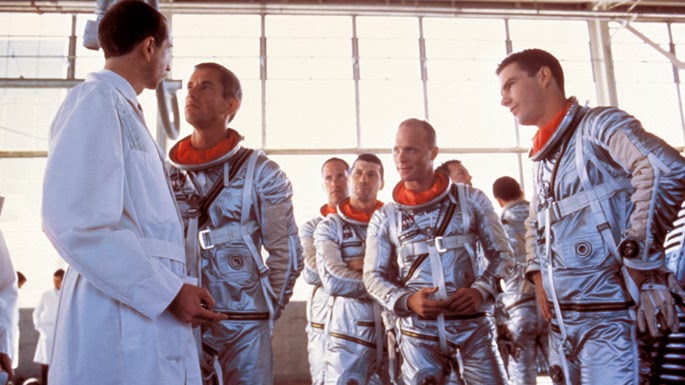
When The Right Stuff came out in 1983, pundits were anticipating it to make a big splash at the box office. Based on Tom Wolfe’s book of the same name, Philip Kaufman’s film depicted the space race between the United States and the Soviet Union with the focus on the Mercury 7 — seven astronauts who trained to become the first Americans in outer space. With this kind of patriotic subject matter how could the film not be a big hit? Despite scoring well with critics, The Right Stuff failed to get off the launch pad with audiences. At the time of its release, the studio backing it decided to market the film in tandem with Mercury 7 astronaut and Ohio Senator John Glenn’s run for the presidency. Mainstream audiences felt that Kaufman’s motion picture was going to be nothing more than an expensive campaign ad and stayed away. The film disappeared off of almost everyone’s radar for several years, only appearing semi-regularly on cable television. However, with anniversary releases on DVD and, more recently, on Blu-Ray, the film has been re-discovered and is generally regarded as an influential cinematic masterpiece.

The film begins with Chuck Yeager (Sam Shepard), a legendary test pilot who was the first man to break the Sound Barrier. He is the perfect embodiment of “the right stuff,” an intangible quality that few people possess. Yeager doesn’t break the Sound Barrier for fame or money. He does it for the challenge, to beat what the film’s narrator (Levon Helm) calls “the demon that lives in the thin air.” There is a scene where Kaufman depicts Yeager riding through the desert on horseback against a very Terrence Malick-esque sunset as if to suggest that the test pilot is akin to a laconic cowboy from a bygone era. Soon, Yeager comes across the rocket-powered Bell X-1, the plane that he will fly to break the Sound Barrier, complete with ominous music and ferocious jet engine sounds. The image of Yeager on horseback staring at a piece of technology that could result in his death sets up a man vs. machine theme that continues on throughout the film.

The give and take between Yeager and his wife Glennis, played wonderfully by Barbara Hershey, during these early scenes is so well done and could be its own short film as she and Sam Shepard convey the unique dynamic between these two people. As the Air Force pitches breaking the Sound Barrier to Yeager, Glennis doesn’t voice her disapproval or fears. She doesn’t have to as the look Hershey gives Shepard says it all. Glennis loves him, but isn’t some subservient housewife as she says later on, “They don’t spend a god-damned thing teaching you how to be the fearless wife of a fearless test pilot.” In many respects, she’s his equal, even challenging him to a race on horseback out in the desert.


The sequence where Yeager breaks the Sound Barrier is beautifully realized with old school visual effects and clever editing. What really helps sell it is the reaction shots of Shepard, even obscured behind a mask, that convey how difficult it must have been. So why does Kaufman spend so much time on Yeager, even having him return intermittently throughout the film as a sort of Greek chorus, commenting on the Mercury 7 astronauts? Clearly, he sees the legendary test pilot as the epitome of “the right stuff” and this is why he’s never made to look silly and always treated reverentially. In one of his early roles, playwright-turned actor, Sam Shepard is perfectly cast as Chuck Yeager. Physically he doesn’t resemble the man, but with his chiseled good looks and piercing stare, he even makes chewing gum an epic gesture. He doesn’t have much dialogue, but he doesn’t need it because he conveys so much with a look or a simple gesture. The Yeager section is The Right Stuff at its most romantic, photographed by Caleb Deschanel with a slight sepia tone to give the footage the feel of an old photograph.

We soon see a sharp contrast between Yeager and the next group of test pilots that show up to make a name for themselves. Even though he is never asked to train for the missions into outer space, all of the Mercury 7 astronauts live in his shadow and the film constantly compares them to his ideal. We are introduced to Gordon Cooper (Dennis Quaid sporting the best shit-eating grin ever) and Gus Grissom (Fred Ward), two cocky pilots who think pretty highly of themselves, but are quickly put in their place. From this point on, whenever the film veers too dangerously close to overt seriousness, Kaufman proceeds to deflate it with comedic moments, usually from Jeff Goldblum and Harry Shearer, two bumbling recruiters who, among many things, show then-Senator Lyndon Johnson (Donald Moffat) a reel of what they feel are ideal candidates to go into outer space: circus acrobats, divers, race car drivers, and so on.

The irony is that the NASA recruiters don’t pick the best pilot – Yeager – because he didn’t go to college, but the ones they do get are certainly among the very best. However, Kaufman constantly reminds us that they are not in Yeager’s league via a montage of arduous physical and mental tests where the potential astronauts are sometimes made to look silly, racist and sexist, but this is put in the context of the times and all of these alpha males competing against each other. The potential astronauts are put in humiliating situations that cut through the instantly iconic status that the government attempts place on them and shows them having human frailties just like everyone else. It’s a fascinating duality that gives these astronauts depth. It also doesn’t hurt that the charisma of the actors shines through and you admire these brave men. As Yeager puts it later on in the film, “You think a monkey knows he’s sittin’ on top of a rocket that might explode? These astronaut boys they know that, see? Well, I’ll tell you something, it takes a special kind of man to volunteer for a suicide mission, especially one that’s on T.V.” What’s interesting is that the film shows how the Mercury 7 were paraded around the press, including a major feature article for Life magazine. The U.S. was in competition with Russia and the government wanted to show that we had men just as capable of going up into outer space as they did.


Looking at The Right Stuff now, it is easy to forget how the now stellar cast was, at the time, relatively unknown. Ed Harris, Dennis Quaid, Fred Ward, Lance Henriksen, Scott Glenn, and Jeff Goldblum were all up-and-coming actors and this film helped put them on the map. The cast is uniformly excellent with Harris, Quaid and Ward as the standouts among the astronauts. It doesn’t hurt that they tend to get more screen-time than the others (poor Henriksen!), but they also make the most of it with Harris playing the all-American Boy Scout and yet managing to go deeper, past the rah-rah façade to show a man who deeply loves his wife as evident in the scene where he tells his harried spouse that if she doesn’t want the Vice-President to come to their house and watch the launch then he will stand by her decision (despite being pressured to do otherwise). Quaid plays the cocky hot shot (“Who’s the best pilot you ever saw?”), and Ward is the gruff one who infamously “screws the pooch,” and was unfairly maligned as the astronaut who made a mistake during his mission. Kaufman does tend to empathize with Grissom in the film and Ward manages to elicit sympathy in what is the lowest point in The Right Stuff as the man even has to defend his actions to his wife (Veronica Cartwright) who is disappointed that she never got to meet Jackie Kennedy like previous astronaut wives.

Speaking of which, I like that Kaufman gives ample screen-time to the wives, showing how they bonded and dealt with the stress of their husbands’ dangerous profession. It also shows their vulnerabilities, like Trudy Cooper’s (Pamela Reed) fear that her husband would die during a mission or Annie Glenn’s (Mary Jo Deschanel) stutter, which makes her so self-conscious that she rarely speaks, which the other wives misinterpret as snobby behavior.

For all of its humor and critique, The Right Stuff certainly doesn’t skimp on awe-inspiring imagery as evident in the wondrous sights on display when Yeager breaks the Sound Barrier or when John Glenn orbits the Earth. The impressive visual effects are as good as anything seen in Stanley Kubrick’s 2001: A Space Odyssey (1968), the benchmark that all other films of this type are measured against. In the latter sequence, Glenn sees all sorts of debris that looks like fireflies, which Kaufman juxtaposes with an aboriginal campfire at night. It is fascinating, almost abstract imagery, which he inserts into this epic, historical biopic.


In 1979, independent producers Robert Chartoff and Irwin Winkler outbid Universal Pictures for the movie rights to Tom Wolfe’s book, The Right Stuff. They hired legendary screenwriter William Goldman to adapt it into screenplay form and his version focused on the astronauts while entirely ignoring Chuck Yeager. United Artists agreed to finance the film and the producers were not satisfied with Goldman’s take on the book. He was unable to find a dramatically convincing way to contrast the experience and outlook of the test pilots and the astronauts, leaving the former out of his script. They approached Philip Kaufman to direct and he shared their dissatisfaction with the script. He was hired in 1980 and Goldman quit the project. Kaufman started off by penning a 35-page memo outlining his take on the material. The filmmaker cited films he admired – The Searchers (1956) and The Grand Illusion (1937) – and that he would emulate their “rambling, episodic quality,” in which “truth is found along the way.” When Wolfe showed no interest in adapting his own book, Kaufman wrote a draft in eight weeks. He restored Yeager to the story because “if you’re tracing how the future began, the future in space travel, it began really with Yeager and the world of the test pilot. The astronauts descended from them.”

After the financial failure of Heaven’s Gate (1980), United Artists put The Right Stuff in turnaround and The Ladd Company stepped in with an estimated $17 million for the budget. According to Alan Ladd Jr., the final budget was closer to $27 million. Kaufman spent a lot of time early on trying to figure out how to do the visual effects. Initially, he looked at what George Lucas was doing with the Star Wars films, but Kaufman found that what “worked in outer space for George didn’t work on Earth. They didn’t have the same reality that we were looking for.” And so, Kaufman wanted to keep with “the theme of the film that what if we started jerry-rigging these things.” To that end, he hired experimental filmmaker Jordan Belson, who was “exploring cosmic mysteries” in his short films, to create transitions from night to day and the background of the Earth as seen from high-flying planes or orbiting spacecraft. In lieu of creating a lot of expensive visual effects from scratch, Kaufman accumulated 300,000 feet of NASA stock footage.

According to special visual effects supervisor Gary Gutierrez, the first special effects were too clean looking and they wanted a “dirty, funky early NASA look.” Kaufman was so unhappy with the results that he shut down work on them and fired many of the effects crew. Gutierrez and his team started from scratch, employing unconventional techniques like going up a hill with model airplanes on wires and fog machines to create clouds, or shooting model F-104s from a crossbow device and capturing their flight with as many as four cameras. A Mercury spacecraft was built from the original NASA molds and an X-1 mockup was constructed from old parts while the only B-29 bomber still flying was used.


Most of the film was shot in and around San Francisco, Kaufman’s hometown, and he transformed Hamilton Air Force Base in Marin County into a studio. The desert sequences were shot near Edwards Air Force Base. Yeager was hired as a technical consultant on the film. He took several of the actors flying, studied the storyboards and special effects, pointing out errors. Barbara Hershey remembered that during filming, he would call her Glennis and his son would call her mom. However, Yeager and Sam Shepard were wary of each other, at first, but became friends. To prepare for their roles, Kaufman gave the actors playing the seven astronauts an extension collection of videotapes to study.

Kaufman gave his five editors a list of documentary images that the film required and they searched the country for film from NASA, the Air Force and Bell Aircraft vaults. They also discovered Russian stock footage that had not been seen by human eyes in 30 years. The director’s rather exacting methods met with resistance from The Ladd Company and he threatened to quit several times. To make matters worse, in December 1982, 8,000 feet of film portraying Glenn’s trip in orbit and return to Earth disappeared or was stolen from Kaufman’s editing facility in Berkeley, California. The missing footage was never found and had to be reconstructed from copies.

The world premiere for The Right Stuff took place on October 16, 1983 in Washington, D.C. The Washington Post’s Gary Arnold felt that the film was “obviously so solid and appealing that it’s bound to go through the roof commercially and keep on soaring for the next year or so.” In his review for The New York Times, Vincent Canby praised Shepard’s performance: “Both as the character he plays and as an iconic screen presence, Mr. Shepard gives the film much well-needed heft. He is the center of gravity.” Roger Ebert gave the film four out of four stars and wrote, “That writer-director, Philip Kaufman, is able to get so much into a little more than three hours is impressive. That he also has organized this material into one of the best recent American movies is astonishing.”


Yeager saw the film and liked “the way Sam played me. Sam is not a real flamboyant actor, and I’m not a real flamboyant-type individual … He played his role the way I fly airplanes.” Deke Slayton said after the screening, “none of it was all that accurate, but it was well done.” Walter Schirra said, “They insulted the lovely people who talked us through the program – the NASA engineers. They made them like bumbling Germans.” Scott Carpenter said, “It was a great movie in all regards.”

In retrospect, Kaufman and several cast members did not like how the film was marketed. The director said, “The publicity had to be exactly right to attract people, and I think it was presented in a way as sort of academic and a history of the space program.” Scott Glenn felt that it was “the most stupidly marketed film I’ve ever made … We made the film, a bunch of people saw it, and they thought it was so powerful, that it was worthy of a hard-news item: Will this movie be influential in the candidacy of John Glenn? People in the media got hold of it and made it hard news … All that influenced the marketing people into believing they had something ‘important’.” Finally, Fred Ward chimed in with his two cents: “My theory is that they seemed to be trying to sell it to the audience as The John Glenn Story. You know, the patriotic this and that. And it wasn’t.”

At once reverential and also irreverent towards its subject matter, The Right Stuff could have easily been tonally all over the place if it weren’t for Kaufman’s assured touch. One reason why the film may not have connected with audiences is the unusual take on the subject matter. Kaufman tends to go back and forth from a reverential look at these men to parodying them as well. Only Yeager is given a purely worshipful treatment because he represents the epitome of “the right stuff.” However, Kaufman isn’t afraid to show that the Mercury 7 astronauts had their flaws. They were cocky braggarts (Gordon Cooper), materialistic opportunists (Gus Grissom) and naively patriotic (John Glenn). Audiences of the day were probably expecting a straightforward historical biopic that put all of these men on pedestals. Kaufman was more interested in presenting these men as interesting, flawed human beings. They may have not been as iconic as Yeager, but, in the end, did have “the right stuff.”


SOURCES

Ansen, David and Katherine Ames. “A Movie with The Right Stuff.” Newsweek. October 3, 1983.

Bumiller, Elisabeth and Phil McCombs. “The Premiere: A Weekend Full of American Heroes and American Hype.” Washington Post. October 17, 1988.

Farber, Stephen. “Rocket’s Red Glare.” DGA Quarterly. Spring 2012.

“Fred Ward – It’s Hard to be a Hero.” Starlog. December 1985.

King, Susan. “Looking Back at a Film with The Right Stuff.” Los Angeles Times. June 7, 2003.

Morganthau, Tom and Richard Manning. “Glenn Meets the Dream Machine.” Newsweek. October 3, 1983.

Naha, Ed. “The Right Fx for The Right Stuff.” Starlog. July 1983.

O’Neill, Patrick Daniel. “Scott Glenn – The Fast-Gun Astronaut.” Starlog. August 1985.

Rushfield, Richard. “Director Philip Kaufman on What Makes The Right Stuff, 30 Years Later.” Yahoo Movies. November 15, 2003.

Schickel, Richard. “Saga of a Magnificent Seven.” Time. October 3, 1983.

Wilford, John Noble. “The Right Stuff: From Space to Screen.” The New York Times. October 16, 1983.


Williams, Christian. “A Story That Pledges Allegiance to Drama and Entertainment.” Washington Post. October 20, 1983.

Friday, June 7, 2013

Remo Williams: The Adventure Begins

For years, I’ve been a big fan of character actor extraordinaire Fred Ward. Back in the day, he was known for playing gruff, tough guys in films like Southern Comfort (1981) and Uncommon Valor (1983). He carved out quite a career for himself, appearing in diverse films like the Space Race epic The Right Stuff (1983) and monster movie homage/spoof Tremors (1990). It was always a treat to see him in prominent roles, like the cult fave Miami Blues (1990) and his one shot at playing a potential franchise action hero with Remo Williams: The Adventure Begins (1985). Ah, what an unfortunate title, automatically jinxing it – the fates punishing the filmmakers for such an act of hubris.

Based on the popular, long-running series of pulp paperback novels known as The Destroyer by Warren Murphy and Richard Sapir, the movie was intended to kickstart a franchise and, despite heavy promotion, promptly tanked at the box office, not even making back half of its budget. While far from being a great movie, Remo Williams is a fun romp with a muscular performance by Ward who looks like he’s having a blast with the role.

Sam Makin (Fred Ward) is a tough New York City police officer. One night, he pursues and stops two guys beating on another man. All three proceed to take on Sam, but he manages to subdue them. Battered and bruised, Sam gets in his vehicle to catch his breath and is rear-ended by an armored car, knocking him into the East River. That night, Sam Makin died. When he awakens, the cop has been given a new face and renamed Remo Williams. He’s been recruited by a secret government organization known as CURE that cuts through the corruption and bureaucracy. As his contact MacCleary (J.A. Preston) tells him rather cheekily, “You’re going to be the 11th Commandment: ‘Thou shall not get away with it.’”

This initial meeting sets the playful, slightly satirical tone as the understandably wary Remo is trained to become a deadly operative. But first, he meets his second handler – Harold Smith (Wilford Brimley), who tells him that their organization only answers to the President of the United States. This scene is a lot of fun to watch as the smartass Remo bounces off the no-nonsense Smith. It’s great to see veteran actors like Ward and Wilford Brimley play off each other.

The bulk of Remo’s training is supervised by an old Korean martial arts master named Chiun (an unrecognizable Joel Grey) who schools him in the ways of Sinanju. They first meet when Remo is told to kill him, unaware who he really is. It’s a test, obviously, which Remo fails in hilarious fashion as Chiun dodges his bullets and then proceeds to avoid Remo’s clumsy attacks, sending him hurtling into furniture. It’s an excellent exercise in physical comedy on Ward’s part and dry wit on Joel Grey’s part.


MacCleary sets the tone for Remo’s training by telling him, “All I can promise you is terror for breakfast, pressure for lunch and aggravation for sleep. Your vacations will be two minutes when you’re not looking over your shoulder and if you live to draw a pension it will be a miracle.” The training sessions are basically a series of humiliating exercises as Chiun insults Remo (“You move like a pregnant yak.”) while repeatedly besting him physically. Initially, Remo is skeptical as he says to Chiun, “Is this gonna be the kind of training where we sit around for ten years and you tell me I’m big enough to break a brick with my big toe?” The ancient martial arts master replies by paralyzing Remo’s left arm with a slight touch. He walks around espousing his philosophy while all Remo can do is writhe around in pain.

A good chunk of Remo Williams is an origins story involving the protagonist’s death and rebirth as a blue collar James Bond. The rest of the movie involves a powerful businessman named George Grove (Charles Cioffi) who is manufacturing a very expensive assault rifle for the U.S. government that has some lethal flaws. The ambitious Major Fleming (Kate Mulgrew) is investigating Grove and his rifle, unaware that he’s in bed with her superior General Scott Watson (George Coe).

Fred Ward has always been a very physical, expressive kind of actor and Remo Williams may be the best example of this as we see him do most of his own stunts. He also shows fantastic comic timing, especially in his scenes with Grey. Ward doesn’t get to show off his comedic chops enough for my tastes and so when he does, in films like Miami Blues and Tremors, it’s a real treat. He does a nice job of showing Remo’s transformation from blunt, two-fisted cop to super efficient secret operative. He plays well off Grey as the relationship between their characters is initially full of friction with Remo refusing to let go of certain old habits while Chiun is the unrelenting disciplinarian.

It’s great to see Ward getting a chance to carry a movie and he commits fully to the role with his rugged charisma and character’s smartass take on life. It’s a lot of fun to watch Remo stumble through the early stages of his training as he grumbles about Chiun’s methods and then see him improve over time. There’s a credible learning curve that many movies of this type tend to gloss over in a montage. It’s a shame that Remo Williams didn’t do better as I would have loved to have seen Ward in a few more installments.

Joel Grey is virtually unrecognizable under all kinds of make-up as he portrays Chiun like a kind of benevolent Yoda Zen master who watches soap operas when he’s not training a.k.a. tormenting Remo. It’s certainly a novel casting choice, but a role that Grey, to his credit, immerses himself in completely. He plays it straight, which makes the way he treats Remo that much funnier. Kate Mulgrew is okay as Remo’s foil, but the role feels underwritten and an attempt to recreate a kind of screwball comedy/sexual tension thing between their characters doesn’t quite work despite the chemistry between the two actors. Mulgrew is an actress I’ve never given much thought about; at times, she gives off a Katherine Hepburn-type vibe and she gamely plays along as Remo’s sidekick in the movie’s third act. That being said, she’s at her most appealing here and I would’ve loved to have seen her and Ward in another, different kind of film – maybe a romantic comedy where they played veteran reporters that fall in love despite their competitive nature. Oh well, they’ll always have Remo Williams.


Guy Hamilton directs Remo Williams with his trademark no-nonsense direction. Clearly, he was brought in to give the movie some of the same panache and pedigree he gave Goldfinger (1964), but he only really cuts loose on the thrilling action sequence where three construction workers confront Remo high atop the Statue of Liberty, that was, at the time, encased in scaffolding as it was undergoing extensive restoration. There’s something inherently thrilling seeing an actual guy performing all these death-defying stunts sans CGI. As a result, there is an intensity and sense of danger to the vertiginous fight that is missing from a lot of contemporary action movies where you know most of it was probably done with a green screen on a soundstage somewhere (with the notable exception of something like the Jason Bourne films or Mission: Impossible: Ghost Protocol).

Orion Pictures executives were interested in creating a blue collar James Bond series of movies and felt that The Destroyer books could be the basis for a potential franchise. At the time, there were more than 62 novels with over 30 million readers, which could result in a very profitable series of movies. Producer Larry Spiegel spent four years getting the rights and developing it for the big screen. To aid in their desire to create an American James Bond, the producers hired Christopher Wood (The Spy Who Loved Me) to write the screenplay and Guy Hamilton (Goldfinger) to direct. Hamilton wasn’t interested in making a Bond rip-off and wanted Remo Williams to have “its own ideas, its own interest, its own characters and its own style.”

Fred Ward read the script and then met with director Guy Hamilton and the producers. They felt his personality suited the character of Remo. The actor was drawn to the character because of how he changes over the course of the film: “He starts as one person and he has a physical plus an emotional change.” Even though they saw him first and Hamilton wanted Ward for the role, the studio wasn’t convinced. And retrospect, it’s not hard to see why. While an excellent actor, Ward was hardly a box office draw or had traditional leading man looks and charisma. At the studio’s request, the filmmakers saw a couple hundred actors, but eventually came around to Ward. Before he agreed to sign on as Chiun, Joel Grey was told that more than three hours a day would be spent applying make-up to transform him into the old man. As result, the actor wasn’t sure if he could play the role because it depended on make-up. After doing several tests, he felt he could act through it. However, he described the actual process like “undergoing surgery. You watch in the mirror as your face disappears and a new one takes its place. At first, it’s unnerving.”

The production spent five weeks shooting on the streets of New York City, including the Coney Island Wonder Wheel and the Statue of Liberty. When filming moved to the soundstages in Mexico, the Statue of Liberty was recreated from the torso up using wood and fiberglass, standing 85 feet tall. In addition, the production used the Itxal Popo Volcano National Park as a stand-in for the logging camp that Remo infiltrates. Ward impressed the cast and crew by performing many of his own stunts as the production and its insurance brokers would allow, including clinging to a swaying beam atop the real Statue of Liberty over several weeks and performing a dangerous stunt in a car submerged underwater.

Remo Williams received mostly negative reviews from critics. In his review for The New York Times, Vincent Canby felt that the movie was “a far cry from even the worst of the Bond movies. It recalls, instead, the now defunct Matt Helm movies, the cheesy James Bond spinoffs that starred Dean Martin.” The Washington Post’s Rita Kempley wrote, “The adventure fails mostly because Ward never achieves super-hero status. He never quite lives up to the name RE-MO. Sluggo maybe.” In his review for the Globe and Mail, John Haslett Cuff wrote, “Considering the collective experience of the filmmakers, Remo Williams should have been much more tightly crafted.” However, the Los Angeles Times’ Kevin Thomas called it, “a slam-bang action-adventure loaded with surprises,” and that it had “some of the funniest, brightest dialogue heard on screen all year.”


Remo Williams is never able to top the thrilling Statue of Liberty sequence, which really should have been at the climax and the movie suffers as a result. I felt myself tuning out as Remo goes after Grove and his cronies. Although, how he dispatches them is kinda cool in an A-Team kinda way. Enough time has passed that it is the right time for a remake/reboot of this franchise. There are certainly enough books to choose from and in the hands of the right people, maybe with some kinetic Jason Bourne style action sequences, you’d have a hit on your hands. In the meantime, we’ll always have this well-intentioned attempt that mixed Bond-type action with a quirky sense of humor that didn’t connect with audiences at the time. They weren’t ready for an everyman special operative until The Bourne Identity (2002), which features a similar action hero that underwent a rebirth of sorts and was well-versed in unarmed combat. That’s not to say Remo Williams was a movie ahead of its time, per se, just not as well-executed or, let’s face it, as good.


SOURCES

Murray, Will. “Fred Ward: It’s Hard to be a Hero.” Starlog. December 1985.

Murray, Will. “Remo & Chiun – The Odd Couple, Assassination Style.” Starlog. January 1986.


Remo Williams: The Adventure Begins Production Notes. 1985.