"...the main purpose of criticism...is not to make its readers agree, nice as that is, but to make them, by whatever orthodox or unorthodox method, think." - John Simon

"The great enemy of clear language is insincerity." - George Orwell
Showing posts with label Peter Hyams. Show all posts

Friday, August 11, 2017

Peeper

Not many people like the movie Peeper (1975). Not its director Peter Hyams who was unemployable for three years after its release. Not its two lead actors Michael Caine and Natalie Wood. And certainly not the studio 20th Century Fox who let it sit on the shelf for a year under the original title Fat Chance, only to recut and rename it to the aforementioned Peeper. Well, I like it. While it may not be in the same league as other hard-boiled detective spoofs to come out of the 1970s, like Woody Allen’s Play It Again, Sam (1972), Robert Altman’s The Long Goodbye (1973), or Neil Simon’s The Cheap Detective (1978), it remains a fascinating cinema oddity. I realize that I’m probably in the minority on this and that’s okay, too.

In a clever, self-reflexive bit, the movie opens with a Humphrey Bogart as Sam Spade wannabe walking down a dirty, deserted city alleyway late at night. He proceeds to say the opening credits in an imitation of Bogart’s distinctive voice. I don’t think I’ve ever seen an opening credits sequence like that before or since. Sadly, the rest of Peeper isn’t as clever…or good.

Los Angeles, 1947. Leslie C. Tucker (Caine) is a British private detective trying to make a go of it in America but judging by the pile of bills he spends a night going through things aren’t going too well. One night, he’s visited by a man named Anglich (Michael Constantine) who wants Tucker to find his daughter Anya who he abandoned 29 years ago at an orphanage. The problem is that he’s being hunted by two hitmen from Tampa, Florida where he’s been living for some time. Intrigued, Tucker takes the case.

His first lead is something of a dead end but he does catch a tantalizing glimpse of Ellen Prendergast (Wood), who may or may not be Anya, and flashes him with her silk robe (and not much else underneath). He gets fleeting glimpses of her on the sprawling family estate. Her sister (Kitty Winn) tells him, “If you want her inside she’ll probably rape you,” to which he deadpans, “There’s no rush.” They soon meet properly and their exchange oddly lacks the sexual tension that W.D. Richter’s screenplay is obviously going for but instead it’s like Michael Caine and Natalie Wood are reciting dialogue from their own respective movies and not the one they’re actually in. It all feels a little flat and I don’t know if it’s the writing or the editing but it’s not a good way to start things.

What’s more surprising about the sometimes flat dialogue is that it’s written by Richter who would go on to pen such hilarious, insanely quotable films like Big Trouble in Little China (1986) and Home for the Holidays (1995). I can’t decide if it’s the script’s shortcomings or that Caine and Wood just aren’t delivering their lines correctly. A stylized film noir comedy is not easy to pull off with Dead Men Don’t Wear Plaid (1982) being the gold standard.

Tucker has a suspicion that either Ellen or her sister is Anya but can’t be sure. As luck would have it, he runs into the former looking for the same man and instead they find his corpse! Tucker and Ellen also run afoul of two thugs, one of whom is played with imposing idiosyncrasy by none other than eccentric character actor Timothy Carey. While Tucker wrestles with one thug, Ellen smashes a bottle over the head of the other and the perplexed expression she gives afterwards – that was too easy – is priceless.

Caine and Wood play along gamely and their chemistry improves as the movie progresses. He tries to be the tough guy to her femme fatale but they are neither and that’s one of the things being parodied with the cliché archetypes turned on their head. The script, however, doesn’t go far enough with this conceit. Their snappy banter could have had a slightly faster, crisper rhythm to it. Caine starts off playing Tucker a bit like he’s anticipating the neurotic mess he would eventually play in Hannah and Her Sisters (1986) but once his life is in jeopardy the actor veers closer to Get Carter (1971) territory, barking orders and threatening people. Tonally, his performance is a little all over the place. He should have maintained the light touch evident early on throughout the movie.

Filmed in an endless series of gorgeous soft focus shots, Wood looks stunning as always and seems to be having fun playing a sexually suggestive femme fatale with something of an enigmatic air about her. The actress seems to struggle a bit early on with some of the dialogue but her performance gets stronger as the movie progresses and her character’s true motivations are gradually revealed.

It also feels like director Peter Hyams is never allowed to cut loose like he does in Busting (1974), for example. Sure, there are the occasional flourishes, like the prowling Steadicam employed effectively during a chase sequence when Tucker and Ellen are pursued by the two thugs from Tampa. He does try to keep things interesting, like staging a car chase in a traffic jam, but one wonders if the workman-like direction is due more to studio meddling that resulted in the year of it being relegated to limbo.

Producer Irwin Winkler had helped Hyams get his start as a director and offered him a project called Fat Chance, a spoof of Raymond Chandler-type private detective movies. Hyams was a fan of the writer and agreed to do it. Natalie Wood just had a child and turned down lucrative offers to appear in The Towering Inferno (1974) and The Great Gatsby (1974) in favor of Peeper in 1974. She had wanted to work with Caine, one of her favorite actors, and many of her scenes would be shot on the former estate of silent film actor Harold Lloyd, only ten minutes away from her own home, convenient as she was taking care of two children. Having just had a child, Wood went on a strict diet, losing 50 pounds for the role. Director of photography Earl Rath, Jr. remembered, “She was getting a little older, so I used a little softer lens, just to enhance the quality of her face. Every shot, I’d glamorize I’d make her look beautiful, which was not hard to do.”

According to Hyams, Peeper did not preview well and the studio didn’t think it would do well commercially. They sat on it for a year, recut it and changed the title.

If it seems like I’m down on Peeper I don’t mean to be. It does have its own undeniable, low-key charm that I’m sometimes in the mood for late at night when there’s nothing else on. Perhaps I’m more receptive to its uneven rhythms. It’s one of those movies I keep coming back to as I feel like there’s a good movie in there somewhere trying to get out but we’ll probably never see the version Hyams intended as there isn’t enough interest on the studio end who could care less and maybe that’s the way it should be. That way those of us that see the movie it could be can continue to imagine their own version.


SOURCES

“A Conversation with Peter Hyams.” Peeper DVD. 20th Century Fox. 2006.

Finstad, Suzanne. Natasha: The Biography of Natalie Wood. Three Rivers Press. 2002.


-->
Harris, Warren G. Natalie and R.J.: The Star-Crossed Love Affair with Natalie Wood and Robert Wagner. Doubleday. 1988.

Tuesday, February 28, 2012

MGM MOD DVD of the Week: Busting

The 1970s were a great decade for gritty buddy cop movies with the likes of The French Connection (1971) and Hickey & Boggs (1972). 1974 was a particularly good year with The Super Cops (1974), Freebie and the Bean (1974) and the largely forgotten Busting (1974), which presented the seedy underbelly of Los Angeles through the eyes of two vice cops and blended comedy with dynamic action sequences.


In the film’s opening sequence, Michael Keneely (Elliott Gould) and Patrick Farrel (Robert Blake) bust a high-end hooker named Jackie Faraday. Keneely is the smirking smartass while Farrel is the tough guy. These guys are a tad unorthodox as evident by the way a routine undercover assignment in a gay bar erupts into chaos when one guy (Antonio Fargas) gets too fresh with Keneely. The Faraday bust seems like a pretty open and shut case until their boss tells them that she got released thanks to a phone call from someone with juice.

Something about the hooker case doesn’t sit well with Keneely and when he checks out Faraday’s client book after it’s been entered into evidence he notices it’s missing all the pages with her clients. Naturally, the case is dismissed for lack of evidence and the two vice cops know something is rotten. They decide to pursue it further by digging deeper despite the opposition that mounts, including smug local crime boss Carl Rizzo (Allen Garfield).

Elliott Gould and Robert Blake make an intriguing team with their contrasting acting styles. During the ‘70s, Gould epitomized disheveled cool and continues that look with the bushy mustache, unkempt hair and rumpled attire that he sported in Robert Altman’s M*A*S*H (1970). He adopts a laidback attitude and is always ready with a joke. Much like his take on Philip Marlowe in Altman’s The Long Goodbye (1973), Gould’s cop treats everything as a joke on the surface but underneath he cares about doing his job, especially when it comes to the corruption he and Farrel uncover. In contrast, Blake, with his tight t-shirts and muscular build, is all intensity and no bullshit attitude. They play well off each other and adopt a shorthand that makes them believable as long-time partners. They have a nice scene together in an empty bathroom where their characters reassess what they’re doing and if they should continue to pursue a case where the odds are clearly stacked against them.

Journeyman cinematographer/director Peter Hyams has had a checkered career with the unnecessary sequel 2010 (1984) and generic thrillers like The Presidio (1988) littering his filmography but Busting may be his best film and oddly influential. When it came to crank out cop shows on television, producer Aaron Spelling used Hyams’ film as a template, even lifting several sequences out of Busting and using them in Starsky and Hutch. Hell, Hutch even wears the same kind of varsity jacket that Gould’s character sports in the film. Hyams, who also wrote the screenplay, clearly did his homework as the film has a scuzzy authenticity that is almost tangible. Apparently, he did a lot of research, interviewing hookers, pimps and cops in order to make sure he got everything right.

Hyams does an excellent job juggling the shifting tones throughout, bouncing back and forth between comedy and drama. He adopts long takes during the action sequences that are very effective and come across as refreshing in this day and age where action films are so heavily edited. For example, there is a sequence early on where Keneely and Farrel chase three crooks through an apartment building, on the street and engage in a tense gun battle in a crowded farmer’s market that is comprised of a series of uninterrupted long takes. Unlike William Friedkin’s edgy hand-held camerawork in The French Connection, Hyams employs smooth, gliding tracking shots and yet still manages to convey an urgency and excitement during the action sequences. Hyams is one of those Hollywood filmmakers able to adapt to prevailing trends. With Busting, he made a gritty ‘70s buddy cop film and then more than 10 years later made the kind of buddy cop film that was popular in the 1980s with Running Scared (1986).

Special Features:

Theatrical trailer.

Thursday, August 26, 2010

The Relic


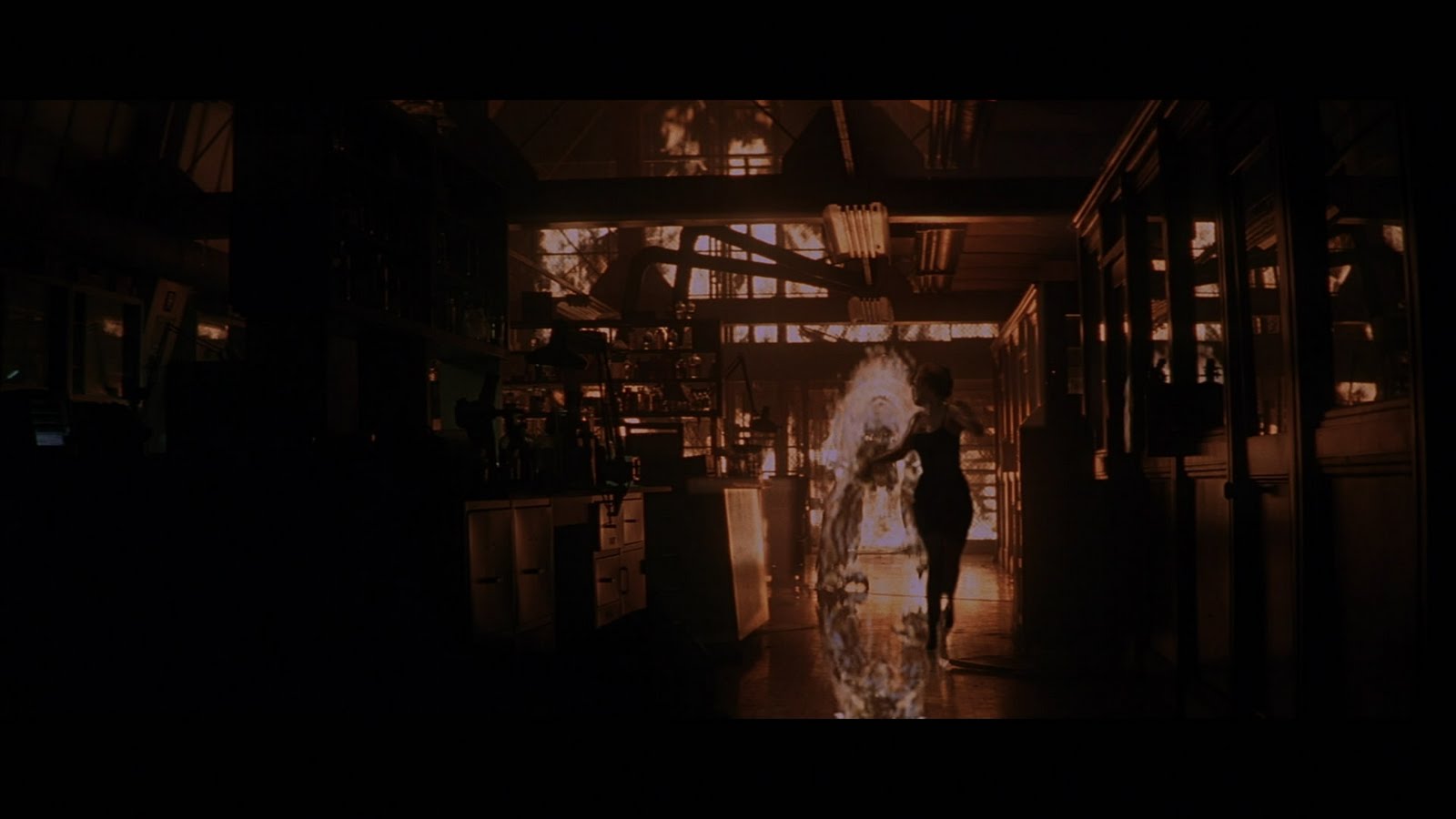
The late-great Stan Winston was responsible for some of the most memorable monsters in modern cinema: the endoskeleton robotic killing machine in The Terminator (1984), the ferocious Queen Alien in Aliens (1986), the alien that hunts Arnold Schwarzenegger in Predator (1987), and, of course, the dinosaurs in Jurassic Park (1993). I don’t know where the Kothoga from The Relic (1997) fits in the pantheon of Winston’s creatures but it is one of my favorites of his creations. Based on the best-selling horror novel of the same name by Douglas Preston and Lincoln Child, The Relic was a modest hit at the box office and predictably received mixed reviews by critics but remains one of my favorite creature features. Peter Hyams’ film has no other ambitions other than to tell an entertaining, things-go-bump-in-the-night story and does so in refreshingly no-nonsense fashion.


A ship arriving from Brazil is stopped by the Coast Guard in Lake Michigan and they find out that everybody on board has been killed. This doesn’t sit too well with Chicago police detective Vincent D’Agosta (Tom Sizemore) who has been put in charge of the investigation. Meanwhile, at the Museum of Natural History in Chicago, evolutionary biologist Dr. Margo Green (Penelope Ann Miller) is trying desperately to get a grant so that she and her team can continue their work. However, a co-worker (Chi Moui Lo) is doing his best to steal her grant away to fund his own work. They both get a chance to impress a crowd of the city’s wealthiest patrons at the gala premiere of a new exhibit. As luck would have it, D’Agosta will also be attending as he investigates a gruesome murder that occurred at the museum the night before. Could it be an ancient creature known as the Kothoga which, legend has it, is the offspring of South America’s answer to Satan? It seems that it was in one of the crates on the ship from Brazil and has now decided to snack on some bluebloods during the gala. It’s up to D’Agosta and Green to stop this creature.

Tom Sizemore brings a solid, matter-of-fact vibe to his character that feels like he carried it over from his role in Heat (1995). D’Agosta isn’t some wisecracking cop trying to make the moves on Penelope Ann Miller’s cute biologist. He’s interested only in solving the murder. However, he does have one distinctive trait: he’s superstitious. Sizemore manages to insert it here and there throughout the film without belaboring it to the point of being painfully obvious. I like that he gives D’Agosta a genuinely inquisitive nature. He’s not some burn out or a stereotypical loose cannon but a guy good at his job. He’s also savvy enough to realize that the murder at the museum hasn’t been done by your garden variety psycho and doesn’t let anybody, not some jerk rent-a-cop or even the condescending mayor of the city, distract him from his investigation.

Sizemore enjoyed a good run in the 1990s, appearing in films like Natural Born Killers (1994), Heat, and Saving Private Ryan (1998) before a myriad of personal problems burned a lot of bridges in Hollywood and relegated him to direct-to-video hell. He’s quite good in The Relic, his first leading man role and the cheap shots by critics back in the day that blasted him as resembling an overweight George Clooney were unfair. Sizemore certainly has the presence and the intensity to be a credible leading man and his blunt cop anticipates a similar one he played in the short-lived television show, Robbery Homicide Division. He was attracted to The Relic because he finally got to play the male lead in a film: “I had the responsibility of pushing the narrative forward.”

Penelope Ann Miller is just fine as the plucky heroine and thanks to action producer Gale Anne Hurd (The Terminator, Aliens) Margo Green is smart and proactive. She’s no damsel in distress and is actually quite resourceful, which is a refreshing change in a film like this one. It is nice to see characters using their intelligence in a horror film. For example, at one point D’Agosta takes Green to her lab so that she can figure out what the creature is and how to stop it. He opens up a little bit and tells her why he’s so superstitious. It’s a brief scene but it gives us some good insight into these characters. In the ‘90s, Miller made a significant push to be regarded as an A-list leading actress in high profile studio films like Awakenings (1990), Carlito’s Way (1993), The Shadow (1994), and The Relic, but none of them set the world on fire in terms of box office and she never became much of a critic’s darling either. I always found her kind of annoying and often miscast (see Carlito’s Way) with the notable exception of The Freshman (1990) in which she was perfect as Marlon Brando’s spoiled daughter. Before The Relic, Miller had not done a horror film but was drawn to director Peter Hyams’ desire to have a strong and smart female lead.

Hyams does a decent job establishing The Relic’s premise and introducing the characters, all the while building towards the climax: gala night at the museum with the creature on the rampage. He cuts between the guests trying to escape the museum while D’Agosta and Green attempt to stop the monster. Journeyman director Hyams epitomizes meat and potatoes filmmaking with his straightforward camerawork devoid of any distinctive style. Guillermo Del Toro he is not but that’s okay. Hyams keeps things moving along while plugging in the requisite jolts at certain moments throughout the film. Once the power goes out in the museum, he uses the darkness to tease us with glimpses of the creature until the full reveal during the final showdown. If I had one complaint it is that he relies too much on the dark and sometimes it is hard to tell what is happening.

Also of note is the solid supporting cast including Linda Hunt as the pragmatic director of the museum and James Whitmore as Green’s kindly old colleague and mentor. Genre veteran Clayton Rohner (G vs E) has a nice role as the junior detective working with D’Agosta. He’s put in charge of taking the mayor and a few others to safety. It’s not a flashy role but he does the best with what he’s given.

The original novel was written by Lincoln Child and Douglas Preston, an ex-journalist and former public relations director for the American Museum of Natural History in New York City. Because their book portrayed the museum’s administration in an unflattering light, they turned down the film’s producers’ request to film there. Paramount Pictures, the studio backing the production, even approached the museum and offered them a seven figure amount to film there but ultimately the administration was worried that a monster movie would scare kids away from the museum. So, the filmmakers were faced with a problem as only museums in Chicago and Washington, D.C. resembled the one in New York. Fortunately, the Field Museum in Chicago loved the film’s premise and allowed the production to shoot there. In addition to shooting on location in Chicago, a set was built in Los Angeles of a tunnel flooded with water for a sequence later on in the film. Sizemore and many of the cast spent most of the shoot either damp, cold or soaking wet. He caught the flu twice and the production shut down briefly when Hyams became too sick to work.

Hyams reviewed makeup artist Stan Winston’s early drawings of the Kothoga and his only suggestion was to make the monster more hideous looking. The director suggested certain invertebrates for inspiration and Winston came up with an arachnoid outline for the creature’s face. He and his team made three creatures with two people moving the heads and people on the side working the electronics to move the arms, claws, mouth, and so on. In the scenes where the creature is running or jumping, a computer-generated version was used.

Film critics of the day gave The Relic negative to mixed reviews. In his review for the Washington Post, Richard Harrington wrote, “the DNA speculation that supposedly fuels the plot feels right out of Beavis and Butt-head.” Entertainment Weekly gave it a “C+” rating and wrote, “If you can stagger around the plot holes (how'd a Brazilian cargo ship with a dead crew get to Lake Michigan?), the last 30 minutes are pure, dumb monster-movie fun.” In his review for the Globe and Mail, Geoff Pevere wrote, “The movie is a shameless cut-and-paste of a half-century of bogeyman-movie clichés.” USA Today gave the film two out of four stars and Susan Wloszczyna wrote, “amid caviar-quality Oscar contenders, it’s a palate cleanser – if you have a taste for explicit decapitations and loopy macabre humor.” However, Roger Ebert gave the film three out of four stars and wrote, “All of this is actually a lot of fun, if you like special effects and gore. To see this movie in the same week as the hapless and witless Turbulence is to understand how craft and professionalism can let us identify with one thriller heroine and laugh at another.” In his review for The New York Times, Stephen Holden wrote, “Yes, we've seen it all before. But The Relic proves that the hoariest clichés, when stirred together with enough money, shaken vigorously and artfully lighted, can still make the adrenaline surge.”

Ultimately, The Relic is barely a notch above the cheesy creature feature films that popular the SyFy Channel but so what? The dialogue at times is kinda clunky and most of the characters never go beyond their stereotypes but that’s what you get when you have four screenwriters credited with writing the damn thing. That being said, the film is relatively devoid of narrative fat, which I like, Stan Winston’s monster looks pretty cool, there’s decapitations a-go-go for the gorehounds, Sizemore plays a gruff, superstitious cop, and Miller’s pretty scientist gets to kick ass. The Relic is a well-oiled thrill machine that delivers on its promise of providing a rollercoaster ride. What more do you want from this kind of film?


SOURCES

Cohen, David S. “Locked in Realm of Monstrous Terror.” South China Morning Post. March 16, 1997.

Slotek, Jim. “They Created a Monster.” Toronto Sun. January 12, 1997.


Williams, Sue. “Actor Immerses Himself in the Part.” The Australian. May 1, 1997.