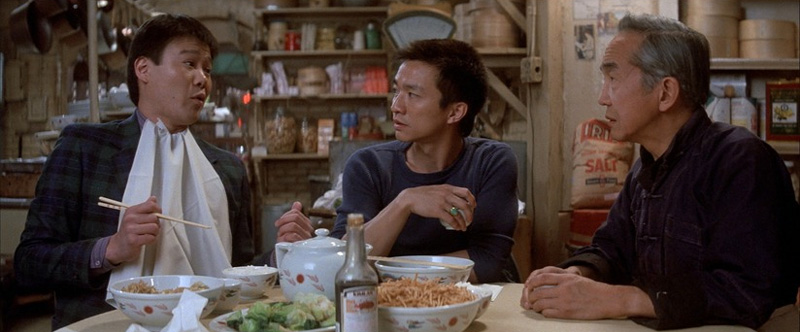
"What I'd like to do
today is get your version of what happened," says a mild-mannered,
middle-aged attorney (Jerry Hardin). "Oh? You mean the truth,"
replies a rather small, aging Chinese man who identifies himself as bus driver,
Egg Shen (Victor Wong). The attorney remains skeptical as his potential client
calmly describes his belief in Chinese black magic, and other supernatural
phenomenon. As if to prove his point, the man holds up his hands so that they are
parallel to one another. Suddenly, small bolts of blue electricity begin to
flow from each palm, much to the attorney's amazement and Shen's bemusement.
"That was nothing," Shen states. "But that's how it always
begins. Very small." And with this intriguing, tell-me-a-scary-story
teaser, John Carpenter's film, Big Trouble in Little China (1986), takes us on a ride into the heart of
ancient Chinese lore and mythology.
Carpenter, always the
maverick director with a knack for exploring offbeat subject matter (see They Live and In the Mouth of Madness), created a film that simultaneously parodies
and pays homage to the kung-fu genre. This often-maligned genre is given a new
level of respectability that is rarely seen in Hollywood. Gone are the ethnic
slurs, the insulting stereotypes and that annoying quasi-Chinese music that
always seems to accompany representations of Asians in past mainstream
features. Big Trouble takes great
care in presenting funny and intelligent characters without caring whether they
are Chinese or not. What is of paramount importance to Carpenter is telling a
good story. He created an entertaining piece of fantasy that cleverly manipulated
the conventions of the action film with often-comical results.
From the engaging prologue, Big Trouble takes us back to the
beginning of our story with the first appearance of truck driver Jack Burton
(Kurt Russell), a good-natured, fast-talking legend in his own mind. When he
and his buddy, Wang Chi (Dennis Dun), go to the airport to pick up the latter's
future bride arriving from China, a mix-up occurs. Wang’s bride-to-be (Suzee Pai) is kidnapped by The Lords of Death, a local gang of Chinese punks, and the
duo quickly find themselves immersed in the middle of an ancient battle of good
vs. evil with immortality hanging in the balance. This struggle takes place
deep in the heart of the Little China neighborhood of San Francisco with Jack
and Wang taking on David Lo Pan (James Hong), "The Godfather of Little
China." Even Egg Shen appears to help our heroes and provide them with the
means to stop the evil that threatens not only Little China, but, of course,
the whole world.

Big Trouble
also saw Carpenter re-team with his old friend, actor Kurt Russell who had
appeared in several of the director's films, most notably Escape From New York (1981) and The
Thing (1982). After watching Big
Trouble it’s impossible to see anybody else as Jack Burton. Russell
perfectly nails the macho swagger of his character: he’s a blowhard who’s all
talk, inept when it comes to any kind of action and yet is still a likable guy.
He is an amusing habit of sometimes referring to himself in the third person –
there’s Jack’s world…then there’s reality. The two do cross paths on occasion
but so very rarely. It is the right mix of bravado and buffoonery, a parody of
the John Wayne action hero much in the same way Russell made Escape From New York’s Snake Plissken a
twisted homage to Clint Eastwood. Russell said, at the time, that he
"never played a hero who has so many faults. Jack is and isn't the hero.
He falls on his ass as much as he comes through. This guy is a real blowhard.
He's a lot of hot air, very self-assured, a screw-up. He thinks he knows how to
handle situations and then gets into situations he can't handle but some how blunders
his way through anyhow." Jack is also the audience surrogate – our guide
into this stranger and exotic world. Russell showcases untapped comedic
potential that ranges from physical pratfalls to excellent comic timing in the
delivery of his dialogue. One only has to look at his scene with Wang and the
elderly Lo Pan to see Russell’s wonderful comic timing. No one before or since Big Trouble has been able to tap into
Russell's comedic potential as well as Carpenter does in this film.
Dennis Dun’s character
starts off as the sidekick of Big Trouble
and ends up accomplishing most of the film's heroic tasks while the initial
hero, Jack Burton, becomes the comic relief. Dun delivers a very strong
performance, holding his own against a veteran actor like Russell. The
chemistry between the two characters is one of the many endearing qualities of Big Trouble as evident from their numerous
scenes together, most notably the one where Wang bets Jack that he can split a
beer bottle in half (“Is this going to get ugly, now?”) and the scene where the
two men attempt to break into Lo Pan’s building to rescue Wang’s fiancée.
Prior to Big Trouble, Dun's only other film role
was a small part in Michael Cimino's Year
of the Dragon (1985) but he was a veteran of more than twenty plays.
Carpenter liked the actor in Cimino's movie and met with him twice before
casting him in Big Trouble. Even
though shooting began only a few days after Dun was cast, the action sequences
weren't hard for the actor who had "dabbled" in martial arts training
as a kid and done Chinese opera as an adult. He enjoyed the freedom he had on
the set. "John gave me a great deal of leeway to develop my character and
pretty much let me do what I wanted. He just encouraged me to be as strong as I
could. He gave me a lot of freedom." Dun remembers that he and Russell
shared the same approach to acting. "We never really talked about the
scenes. We would come in that day to shoot a scene, and we would just do it. A
large part of it was working off each other, just looking in each other's eyes
and taking each other's energy and running with it."

Right from the get-go,
Carpenter establishes their long-standing friendship in the way they relate to
each other – the shorthand between them that is immediately believable, like
how Wang good-naturedly tries to get out of paying off a debt he owes to Jack.
They argue in a way that you imagine they’ve done many times before but when
Wang needs a favor Jack is there for him.
Kim Cattrall plays Gracie as
a pushy, talkative lawyer who acts as the perfect foil for deflating Burton's
macho ego at every opportunity, acting as his love interest and constant source
of aggravation. Big Trouble’s script
cleverly avoids the trap of reducing her role to a screaming prop by having Gracie
take an aggressive part in the action. There’s a great give and take between
her and Russell. Their characters make for an entertaining screwball comedy
couple: he’s always on the make while she constantly fends off his obvious
advances. This was Carpenter's intention. He saw the characters in Big Trouble like the ones in classic
Hollywood screwball comedies. Listen to how Jack and Gracie talk to each other
– it’s a very rapid-fire delivery of dialogue reminiscent of Howard Hawks'
comedies. There’s the memorable first meeting between them at the airport where
he tries to hit on her and she rebuffs him by saying, “You should try standing
downwind from where I am. It’s Miller Time,” to which he replies, “You know
what I say when it’s Miller Time?” before being interrupted by The Lords of
Death.
The studio pressured
Carpenter to cast a rock star in the role of Gracie Law, Jack Burton's love
interest and constant source of aggravation. For Carpenter there was no
question, he wanted Kim Cattrall. The studio wasn't crazy about the idea
because at the time Cattrall was primarily known for raunchy comedies like Porky's (1981) and Police Academy (1984). "I told them we needed an actress, and
I enjoyed the way Kim wanted to play the character. She blended in well with
the film's style." Cattrall plays Gracie as a pushy, talkative lawyer who
acts as the perfect foil for deflating Burton's macho ego at every opportunity.
"Actually," Cattrall said in an interview, "I'm a very serious
character in this movie. I'm not screaming for help the whole time. I think
humor comes out of the situations and my relationship with Jack Burton. I'm the
brains and he's the brawn." Carpenter saw the characters in Big Trouble like the ones "in Bringing Up Baby or His Girl Friday. These are very 1930s, Howard Hawks people."

I was struck at how good
Victor Wong is as Egg Shen, the wizard that helps Jack and Wang defeat Lo Pan.
He introduces the film with a fantastic little bit of magical flourish and then
disappears for a spell until our heroes are ready to take on Lo Pan. I like how
his tourist bus driver cover is something he does to pass the time. Later on we
find out that he's quite the legend in Chinatown and apparently quite wealthy,
owning a rather large city block. It is also how Carpenter treats the character
– with respect and dignity. He gets his moments of humor, imparts crucial
expositional dialogue about Chinese magic and mysticism and even goes
toe-to-toe with Lo Pan.
However, my favorite Egg
Shen moment is at the end of the film, after Lo Pan has been vanquished and our
heroes celebrate at Wang's restaurant. I like how Egg is off in the corner
having a drink by himself, quietly smiles and gives a little chuckle. It's
subtle and something you'd never see in a studio blockbuster these days but it
is a little touch, a moment that provides a wonderful bit of insight into his
character.
While much of W.D. Richter’s
quotable dialogue is well-written, it is also how the actors say these lines
that makes them so memorable, like the way Russell has Jack give his allies a
pep talk: “Okay, you people sit tight, hold the fort, keep the home fires
burning and if we’re not back by dawn, call the President.” It is the beat that
he takes between “dawn” and “call,” and the tone of bravado in his delivery
that makes this dialogue so amusing.
To this end, Carpenter is
not given enough credit for being one of the best directors at conveying
exposition dialogue in film. So often it is awkwardly shoehorned into the
narrative and/or badly written, stopping the narrative momentum cold as it
explains instead of shows. Carpenter inherently understands this and makes sure
that the dialogue is not only interesting, providing us with tantalizing
details that flesh out this cinematic world, but also makes sure his actors do
a good job delivering it.
For example, there’s an
excellent scene where Jack and Wang have been captured breaking into Lo Pan’s
lair and Wang explains what he is and his place in Chinese history. It is
important moment as it gives us an idea of what our heroes are up against and
puts the villain in a historical context that establishes the stakes for him.
Carpenter even slyly alleviates the solemnity of the moment when Jack says to
Wang, “No horseshit, Wang?” His friend replies, “Hey, I don’t blame you. I’m
Chinese and I don’t even want to believe it. But it’s for real: sorcery,
Chinese black magic.” Dun really nails this scene and that last line sets an
ominous tone that foreshadows the daunting task our heroes have to undertake.
This scene also immerses us in authentic Chinese myths and legends. Big Trouble could have easily made light
of Chinese culture, but instead mixes respect with a good dose of fun.
Big Trouble
also places Asian actors in several prominent roles,
including Victor Wong and Dennis Dun who is the real hero of the story, as
opposed to Kurt Russell's character who is a constant source of comedy. Big Trouble crushes the rather
derogatory Charlie Chan stereotype by presenting interesting characters that
just happen to be Chinese. For example, when a group of Chang-Sings show up to
help Jack, Egg and Wang defeat Lo Pan, Jack asks, “Any of them savvy English?”
to which one of them replies in perfect English, “Hey man, who is this guy?”
This moment immediately and hilariously deflates an old Chinese stereotype in
Hollywood films.

Big Trouble in Little China was originally written as a period Western set in
the 1880s with Jack Burton as a cowboy who rides into town. Producer Paul
Monash bought Gary Goldman and David Weinstein's screenplay but after a reading
he found that it was virtually unfilmable due to the bizarre mix of Chinese
mythology and the Wild West setting. He had the two first-time screenwriters do
a rewrite, but Monash still didn't like it. "The problems came largely
from the fact it was set in turn-of-the-century San Francisco, which affected
everything — style, dialogue, action." The producer decided against having
Goldman and Weinstein do additional rewrites because they didn't want to
upgrade the story to a contemporary setting and felt that they had done their
best.
Keith Barish and Monash
brought in W.D. Richter, a veteran script doctor (and director of cult film, The Adventures of Buckaroo Banzai) to
extensively rewrite the script. Almost everything in the original screenplay
was discarded except for Lo Pan's story. "I realized what it needed wasn't
a rewrite but a complete overhaul. It was a dreadful screenplay. This happens
often when scripts are bought and there's no intention that the original writers
will stay on." Richter's template for his draft was Rosemary's Baby (1968). "I believed if, like in Rosemary's Baby, you presented the
foreground story in a familiar context — rather than San Francisco at the
turn-of-the-century, which distances the audience immediately — and just have
one simple remove, the world underground, you have a much better chance of
making direct contact with the audience." Richter was having a hard time
getting his own scripts made into movies so he tried sneaking in his own eccentric
ideas into other people's projects. "It's often easier to take an idea
that they bring to you and try to pass it through your sensibility. If you're
honest up front, you get license to work with material you wouldn't get them to
look at if it was your own story."
John Carpenter had wanted to
do a film like Big Trouble in Little
China for some time. Even though it contains elements of an action /
adventure / comedy / mystery / ghost story / monster movie, it is, in the
filmmaker's eyes, a kung fu film. "I have dug the genre ever since I first
saw Five Fingers of Death in 1973. I
always wanted to make my own kung fu film, and Big Trouble finally gave me the excuse to do just that."
Barish and Monash offered Carpenter the movie in July of 1985. He had read the
Goldman/Weinstein script and deemed it “outrageously unreadable though it had
many interesting elements.” After reading Richter's script he decided to
direct. Carpenter loved the off-the-wall style of Richter's writing and coupled
with his love of kung fu films, it is easy to see why he jumped at the
opportunity to make Big Trouble.

The two filmmakers had
crossed paths before when Carpenter rewrote Richter's screenplay, The Ninja, a big-budget martial arts
epic, for 20th Century Fox. In fact, Richter and Carpenter had both attended
University of Southern California Film School from 1968 to 1971. "Rick and
I went through all three production classes together. We each had our own
crews, so we never actually collaborated on a film." Carpenter made his
own additions to Richter's screenplay, which included strengthening Gracie
Law's role and linking her to Chinatown, removing a few action sequences (due
to budgetary restrictions), and eliminating material deemed offensive to
Chinese Americans. Carpenter was disappointed that Richter didn't receive a
proper screenwriting credit on the movie for all of his hard work. A ruling by
the Writer's Guild of America gave Goldman and Weinstein sole credit.
Problems began to arise when
Carpenter learned that the next Eddie Murphy vehicle, The Golden Child (1986), featured a similar theme and was going to
be released near the same time as Big
Trouble. Ironically, Carpenter was asked by Paramount to direct The Golden Child. "They aren't
really similar. Originally, Golden Child
was a serious Chinese, mystical, very sweet, very nice film. But now they don't
know whether to make it funny or serious." However, as both films went
into production, Carpenter's views of the rival production became increasingly
bitter. "Golden Child is
basically the same movie as Big Trouble.
How many adventure pictures dealing with Chinese mysticism have been released
by the major studios in the past 20 years? For two of them to come along at the
exact same time is more than mere coincidence." To avoid being wiped out
by the bigger star's film, Carpenter began shooting Big Trouble in October 1985 so that 20th Century Fox could open the
film in July 1986 — a full five months before Golden Child’s release. This forced the filmmaker to shoot the film
in 15 weeks with a $25 million budget.
To achieve the efficiency
that he would need for such a shoot, Carpenter surrounded himself with a
seasoned crew from his previous films. He reunited with three long-time
collaborators, line producer Larry J. Franco (Starman), production designer John Lloyd (The Thing), and cinematographer Dean Cundey. The cameraman had
worked with Carpenter on his most memorable features: Halloween (1978), Escape from
New York (1981), and The Thing
(1982). The director wanted as many familiar faces on board because "the
size and complexity are so vast, that without it being in dependable,
professional hands, it could have gone crazy...So I went back to the guys who
had been with me in the trenches before on difficult projects."

Carpenter and Cundey had
parted company before Starman due to
"attitude problems." Cundey says it was due to scheduling conflicts,
but Carpenter has said that they had problems while working on The Thing. However, when Big Trouble came along, Carpenter met
Cundey in Santa Barbara one weekend. "His attitude about survival in the
[movie] business coincided with my own. We had a really good time, so we
decided to work together again."
Big Trouble
also saw Carpenter re-team with his old friend, actor Kurt Russell who has
appeared in several of the director's films, most notably Escape From New York and The
Thing. At first, Carpenter didn't see Russell as Jack Burton. He wanted to
cast a big star like Clint Eastwood or Jack Nicholson to compete with Golden Child's casting of Eddie Murphy.
However, both Eastwood and Nicholson were busy and Fox suggested Russell
because they felt that he was an up-and-coming star. The actor remembered
reading the script and thinking that it "was fun, but I was soft on the
character. I wasn't clear how to play it. There were a number of different ways
to approach Jack, but I didn't know if there was a way that would be
interesting enough for this movie." After Carpenter and Russell began to
go over the script, the character started to take shape. The role was a nice
change for Russell as Carpenter remembers, "Kurt was enthusiastic about
doing an action part again, after playing so many roles opposite ladies
recently. So off we went."
Production designer John
Lloyd designed the elaborate underground sets and re-created Chinatown with
three-story buildings, roads, streetlights, sewers and so on. This was
necessary for the staging of complicated special effects and kung fu fight
sequences that would have been very hard to do on location. For the film’s many
fight scenes Carpenter “worked with my martial arts choreographer, James Lew,
who literally planned out every move in advance. I used every cheap gag –
trampolines, wires, reverse movements and upside down sets. It was much like
photographing a dance.”

Another refreshing aspect of
Big Trouble is the way it is immersed
in authentic Chinese myths and legends. Carpenter explains: "for example,
our major villain, Lo Pan, is a famous legend in Chinese history. He was a
'shadow emperor,' appointed by the first sovereign emperor, Chan Che Wong. Lo
Pan was put on the throne as an impersonator, because Chan Che Wong was
frightened of being assassinated. Then, Lo Pan tried to usurp the throne, and
Chan Che Wong cursed him to exist without flesh for 2,000 years, until he can
marry a green-eyed girl."
Big Trouble
also places Asian actors in several prominent roles, including Victor Wong and
Dennis Dun who is the real hero of the story, as opposed to Kurt Russell's
character who is a constant source of comedy. "I've never seen this type
of role for an Asian in an American film," Dun commented in an interview,
"I'm Chinese in the movie, but the way it's written, I could be
anybody." Big Trouble crushes
the rather derogatory Charlie Chan stereotype by presenting interesting
characters that just happen to be Chinese. Carpenter also wanted to avoid the
usual cliché soundtrack. "The other scores for American movies about
Chinese characters are basically rinky tink, chop suey music. I didn't want
that for Big Trouble. I wanted a
synthesizer score with some rock 'n' roll."
As if sensing the rough
commercial road that the film would face, Russell felt that it would be a hard
one to market. "This is a difficult picture to sell because it's hard to
explain. It's a mixture of the real history of Chinatown in San Francisco
blended with Chinese legend and lore. It's bizarre stuff. There are only a
handful of non-Asian actors in the cast.” Unfortunately, mainstream critics and
audiences did not care about this radical reworking of the kung fu film.
Opening in 1,053 theaters on July 4, 1986, Big
Trouble in Little China grossed $2.7 million in its opening weekend and
went on to gross $11.1 million in North America, well below its estimated
budget of $25 million.

The film received critically
mixed reviews when it was first released. Ron Base, in his review for the Toronto Star, praised Russell's
performance. "He does a great John Wayne imitation. But he's not just
mimicking these heroes, he is using them to give his own character a broad, satiric
edge.” Walter Goodman in The New York
Times wrote, "In kidding the flavorsome proceedings even as he gets
the juice out of them, the director, John Carpenter, is conspicuously with it.”
Harlan Ellison praised the film, writing that it had "some of the funniest
lines spoken by any actor this year to produce a cheerfully blathering
live-action cartoon that will give you release from the real pressures of your
basically dreary lives.”
However, in his review for
the Chicago Sun-Times, Roger Ebert
wrote, "special effects don't mean much unless we care about the
characters who are surrounded by them, and in this movie the characters often
seem to exist only to fill up the foregrounds", and felt that it was
"straight out of the era of Charlie Chan and Fu Manchu, with no apologies
and all of the usual stereotypes.” Paul Attanasio in the Washington Post, criticized the screenwriters for being "much
better at introducing a character than they are at developing one.” David Ansen
wrote, in his review for Newsweek,
"though it is action packed, spectacularly edited and often quite funny,
one can't help feeling that Carpenter is squeezing the last drops out of a
fatigued genre.” In his review for The
Times, David Robinson felt that Carpenter was, "overwhelmed by his own
special effects, without a strong enough script to guide him.”
Big Trouble
came out before the rise in popularity of Hong Kong action stars like Jackie
Chan, Jet Li and Chow Yun-Fat, and filmmakers like John Woo and Wong Kar-Wai.
Mainstream audiences weren’t ready for this kind of film. Despite being
promoted rather heavily by 20th Century Fox, Big Trouble disappeared quickly from theaters. Bitter from having
yet another film of his snubbed by critics and ignored by audiences, Carpenter
swore off the big studios. He learned the hard way that working with them meant
compromising his art in order to advance his career.

In an effort to have more
freedom on the films he made, Carpenter became an independent yet again,
cranking out Prince of Darkness
(1987) and They Live (1988) in rapid
succession. The veteran filmmaker didn't fully embrace a big studio again until
Escape From L.A. in 1996, but its
disastrous critical and commercial reception drove Carpenter back underground
where he's been ever since, continuing to make the kinds of films we wants to
make. Big Trouble in Little China has
stood the test of time. It was rediscovered on home video where it has become a
celebrated cult film with a dedicated audience. Big Trouble has since become one of the most beloved films in
Carpenter’s career and with good reason. It is a fun, clever film that still
holds up today and remains one of the finest examples of cinema as pure
entertainment.
SOURCES
Dickholtz, Daniel.
"Dennis Dun, Kung Fu Hero." Starlog. September 1986.
Goldberg, Lee. "Big Trouble in Little China." Starlog.
May 1986.
Goldberg, Lee. "W.D.
Richter Writes Again." Starlog. June 1986.
Goldberg, Lee. "Kurt
Russell: Two-Fisted Hero." Starlog. July 1986.
Salem, Rob. “Big Trouble in Little China Touches Off
Stars’ Private Hells.” Toronto Star. June 29, 1986.
Scott, Vernon. “Kurt as
Klutz.” United Press International. July 9, 1986.
Swires, Steve. "John
Carpenter: Kung Fu, Hollywood Style." Starlog. August 1986.
Steranko, Jim. "The
Trouble with Kurt." Prevue. August 1986.
Teitelbaum, Sheldon. “Big Trouble in Little China.” Cinefantastique.
July 1986.